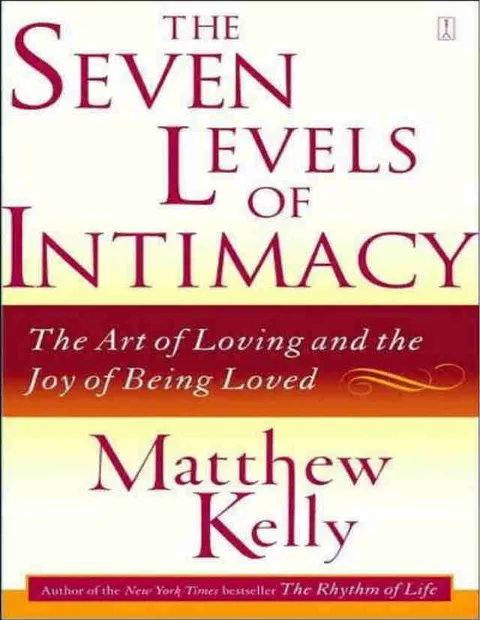

The Seven Levels Of Intimacy: The Art Of Loving And The Joy Of Being Loved Order Printed Copy
- Author: Matthew Kelly
- Size: 923KB | 223 pages
- |
Others like the seven levels of intimacy: the art of loving and the joy of being loved Features >>

The Meaning Of Marriage: A Couple’s Devotional
-160.webp)
How To Hug A Porcupine (101 Ways To Love The Most Difficulty People In Your Life)

Learning
Sacred Parenting

Emotional Blackmail

Loving Your Spouse When You Feel Like Walking Away

Love Like You've Never Been Hurt

Her Daughter's Dream

10 Things Every Minister's Wife Needs To Know
In-Law Relationships
About the Book
"The Seven Levels of Intimacy" explores the different dimensions of intimacy in relationships, emphasizing the importance of developing deeper connections with others. The author, Matthew Kelly, presents practical strategies for achieving greater intimacy and fulfillment in all types of relationships, offering insights on communication, vulnerability, and love. Kelly encourages readers to cultivate a genuine sense of connection and understanding with others to experience joy and fulfillment in their relationships.
D.L. Moody

iwo jima and the monumental sacrifice
“Some people wonder all their lives if they made a difference,” Ronald Reagan once said. Then he added, “The Marines don’t have that problem.” That was certainly true of the Marines who fought and died on a little island called Iwo Jima seventy years ago now. In the final phase of the war in the Pacific, Iwo Jima was strategic and essential to America and Japan — and it would cost them both dearly. Two out of every three Marines on Iwo Jima were killed or wounded before the Americans took the island. The fierce, heroic struggle was captured in what would become the most famous photograph of the war: Raising the Flag on Iwo Jima, taken on Mount Suribachi on February 23, 1945. Joe Rosenthal’s photograph, like the larger-than-life men he captured on camera, became the basis for the Marine Corps War Memorial in Arlington, Virginia. Though dedicated to the service and sacrifice of the Marines in all of America’s wars, it is still often referred to simply as the “Iwo Jima Memorial.” It is the tallest bronze statue in the world. The soldier figures are each over thirty feet tall, and the rifles are sixteen feet long. Photographs, to use Lance Morrow’s phrase, “imprison time in a rectangle,” but they can never tell the whole story. Raising the flag on Mount Suribachi wasn’t the moment of victory — a triumphant point between war and peace. Three of the six men who raised the flag on February 23 would be killed in action on Iwo Jima in a battle that would rage on for another month. The flag represented hope when it was raised — it did not represent victory. Worthy Sacrifices The last time I visited the Iwo Jima monument, it was a lovely evening in Arlington. Visitors who walked around the base of the great bronze spoke with hushed voices. Even the selfie-snapping was reserved. The bronze giants basked in the warmth of the last light, and the flag snapped in the wind, much like the first time. It made me feel proud and humble at the same time. From the bluff, I could see across the Potomac the tops of America’s other monuments huddled along the great expanse leading to the Capitol. Marble and bronze — the stuff of enduring memory — worthy of the sacrifices they commemorate. At the time I was at Arlington, Christians were being shot, beheaded, even crucified by the Islamic State, and whole Christian populations were being utterly obliterated in Syria and Iraq. I thought to myself, “Where’s the monument to their sacrifice? What’s left for the generations to follow to remember?” Tragically, all that remains are smoldering ruins, bloodstains, and boot prints, as their killers move on. Sometimes, even less than that remains. In November, a Christian couple in Pakistan were incinerated. Here’s their story. The Barbarians Are Back Debt peonage has long existed in Pakistan, keeping generations of Christians in slavery working in the brick kilns. Once I walked through such a slave colony near Lahore when the master was away in order to hear the workers’ stories. Little children stacked bricks, men tended the massive furnace firing the bricks, and women washed clothes in a stream that doubled as the sewer. It was in this same area last November that two brick workers, Shahzad Masih and his wife Shama, were killed. They were in a debt dispute with their owner, and in order to settle the score, he accused them of blasphemy, of burning pages of the Koran. The blasphemy law in Pakistan is a convenient way of dealing with inconvenient people and usually works like this: kill first, then maybe ask questions later. The setting was readymade for a mob. Bricks were handy for stoning, the legs of the husband and wife were broken so they couldn’t escape, and then they were thrown into the furnace. Shahzad and his wife, who was five months pregnant, were burned to ash. This didn’t happen centuries ago in barbaric times — it happened in November. The barbarians are back. Tragically, the murders of Shahzad and his wife are just more of the same. In the past three years alone, between the work of ISIS and other al-Qaeda franchises, the number of Christians killed or displaced in Iraq and Syria is in the tens of thousands, including hundreds of girls taken as sex slaves for the fighters. In sub-Saharan Africa, more than seven thousand Christians have been killed by Boko Haram and al-Shabaab in the past three years. When We Hear of Persecution It’s understandable that these al-wannabes tend to sound alike — their handiwork certainly tends to look alike. After more than a decade in the new world disorder, they are just names and numbers on the news crawl, accompanied with a blur of blood and bombs, of gun-toting “spiritual leaders” doing selfies on YouTube as they crow about their latest kill. I think of the lines from a Patty Griffin song, “There’s a million sad stories on the side of the road. Strange how we all just got used to the blood.” The unspeakable seems unanswerable; and so we shrug. What can we say? What can we do that would make any difference? As Christians we must not look at persecution as just “bad things happening to good people.” And we shouldn’t look away either. Christian persecution is tied to the very work and nature of the gospel. Here are three truths to remember when we hear of Christian persecution, whether in distant places or when it comes to our own shores. 1. We are vitally linked to our suffering brothers and sisters. “Remember those who are in prison, as though in prison with them, and those who are mistreated, since you also are in the body” (Hebrews 13:3). This is why we pray, why we speak, and why we hurt alongside suffering Christians — they are family. Through the power of the gospel, our lives are forever bound up in Christ’s life and, therefore, forever bound up with all other believers as well. 2. God is glorified, and his gospel advances, when his people demonstrate trust, love, and grace as they suffer for him. “I want you to know, brothers, that what has happened to me has really served to advance the gospel, so that it has become known throughout the whole imperial guard and to all the rest that my imprisonment is for Christ. And most of the brothers, having become confident in the Lord by my imprisonment, are much more bold to speak the word without fear” (Philippians 1:12–14). Persecution has many outcomes — sometimes they don’t make sense to us. But clearly, one of the outcomes is gospel advance. Saul-the-Persecutor-turned-Paul-the-Preacher was a powerful demonstration of this truth. In our day, he would have been the equivalent of an al-Qaeda commander; so his conversion was the talk of the town. “They only were hearing it said, ‘He who used to persecute us is now preaching the faith he once tried to destroy.’ And they glorified God because of me” (Galatians 1:23–24). Samuel Zwemer, the apostle to Arabia, with his “Big God, Big Gospel” perspective on the long campaign of Kingdom advance could write, When you read in reports of troubles and opposition, of burning up books, imprisoning colporteurs, and expelling workers, you must not think that the gospel is being defeated. It is conquering. What we see under such circumstances is only the dust in the wake of the ploughman. God is turning the world upside down that it may be right side up when Jesus comes. He that plougheth should plough in hope. We may not be able to see a harvest yet in this country, but furrow after furrow, the soil is getting ready for the seed. 3. Persecution is linked to Christ’s persecution. “God is turning the world upside down that it may be right side up when Jesus comes.” “Beloved, do not be surprised at the fiery trial when it comes upon you to test you, as though something strange were happening to you. But rejoice insofar as you share Christ’s sufferings, that you may also rejoice and be glad when his glory is revealed” (1 Peter 4:12–13). Suffering that comes for the sake of his name is Christ-like. And so there is, in fact, a monument to Christian sacrifice — it is the cross, in all its blood-stained splendor. Unlike the inspiring flag-raising on Iwo Jima, when the cross was raised, it seemed to symbolize only defeat and death. Yet, secured by Sovereign Love and the empty tomb, Christ’s work was so complete that everyone who comes to him will live forever. This is the reward of the Lamb’s suffering. Only he could heal the hurt of his people, turning their sorrow into song and their death into life.