
Others like the power of the communion table Features >>
The Price Of God's Miracle Working Power
The Power Of The Blood
The Priesthood And The Blood
The Logic Of Penal Substitution

The Power Of Forgiveness

The Bookends Of The Christian Life
The Work Of The Holy Spirit In Regeneration
The Life Of Repentance And Purity
A Treatise On The Law And The Gospel
The Blood Of Jesus: Blood Power
About the Book
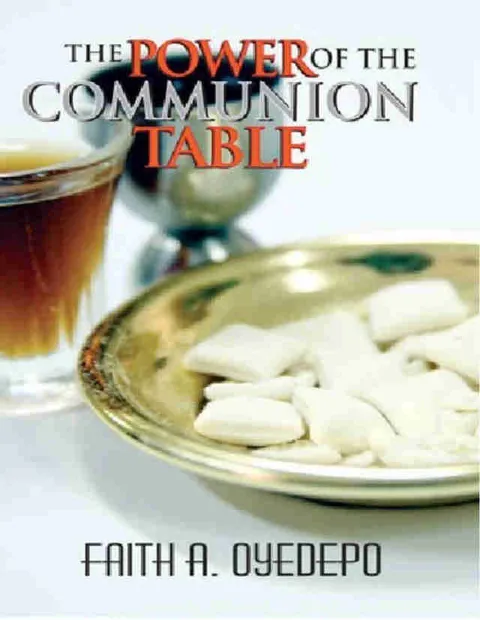
"The Power of the Communion Table" by Faith Oyedepo explores the significance and benefits of regularly participating in the act of communion. The book delves into the spiritual implications of communion and how it can strengthen believers' faith, bring healing, and promote intimacy with God. Ultimately, Oyedepo emphasizes the transformative power of partaking in communion and encourages readers to make it a regular practice in their spiritual walk.
Oral Roberts
Granville Oral Roberts was born January 24, 1918 in Pontotoc County, near Ada, in Oklahoma. His parents were deeply religious. His father was a farmer who also preached the gospel and established Pentecostal Holiness churches. His mother regularly prayed for the sick and led people to Christ. While she was still pregnant, Robert's mother committed Oral to God's service. Even though Oral had a very strong stutter his mother would tell him that one day God would heal his tongue and he would speak to multitudes.
The Roberts family was desperately poor. When Roberts was 16 he moved away from home, hoping for a better life. He rejected God and his upbringing. He started living a wild life and his health collapsed. Roberts had contracted tuberculosis. He returned home and eventually dropped to 120 pounds. He was a walking skeleton. God spoke to his older sister, Jewel, and told her that He was going to heal Oral. During this same time Oral turned his heart back to God and gave his life to Christ. A traveling healing evangelist named George Moncey came to Ada and held meetings in a tent. Oral's elder brother was touched when he saw friends of his healed in the meeting. He decided that he should get Oral and bring him to be healed. On the way to the meeting God spoke to Oral and said "Son, I'm going to heal you and you are to take my healing power to your generation. You are to build me a University and build it on My authority and the Holy Spirit." Once at the meeting Oral waited until the very end. He was too sick to get up and receive prayer, and so had to wait for Moncey to come to him. At 11:00 at night his parents lifted him so he could stand. When Moncey prayed for him the power of God hit him and he was instantly healed. Not only that but every bit of his stutter was gone!
After Roberts was healed he began to travel the evangelistic circuit. He met and married Evelyn Lutman, a school teacher from the same Holiness Pentecostal background as Roberts. They had their first child Rebecca and then the entire family began traveling as ministers. In 1942 they left the evangelistic field for a while and Roberts became a pastor. He also returned to college to further his education. While a pastor he prayed for a church member whose foot was crushed. The foot was instantly healed. God continued to speak to Roberts about his call to the multitudes. God called him to an unusual fast. Roberts was to read the four gospels and the book of Acts three times consecutively, while on his knees, for thirty days. God began to reveal Jesus as the healer in a new way. God also began to give Roberts dreams where he would see people's needs as God saw them. God called him to hold a healing meeting in his town. A woman was dramatically healed, several people were saved and Roberts' ministry changed overnight.
Roberts resigned his church in 1947 and began an itinerant ministry. Notable healings began to occur. One man tried to shoot Roberts. God used the story to bring him media attention, which expanded his ministry very quickly. Roberts felt called to purchase a tent and take his evangelistic ministry to larger cities. His first tent held 3,000 but he quickly exchanged it for a tent that held 12,000. In July 1948 The Oral Roberts Evangelistic Association was established. Oral began traveling continuously throughout the United States. Like many of his Pentecostal brethren Roberts held inter-racial meetings. This brought him a lot of negative attention from groups who didn't like his stand. He even received death threats for not holding segregated meetings. In 1956 Roberts was invited to Australia. He held meetings in Sydney and Melbourne. In Melbourne there were outright physical attacks and destructive gangs. He was literally driven out of the city for praying for the sick. Often when people discuss the healing revival of the 1950s Oral Roberts and William Branham are listed as the most widely recognized leaders of the movement. Others came along side and many emulated them, but they were the most widely recognized personalities.
Roberts was a man who understood and used the media for his benefit. Roberts began publishing a magazine almost immediately upon starting his ministry. He grasped the power of radio and television. In 1954 Roberts began filming his crusades. He began playing his sermons on radio and then airing the crusade tapes during evening television prime time. Unfortunately there is some evidence that healing meetings were scripted ahead of time, and not all healings were genuine. People began writing to the Ministry headquarters by the thousands. They were accepting Christ as their savior after seeing a person healed on TV. By 1957 the ministry was receiving 1,000 letters a day and he was getting thousands of phone calls. He established a round the clock prayer team to answer calls and pray for people who contacted the ministry. In 1957 Roberts claimed 1,000,000 salvations. Between 1947 and 1968 Roberts conducted over 300 major Crusades. Money was flowing into the organization at an unprecedented rate.
In the late 1950s the healing movement was waning and ministries were under attack for their lack of financial accountability. Roberts began to move on the vision God gave him to build a University. It was chartered in 1963 and became open to students in 1965. Roberts was having a significant national impact in the late 1950s and early 1960s. For several years his named appeared in the Top 100 list of the nation's most respected people. Although Roberts continued to hold healing meetings his focus shifted to the University and the television programs.
The 1970s and 80s brought many crises to the Roberts family. Their daughter Rebecca and son-in-law Marshall were killed in a plane crash. Their son Ronnie struggled with depression after serving in Vietnam and also declaring himself gay. He grew despondent after losing his job and committed suicide. Richard Roberts got a divorce. After Richard remarried he and his wife lost a new born son within two days. Roberts began teaching a doctrine of "seed faith" where he claimed that if you gave to his ministry then God would pay you back in multiplied ways. The television ministry received heavy criticism for the constant requests for money. The Roberts were living an extravagance lifestyle while many of their supporters were not wealthy. Financial questions were raised in how Roberts used University endowment funds to purchase personal homes and cars.
In 1977 Roberts had a vision to build a hospital where people not only received care but received healing prayer. It was to be called City of Faith. Roberts put his heart and soul into the project, believing that God would build it as He had the University. The hospital struggled along and Roberts called his followers to give to the project, believing he had a vision from God to raise the money. Roberts even claimed twice that if money didn't come in that Jesus would "take him home." The hospital was built, but never succeeded financially, and finally closed in 1989. Financial giving was plummeting for both the Oral Roberts Evangelistic Association and Oral Roberts University.
Roberts retired in 1993, at the age of 75. Roberts, with his wife Evelyn, moved to California to live near the coast. Evelyn died in May 2005. Although Roberts influence waned after the problems of the 1970s and 1980s, he was still recognized for his pioneering work on the "sawdust trail", television evangelism, and building a Christian University. He often appeared on religious broadcasting networks as a recognized leader in the healing movement of the last half century. He died December 15, 2009 at the age of 91.
Oral Roberts' legacy is a mixed one. Roberts brought the truth of God's healing to the public in a way that few others accomplished in his lifetime. His financial and personal issues and increasingly extravagant claims eventually brought his ministry into disrepute. The University he established continued to have financial crises under the leadership of his son Richard Roberts. It was only after Richard stepped down in 2009 and new leadership took over the University that it stabilized financially. The University is no longer connected to the Oral Roberts Evangelistic Association.
do not despise the day of small groups
Some three hundred years ago, an unusual kind of church gathering spread throughout the English-speaking world like fire in the brush. When describing these groups, church historians reach for the language of newness : one refers to the gatherings as “innovations,” another as “a fresh ecclesiological proposal,” and still another as “decidedly novel.” To some, the groups seemed dangerous, a threat to existing church order. But to countless normal Christians, the groups held immense attraction. They were a new wineskin of sorts, and new wineskins have a way of offending and appealing in equal measure. Revealing the name of these gatherings risks anticlimax, however, because today they seem to many Christians as somewhat ho-hum, a churchly inheritance as traditional as pulpits and pews. For these innovative groups, these fresh and novel gatherings, were none other than the first modern small groups. Daring Idea of Small Groups Small groups, of course, were not all  new three hundred years ago. In fact, when the German Lutheran Philip Jacob Spener (1635–1705) proposed the idea in 1675, he likened the groups to “the ancient and apostolic kind of church meetings” ( Pia Desideria , 89). Bruce Hindmarsh, in his article “The Daring Idea of Small Groups,” suggests Spener had in mind passages like Colossians 4:15 and 1 Corinthians 14:26–40, where the early Christians met in houses and exercised the gifts of the Spirit. To these we might also add Acts 2:42–47, where the newly Spirit-filled church met not only at the temple but also “in their homes.” For Spener, then, small groups were a retrieval project, an attempt to restore an ancient gathering somehow lost through the centuries. He wanted passive laypeople to act like the “royal priesthood” they really were in Christ (1 Peter 2:9). He wanted to see the Spirit working mightily through not only pastors and teachers but all  members of the body, as in the days after Pentecost. Spener couldn’t help but trace a connection between the new-covenant ministry of the Spirit and the New Testament pattern of small groups. He was right to trace a connection. A few decades after Spener proposed his daring idea, a massive spiritual awakening spread throughout Western Europe and America. And just as in the days of Acts 2, the newly Spirit-filled church began to gather in small groups. Sunday morning couldn’t contain the Spirit’s flame. Fostering and Facilitating Revival Richard Lovelace, in his Dynamics of Spiritual Life , notes “the persistent reappearance of small intentional communities in the history of church renewal” (78). And so it was in the First Great Awakening of the 1730s and beyond. In the decades surrounding the awakening, small groups were instrumental in both fostering and facilitating revival. In the first place, small groups had a way of fostering  revival. Fascinatingly, we can draw a providential line between Spener’s small-group advocacy and the awakening of the 1730s. Spener’s godson, Nicolaus von Zinzendorf (1700–1760), led a group called the Renewed Moravian Brethren, who themselves had experienced the Spirit’s power in small-group community life. Then, in 1738, Moravians in London helped start the Fetter Lane Society, one of whose members was named John Wesley (1703–1791). And that society, writes Colin Podmore, would become “the main seed-bed from which the English Evangelical Revival would spring” ( The Moravian Church in England, 1728–1760 , 39). Spener’s idea — taken, tried, and tweaked from the 1670s to the 1730s — became one of the greatest means God used in the awakening. From then on, small groups also had a way of facilitating  revival. As awakening spread through England, Wesley and his colaborers gathered earnest believers into small groups or “bands.” As awakening spread through America, writes Mark Noll, Jonathan Edwards created small groups “as part of his effort to fan this spiritual blaze” ( Rise of Evangelicalism , 77). Really wherever you look, Hindmarsh writes, “As the fires of evangelical revival spread, the fervor of small-group religion branched out too.” Small groups may have looked, at first, a little like the disciples in Acts 2:1, huddled “all together in one place,” waiting for the fire to fall. And then the fire did fall, creating communities that resembled Acts 2:42–47 in various degrees. Those awakened wanted  to gather — indeed, felt compelled  to gather — just like those early Christians in Jerusalem. And one gathering a week simply was not enough. Small groups fostered revival, and small groups facilitated revival, in both the first century and the eighteenth. And so they may again today. Four Marks of the First Small Groups Three hundred years after the First Great Awakening, small groups no longer raise eyebrows. The new wineskin has grown familiar, becoming one of the most common features of evangelical church life. Nevertheless, a closer look at these groups reveals a gap between the first modern small groups and many of our own. Often, we have settled for something less daring. Recovering the features of the first groups would not guarantee revival, of course. Awakening is the Spirit’s sovereign work. But in God’s hands, small groups like those of old may become a means of revival — or, short of that, a means of greater growth in Christ. Consider, then, four features of the first small groups, and how we might work to recover them. Experiential Bible Study When many of us think of small groups today, we imagine a Bible study: several people in a circle, Bibles open, discussing some passage and praying afterward. The Bible held a similarly central place in many early small groups; Spener couched his whole proposal, in fact, within the larger aim to introduce “a more extensive use of the word of God among us” ( Pia Desideria , 87). Even still, the phrase Bible study  may not capture the practical, experiential spirit of these groups. Listen to Spener’s hope for “a more extensive” use of Scripture: “If we succeed in getting the people to seek eagerly and diligently in the book of life for their joy, their spiritual life will be wonderfully strengthened and they will become altogether different people” (91). Altogether different people  — that was the goal of Bible study in these first groups. And so, they took an immensely practical bent to the Scriptures, studying them not only with their minds but with their lives. I can remember, as a young college student freshly awakened to Christ, how eager a group of us were to open Scripture together, often spontaneously. The Bible seemed always near, its wisdom ever relevant for “all things that pertain to life and godliness” (2 Peter 1:3). Importantly, we were as eager for application  as we were for knowledge . Yet I can also recall Bible studies that must have seemed, to any impartial observer, like a mere matter of words. We were studying a map without any clear intention of visiting the country. The first groups, needless to say, resembled the former far more than the latter. “These were not book clubs, lifestyle enclaves, or discussion groups,” Hindmarsh writes. “These were places for those who were serious about the life application of the teaching of Scripture.” We cannot manufacture a spirit of biblical earnestness, of course; we can, however, refuse to treat Scripture as a mere collection of thoughts to be studied. Frank Confession Zeal for life application, for becoming “altogether different people,” naturally gave rise to another feature: utterly honest confession. In fact, Podmore writes that, for many of the groups associated with Wesley and the Moravians, “mutual confession, followed by forgiveness and the healing of the soul, was not just a feature of the society, but its raison d’être ” — its very reason for being ( Moravian Church , 41). The word band , sometimes used for these groups, referred to “conversations or conferences where straight talking had taken place” (129). Hence, “these small groups were marked by total frankness.” For biblical warrant, the group leaders often looked to James 5:16: “Confess your sins to one another and pray for one another, that you may be healed.” The rules of the Fetter Lane Society even stated that “the design of our meeting is to obey that command of God” ( Pursuing Social Holiness , 78). The groups exercised wisdom, to be sure: they often shared only with those of the same sex, and they agreed to keep others’ confessions confidential. But there was no way to escape exposure in these groups. Honesty was the cost of admission. Some of our small groups already have a ready-made structure for mutual confession in what we may call accountability groups . Yet even here, I suspect much of our accountability has room to grow toward the kind of utter honesty Wesley and others had in mind, as reflected in one of the rules for Fetter Lane: “That each person in order speak freely, plainly, and concisely as he can, the state of his heart, with his several temptations and deliverances, since the last time of meeting.” How can our groups grow toward such free, plain honesty? Partly by believing, as they did, that greater healing lies on the other side. Common Priesthood The Reformation, as has often been said, did not get rid of the priesthood; it gave the priesthood back to all believers. Or at least in theory. In Spener’s Germany, a century and a half after Luther heralded the priesthood of all believers, the laity once again had become largely passive. And not only passive, but fractured by class, creating an unbiblical hierarchy not only between clergy and laity but between rich and poor laity: “Elevated and upholstered places were reserved for the upper classes and only the common people sat on hard seats in the nave,” Theodore Tappert writes (introduction to Pia Desideria , 4–5). The small groups of Spener and those who followed him dealt a devastating blow to that state of affairs. All of a sudden, normal Christians — mothers and fathers, bakers and cobblers, lawyers and doctors, farmers and clerks — sat in the same room, none of them elevated above the others. And more than that, they believed that they, though untrained in theology, could edify their brothers and sisters by virtue of the Spirit within them. Small groups made the people priests again. “Small groups made the people priests again.” The groups, rightly, did not aim to erase all distinction: pastors often led or oversaw the gatherings, aware that small groups could sometimes splinter from the larger body and seek to overturn godly authority. That danger will always be present to some extent when the people are empowered to be priests. But far better to deal with that danger than to render laypeople passive. Are we as persuaded as they were that the body of Christ grows only when it is “joined and held together by every joint  with which is it equipped, when each part  is working properly” (Ephesians 4:16)? If so, we’ll seek to unleash the gifts of every believer, including those “that seem to be weaker” (1 Corinthians 12:22). Though weak in the world’s eyes, they have been given crucial gifts “for the common good” (1 Corinthians 12:7). Outward Mission We have small groups today, in part, because some of the first small-group members refused to keep the groups to themselves. Hindmarsh notes that, among the Moravians, revival drove them “in two directions: inward, in an intensity of community life together; and outward, in missionary enterprise to places like Georgia and the American frontier.” How easily the Moravians might have prized their rich community life at the expense of outward mission, as we so often do. Instead, they lifted their glorious banner — “May the Lamb that was slain receive the reward of his suffering” — and sought to spread that same community life elsewhere. And because they did, they encountered John Wesley, helped begin the Fetter Lane Society, and thus gave shape to the small groups that would explode throughout the North Atlantic. “From the beginning, small groups, like cells in a body, were meant to multiply.” From the beginning, small groups, like cells in a body, were meant to multiply. Sometimes multiplication happened as Christians like the Moravians traveled to far-flung places as missionaries; other times, it happened as small groups remained porous enough for outsiders to look in and, like the unconverted John Bunyan, hear serious believers speak “as if they had found a new world” ( Grace Abounding , 20). One of our great challenges, then and now, is how to move our groups outward in mission while maintaining the kind of trusting relationships that allow for mutual confession and life together. That challenge likely will feel perennial. But believers with an inward bent — perhaps most of us — can probably risk erring in the outward direction, whether by finding some common mission, inviting outsiders into the group, or praying together earnestly for the nonbelievers in our lives. We may even find that mission binds us together like never before. Small Day of Small Groups Perhaps, as we consider the vitality that marked the first evangelical small groups, our own group grows a bit grayer. If so, we may do well to remember the biblical passage cited, it seems, more often than Acts 2 or 1 Corinthians 14 — that is, James 5. James 5:13–20 lays out a compelling program for small-group life. Yet we know from James’s letter that the community was not enjoying the kind of awakening we see in Acts 2. Class division, bitter tongues, fleshly wisdom, and worldly friendships were compromising the church’s holiness (James 2:1–13; 3:1–18; 4:1–10). Yet even still, James tells them to gather, to sing, to confess, to pray. Spener, himself unimpressed with the state of his church community, reminds us, The work of the Lord is accomplished in wondrous ways, even as he is himself wonderful. For this very reason his work is done in complete secrecy, yet all the more surely, provided we do not relax our efforts. . . . Seeds are there, and you may think they are unproductive, but do your part in watering them, and ears will surely sprout and in time become ripe. ( Pia Desideria , 38) Indeed, those seeds did bear fruit in time — far more fruit than Spener could have imagined. So don’t despise the small day of small groups. More may be happening than we can see.