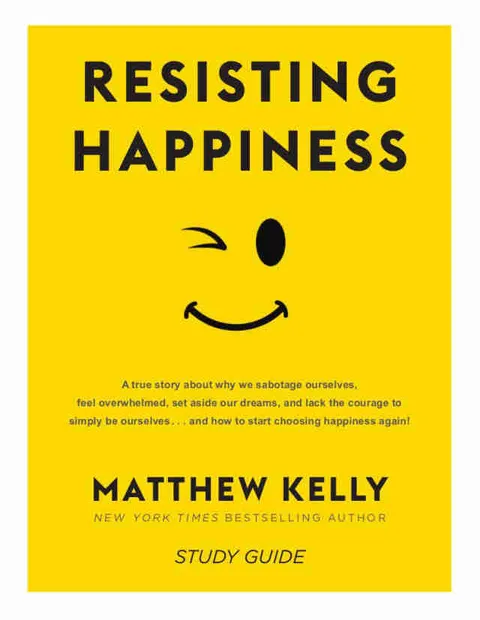

Resisting Happiness: A True Story About Why We Sabotage Ourselves Order Printed Copy
- Author: Matthew Kelly
- Size: 265KB | 32 pages
- |
Others like resisting happiness: a true story about why we sabotage ourselves Features >>
Top 7 Classics On Holiness

Longing For Godliness - Restoring Godâs Image Within Us
Latent Power Of The Soul

How To Know The Will Of God
How You Can Know The Will Of God

A Heart Ablaze
The Price Of Spiritual Power
Most Important Person On Earth
Renovation Of The Heart: Putting On The Character Of Christ
Now Faith Is
About the Book
In "Resisting Happiness," Matthew Kelly shares his personal journey and struggles with self-sabotage, and offers insights and practical advice on how to overcome the barriers that prevent us from embracing happiness and fulfillment in our lives. Through personal anecdotes and reflections, Kelly encourages readers to confront their fears and adopt habits and attitudes that lead to a more joyful and purposeful life.
Sophie Scholl
Sophia Scholl was a German student, active in the White Rose â a non-violent resistance group to Hitler and the Nazi party. In 1943, she was caught delivering anti-war propaganda and, with her brother Hans Scholl, was executed for high treason. Sophie Scholl has become an important symbol of anti-Nazi resistance in Germany.
Sophie Scholl was born in Forchtenberg, Germany on 9 May 1921. She was the fourth out of six children. Her father Robert was the Burgermeister (Mayor) of Forchtenberg am Kocher, in Baden-WĂźrttemberg.
She was brought up as a Lutheran Christian, and her childhood was relatively happy and carefree. However, in 1933, Hitler came to power and began controlling all aspects of German society. Initially, Sophie was unaffected, but her father and brothers were critical of the Nazi regime and this political criticism filtered through to leave a strong impression on the young Sophie.
At the age of twelve, she joined a pseudo-Nazi organisation, the League of German Girls. Initially, Sophie enjoyed the activities of the group, and she was promoted to Squad Leader. However, after her initial enthusiasm with the activities of the group, Sophie became uneasy about the conflict between her conscience and the creeping Nazi ideology of the organisation. In 1935, Nuremberg Laws were passed which increased the discrimination against Jews, banning them from many public places. Sophie complained when two of her young Jewish friends were barred from joining the League of German Girls. She was also reprimanded for reading from the âBook of Songsâ by the banned Jewish writer Heinrich Heine. Scholl indicated her rebelliousness by replying, that Heine was essential for understanding German literature. These incidents and the bans against Jews led to Sophie taking a much more critical attitude to the Nazi regime. She began choosing friends more carefully â people who were politically sympathetic to her viewpoint.
In 1937, her brothers and some of her friends were arrested for participating in the German Youth Movement. This incident left a strong impression on Sophie and helped to crystallise her opposition to the Nazi regime. In 1942, her father was later sent to prison for making a critical remark about Hitler. He referred to Hitler as âGodâs Scourge.â
Sophie was an avid reader and developed an interest in philosophy and theology. She developed a strong Christian faith which emphasised the underlying dignity of every human being. This religious faith proved an important cornerstone of her opposition to the increasingly all-pervading Nazi ideology of German society. Sophie also developed a talent for art â drawing and painting, and she became acquainted with artistic circles which, in Nazi terms, were labelled degenerate.
In 1940, after the start of the Second World War, she graduated from her Secondary School and became a kindergarten teacher at the Frobel Institute. However, in 1941, she was conscripted into the auxiliary war service working as a nursery teacher in Blumberg. Sophie disliked the military regime of war service and started to become involved in passive resistance to the war effort.
After six months in the National Labour Service, in May 1942, she enrolled in the University of Munich as a student of biology and philosophy. With her brother Hans, she became associated with a group of friends who shared similar artistic and cultural interests but also developed shared political views, which increasingly opposed the Nazi regime they lived in. She came into contact with philosophers such as Theodor Haecker, who posed questions of how individuals should behave under a dictatorship.
The White Rose Movement
The White Rose was an informal group who sought to oppose the war and Nazi regime. It was founded in early 1942 by Hans Scholl, Willia Graf and Christoph Probst. They wrote six anti-Nazi resistance leaflets and distributed them across Munich. Initially, Sophie was not aware of the group, but when she found out her brotherâs activities, she was keen to take part. Sophie participated in distributing leaflets and carrying messages. As a woman, she was less likely to be stopped by the SS.
The leaflets of the White Rose contained messages, such as
âNothing is so unworthy of a nation as allowing itself to be governed without opposition by a clique that has yielded to base instinctâŚWestern civilization must defend itself against fascism and offer passive resistance, before the nationâs last young man has given his blood on some battlefield.â
However, there was a pervasive police state which kept a high degree of surveillance on any resistance activity. After leaflets had been found at the University of Munich, the local Gestapo stepped up its efforts to catch the resistors. Hans, Willi and Alex also began painting anti-Nazi slogans on buildings in Munich.
On 18 February 1943, Sophie and other members of the White Rose were arrested for distributing anti-war leaflets. The leaflets were seen by Jakob Schmidt, a local Nazi party member. Sophie and Hans were interrogated by Nazi officials and, despite trying to protect each other, just four days later were sent to court. The trial was presided over by Roland Freisler, chief justice of the Peopleâs Court of the Greater German Reich. Freisler was an ardent Nazi; with great vigour and a manic intensity, he frequently roared denunciations at the accused.
Despite the hostility and appearing in court with a broken leg after her interrogation. Sophie replied to the court:
âSomebody, after all, had to make a start. What we wrote and said is also believed by many others. They just donât dare express themselves as we did.â
She also said:
âYou know the war is lost. Why donât you have the courage to face it?â
No defence witnesses were called and, after a very short trial, the judge passed a guilty verdict, with a sentence of death. The sentence was to be carried out early the next morning by guillotine.
Walter Roemer, the chief of the Munich district court, supervised the execution, he later described Sophieâs courage in facing her execution. He reports that Sophieâs last words were:
âHow can we expect righteousness to prevail when there is hardly anyone willing to give himself up individually to a righteous cause. Such a fine, sunny day, and I have to go, but what does my death matter, if through us, thousands of people are awakened and stirred to action?â
The guards were impressed with the courage of the resistors and relaxed the rules to allow Hans, Christoph and Sophie to meet before their execution.
After the execution of Sophie, Hans and Christoph, the Gestapo continued their relentless investigation. Other members of the White Rose were caught and executed. Many students from the University of Hamburg were either executed or sent to concentration camps.
Legacy of Sophie Scholl
In a poll to find the greatest German, Sophie and her brother were voted to be fourth. Amongst the young generation, under 40, they were the most popular. On February 22, 2003, a bust of Sophie Scholl was unveiled by the government of Bavaria in the Walhalla temple. In 2005, a movie about Sophie Schollâs last days was made featuring Julia Jentsch (Sophie Scholl: The Final Days)
Motivations of Sophie Scholl
Several factors inspired Sophie Scholl to take part in this highly dangerous resistance. Firstly, her family shared a dislike of the Nazi regime. Both her brothers and father had been arrested for making critical comments. Her father said to the family:
âWhat I want for you is to live in uprightness and freedom of spirit, no matter how difficult that proves to be,â (link)
She lived in a family environment which encouraged opposition to Hitler.
Sophie had a strong Christian faith and was motivated after hearing speeches by anti-Nazi pastors. She read two volumes of Cardinal John Henry Newmanâs sermons which made a strong impression on Sophie, especially his sermon on the âtheology of conscience.â During her interrogation, she referred to this ideology as a defence.
âI am, now as before, of the opinion that I did the best that I could do for my nation. I, therefore, do not regret my conduct and will bear the consequences that result from my conduct.â
Official examination transcripts (February 1943); Bundesarchiv Berlin, ZC 13267, Bd. 3
Her boyfriend Fritz Hartnagel was on the Eastern Front; he reported to Sophie the dreadful conditions of war, the German failure at Stalingrad and also witnessing war crimes undertaken by German and SS forces.
Reports of mass killings of Jews were also widely shared amongst members of the White Rose. This features in the second White Rose pamphlet.
âSince the conquest of Poland 300,000 Jews have been murdered, a crime against human dignityâŚGermans encourage fascist criminals if no chord within them cries out at the sight of such deeds. An end in terror is preferable to terror without end.â
Sophie Scholl and other members of the White Rose remain a potent symbol of how people can take a courageous action to resist, even the most brutal totalitarian regime.
Citation: Pettinger, Tejvan. âBiography of Sophie Schollâ, Oxford, UK â www.biographyonline.net. Published 12th Aug 2014. Last updated 8th March 2017.
Too Afraid to Say Nothing
On a steamy Saturday in July, I dropped off our son at a local community college to take the ACT. Earlier that morning, before leaving the house, we paused for prayer. I knew how nervous he was, how much he hates a timed test. I remembered my own anxiety and apprehension as a high schooler, realizing that part of your future rests on a few hours in a room full of strangers. So, I prayed for him not to be afraid. Fear is a curious and powerful emotion. It can debilitate. Fear can stop our mind, shut our mouth, and stay our hand. Yet fear can also set us into action. As much as fear keeps us from taking risks and being effective, fear can also be an incredible motivator. In a way, fear is whatâs made our son an excellent student thus far. Itâs what kept him up studying late at night, and itâs why he willingly walked into that testing room. The right kind of fear is also one of the best motivators for our evangelism. Fear That Freezes Evangelism When it comes to evangelism, Christians tend to view fear as purely negative. Many of us have come to believe that fear is the primary factor that keeps us from speaking the gospel to others. Fear freezes us. When we sense the Spirit leading us to talk with our neighbor, friend, or family member, we get the same feeling that many of us experienced on a Friday algebra exam. We struggle to focus. Our hands perspire. We donât even know where to begin. Some of that physical response comes from a fear of failure. Like when taking a test, we donât want to mess up. We donât want to give someone the wrong answer. So, churches often respond by providing evangelism training. Education is the solution. We help people prepare, supply them with resources, and even give them, as it were, the opportunity for practice tests. And this information is truly important. We must be able to proclaim the gospel clearly and truthfully. Such an approach in evangelism training, however, might assume that the way we address fear in evangelism is primarily through increasing our accuracy and ability. But Iâm not convinced, because I believe the fear that freezes us would more accurately be labeled as shame (Luke 12:8â9; 2 Timothy 1:8â12). The Fear of Rejection I suspect the greatest hindrance to bold witness is not the fear of getting it wrong; itâs the fear of being rejected. We donât want to be ostracized or shunned. We donât want our friends to think weâre narrow-minded, unscientific, bigoted, intolerant, or just uncool. If weâre honest, weâre often too embarrassed to evangelize. Weâre ashamed of Christ. Education will never overcome that kind of fear. Instead, we need to encourage bold witness by dealing with the emotional and social dynamics of shame. Shameâs power is its ability to disgrace and divide. Shame humiliates and separates from others. Which means the antidote to shame is glory and community â and we find those in the gospel. The good news of Jesus promises us both honor and a home (Matthew 10:32; John 14:1â3). Only when Christians recognize this will they be able to overcome the shame that silences their witness. Because theyâll be more confident in the praise and glory that God himself promises them on the final day (1 Peter 1:7; Romans 2:7). Theyâll fear rejection less, because theyâll have experienced the welcome of Christian fellowship, the earthly foretaste of the heavenly home that God gives his chosen exiles. Fear That Fuels Evangelism Realizing the social and emotional dynamics of fear can also help us see how it can be a positive motivator for mission. In recent years, thereâs been such an experiential increase in a particular kind of fear that the phenomenon has been given a pop-culture label: FOMO â the fear of missing out. FOMO is understood as peopleâs anxiety, largely fueled by viewing social media, that theyâll miss out on some exciting event, important relationship, or salacious news. But this particular fear doesnât generally stifle people. It drives them to constantly check their phones. It leads them to follow more people, make more friends, be more active. Now, Iâm not suggesting that FOMO leads to positive or healthy behavior. What is helpful to see, though, is how fear can powerfully move us into action. If we experience a fear similar to FOMO with regard to evangelism, we can see how it could lead us to pursue our neighbors and open our mouths with the gospel. Once we have tasted of Godâs goodness in the gospel, we will want others to experience the same. We will fear them missing out on the glories of heaven, the wonders of Christ, and the most spectacular news of all. Such fear is not antithetical to love; itâs a demonstration of Christâs compassion for them (2 Corinthians 5:14). But thereâs more to understanding how fear should fuel our evangelism. Jesus said, âWhoever is ashamed of me and of my words, of him will the Son of Man be ashamed when he comes in his glory and the glory of the Father and of the holy angelsâ (Luke 9:26). There it is. The solution to the shame that silences our witness is our fear of missing out on glory and honor with the heavenly host. If we are embarrassed of Christ and his gospel, if we avoid evangelism as a way to protect our reputation and maintain our relationships, we will lose the honor he promises. We will miss out on the community of glory, with the Father and all his holy angels. More Fear, Not Less This means that fear is not the greatest hindrance to evangelism. Our lack of fear is. Instead of being ashamed before others, we need to be concerned about being ashamed before Christ at his coming (1 John 2:28). Instead of fearing what others will say about us or do to us, we need to fear God, the one âwho can destroy both soul and body in hellâ (Matthew 10:28). Shame isnât purely negative. âKnowing the fear of the Lord, we persuade othersâ (2 Corinthians 5:11). Fear can be a positive force. My son realized that taking the ACT is the means to college admission, a potential scholarship, and a future career. The results also have a profound emotional and social dimension â just wait until the scores come back! He knows the stakes are high. But recognizing the weight can be a motivating factor, and not necessarily a debilitating one. So it can be for us. As we grow in an appropriate fear of God and for othersâ eternal well-being, we will be moved to speak the gospel with more urgency and care. And as we sense the honor and home that God promises us in Christ, we will fear less the humiliation and rejection of others. We will not be ashamed of the gospel. Article by Elliot Clark