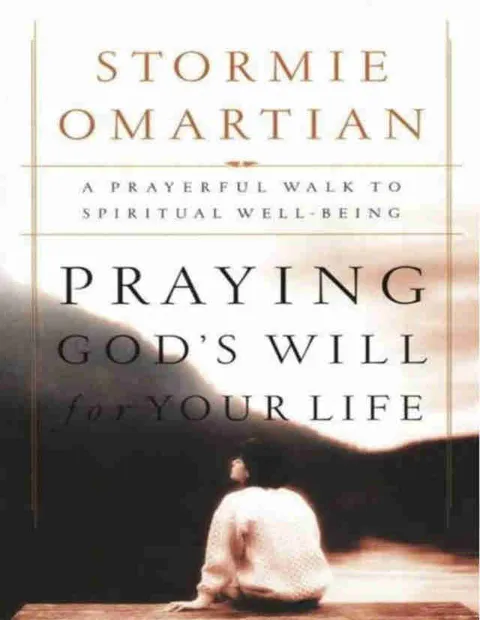

Praying God's Will For Your Life Order Printed Copy
- Author: Stormie Omartian
- Size: 569KB | 131 pages
- |
Others like praying god's will for your life Features >>
About the Book
"Praying God's Will For Your Life" by Stormie Omartian explores the power of prayer and how it can align our lives with God's purpose. The book provides practical guidance on how to pray effectively, surrendering to God's plan and seeking His will in all aspects of our lives. Through personal anecdotes and scriptures, Omartian encourages readers to trust in God's timing and direction, leading to a more fulfilling and purposeful life.
Emerson Andrews
His Early life
Emerson Andrews was born in Mansfield, Bristol County, Massachusetts in 1806 to godly parents, James and Mercy Andrews. They were from English stock and were strict Puritans in faith and lifestyle. Although young Emerson was raised in the Congregational Church he was far from God in his teens and twenties.
Nevertheless, periodically, he experienced intense conviction, usually through his parentsâ counsels and prayers but particularly through two unforgettable sermons delivered by the eccentric revivalist, Lorenzo Dow. Soon after this he was converted under the ministry of another revival preacher, Asahel Nettleton.
He was a very educated man formerly studying at Chesterfield Academy and, at the time of his conversion, at Plainfield Kimball Union Academy, in New Hampshire. In the spring of 1832 whilst studying further at Union College in Schenectady, New York, he was baptised by immersion in the Mohawk River. It was his convictions about the Bibleâs teaching on water baptism that caused him to join the Baptistâs instead of the Congregationalists or Presbyterians.
A Lover of Revival
He wrote âMany revivals and protracted meetings of one, two, or more days, and some for weeks and months, have been held, in New England and elsewhere, within, my personal remembrance. These have sent out their hallowed influences, as the light of the world and salt of the earth. Just before and at the time of my second birth, many sweeping and glorious revivals, under the celebrated Dr. Netteton, John Leland, Jedediah Burchard, C. G. Finney, were hailed, enjoyed, and sounded all around and over the country.
As soon as I was converted I cherished the good news of revivals; and I sought a place and portion with live Christians, that I might speak for Christ and win souls to salvation. I asked God for direction and help, and was answered.
His first visit to a Revival
He describes his first visit to a Revival âThe first meeting that I attended after my regeneration was held in the town of Windsor, Vt. It was called a âfour daysâ meeting.â But many such were held in different places about that time. This came off in the summer of l830. I was much delighted, fed, and strengthened by such a sight, experience, exercise, and spiritual supper. It was a precious banquet, adapted to develop and enlarge the young convertâs soul.
The four pastors of the town, with their respective churches and congregations, and some from neighboring towns, met with the Baptist church, of which Elder Leland Howard was the long-honored pastor. Some twenty other pastors also came in from adjacent towns, and a few Lawyers and teachers, who took leading parts in the services. Large congregations were constantly in attendance, and all the various exercises and meetings were interesting and profitable.
Some of the sermons and prayers were most powerful, melting, and effective. Sinners often arose, requesting prayers, or sent up short petitions to be read. A lawyer by the name of Shepherd, from New York, was found to be very able, pointed, and specific in prayer, and so effective and precise in noting each different request more perfectly than the ministers, that he was often invited to lead in prayer â especially when there were some ten or twenty different, or some difficult requests presented.
He seemed to be full of the Spirit, and was especially gifted and successful. Ministers learned something valuable from his wisdom and tact. I confess that his pointedness made a powerful and lasting impression on my mind and practice.
The professors and ministers were much blessed, and many sinners were converted in the meetings. The gospel was preached and the Spirit poured out, prayer and sacrifices made. Novelty and wonder attracted many. Here God crowned the effort.â
Mentored by Jacob Knapp
He writes. â ROCHESTER, N.Y. 1839. Here I assisted in a powerful meeting, under the preaching of the celebrated Elder Jacob Knapp, for three weeks. Marvellous things were done. The wicked raged, the Spirit worked, grace prevailed, and hundreds were converted â a glorious triumph over rum, gambling, and infidelity. Jesus reigned.â This exposure to revival power whetted his appetite for an evangelistic ministry.
His first revival efforts
âWHITE DEER, PENN. 1839. In this rich farming district I had a revival meeting of five weeks, with a feeble Baptist church. We began at the close of the Association; but, with all the eloquent pastoral preaching in it, the brethren were not aroused, nor sinners much convicted.
Here my first sermon was from the text, âO Lord, revive thy work!â And he did so immediately. Some half a dozen persons were convicted and converted, and the church was revived by the power of God on that eveningâs effort. The whole region, then, for seven miles around, was awakened, and some forty converts were immersed by Elder Spratt, D.D.
Here, too, we experienced severe opposition and much persecution from outside professors and sinners, but God strengthened our hands for a triumphant work. This was a blessed era with the church, and it is fragrant still.
âCLINTON, PENN. I had a revival meeting in this township. It was very great and powerful. Satan and sinners raged, at times, terribly, but the cross was triumphant. Many were immersed by the beloved pastor, Elder Spratt, D.D.
Hugh Donelly, the postmaster, rum-selling merchant, and an avowed infidel, who had slandered me and ridiculed the meeting, crept in away back, then into the middle seats; then, after a few nights, fell on his knees groaning and crying for mercy. I soon aided him in coming forward.
Then out came his wife and sister. We all prayed, and soon the three rejoiced in hope, and spoke boldly for Jesus. Brother Donelly has made a noble record in Pennsylvania and Indiana for Jesus and his causeâŚ..
PARMA, N.Y. In this western village, in mid-winter, I preached night and day, for three weeks, to overflowing houses and attentive hearers. Christians renewed their âfirst love and vows,â and many sinners were converted and baptized.
An infidel, hearing a few sermons, was struck under conviction, and fled away thirty miles for comfort; but, feeling worse and worse, returned like the prodigal, feeling wretched and lost. He came forward, prayer was offered, and he soon yielded and believed, giving glory to God. Then he told his experience, and exhorted his old Universalist and infidel friends to repent and be saved from hell.
Emerson Andrews Preaching
His preaching zeal and effectiveness were quickly recognised and he was soon licensed to preach and for a four year period served brief pastorates in New York State â Waterford, West Troy, Lansingburg and Rome (1834-1838)
In 1838 began an itinerant evangelist for thirty-five years, mainly in America, but also in Europe, Africa, Asia and Canada. His estimates were that 40,000 were converted through his ministry.
An Excellent New Book on Justification
If a thoughtful layman asked me what he should read to understand the doctrine of justification in relationship to the New Perspective on Paul, I would send him to Stephen Westerholmâs new book, Justification Reconsidered: Rethinking a Pauline Theme (Eerdmans, 2013). I enjoyed this book so much I found it difficult to put down. It is constructive. That is, it builds a clear and positive view of what justification is, rather than simply criticizing other views. For that reason, it provides a good introduction to the doctrine of justification itself for those who may not be clear on what Paul taught. According to the New Perspective But it is obviously written with a view to explaining and criticizing the so-called New Perspective (including Krister Stendahl, E.P. Sanders, J.D.G. Dunn, and N.T. Wright). The gist of that perspective is that the Judaism of Paulâs day was not a religion of legalism but of grace, and so, contrary to the historic view of Paul, legalism can hardly be what Paul found wrong with Judaism. His doctrine of justification must have had a different target. Therefore, the New Perspective says, justification âwas not about how sinners could find a gracious God (by grace, not by works), but about the terms by which Gentles could be admitted to the people of God (without circumcision, Jewish food laws, and the like). A new Perspective was bornâ (26). The problem, Westerholm points out, is that the views of grace in contemporary Judaism did not exclude the merit of works alongside it. E.P. Sanders himself shows that the Rabbis âdid not have a doctrine of original sin or of the essential sinfulness of each man in the Christian senseâ (33). It follows, Westerholm argues, that âhumanityâs predicament must be more desperate than Jews otherwise imaginedâ (33). Desperate for Grace This means that Paulâs âdepiction of humanityâs condition required a much more rigorous dependence on divine grace than did Judaismâsâ (34). Therefore, to show that Judaism had a doctrine of grace âis no reason to deny that Paul could have understood justification in terms of an exclusive reliance on grace in a way that was foreign to the thinking of contemporary Jewsâ (34). Therefore, Paulâs doctrine of justification did target not only a Jewish view, but any human view, that presumes to make good works any part of the ground of our being found righteous before God. âFor Paul, Godâs gift of salvation [i.e., justification] necessarily excludes any part to be played by God-pleasing âworksâ since human beings are incapable of doing themâ (32). âPaul sees the only righteousness available to sinful human beings to be that given as a gift of Godâs grace, âapart from worksâ (Romans 3:24; 4:2, 6; 5:17) â distinguishing grace from works in a way other Jews felt no need to doâ (98). What the Doctrine Means In a statement that summarizes the whole book, Westerholm writes that this historic view of justification, shared by the Reformers and most Protestants, cannot be dismissed by the claim that the ancients were not concerned to find a gracious God (how could they not be, in the face of pending divine judgment?); or that it wrongly casts first-century Jews as legalists (its target is rather the sinfulness of all human beings); or that non-Christian Jews, too, depended on divine grace (of course they did, but without Paulâs need to distinguish grace from works); or that ârighteousnessâ means âmembership in the covenantâ (never did, never will) and the expression âworks of the lawâ refers to the boundary markers of the Jewish people (it refers to all the ârighteousâ deeds required by the law as its path to righteousness). (98) And, Westerholm observes, it is, of course, right to âemphasize the social implications of Paulâs doctrine of justification . . . in his own day and . . . draw out its social implications for our ownâ (98). But we should not identify the meaning of justification with its social implications (for example, table fellowship between Gentiles and Jews in Galatians 2; and multi-ethnic implications today). No. âThe doctrine of justification means that God declares sinners righteous, apart from righteous deeds, when they believe in Jesus Christâ (99). Confusing the root with the fruit will, in the long run, kill the tree. Article by John Piper Founder & Teacher, desiringGod.org