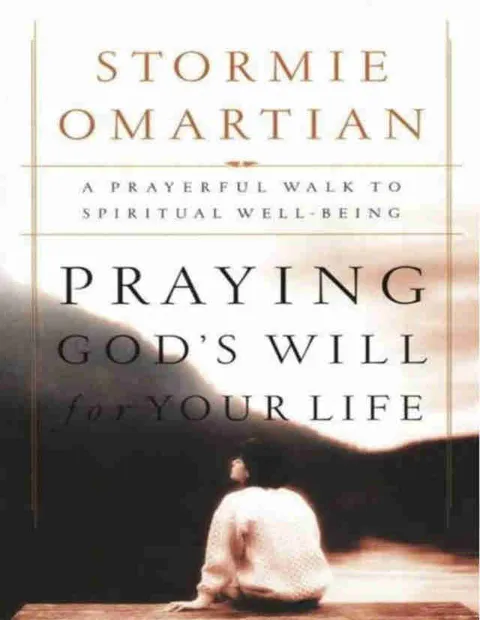

Praying God's Will For Your Life Order Printed Copy
- Author: Stormie Omartian
- Size: 569KB | 131 pages
- |
Others like praying god's will for your life Features >>
About the Book
"Praying God's Will For Your Life" by Stormie Omartian explores the power of prayer and how it can align our lives with God's purpose. The book provides practical guidance on how to pray effectively, surrendering to God's plan and seeking His will in all aspects of our lives. Through personal anecdotes and scriptures, Omartian encourages readers to trust in God's timing and direction, leading to a more fulfilling and purposeful life.
John Owen
John Owenâs life was incredibly difficult.
Born in 1616 and dying in 1683, Owen lived through the deaths of his first wife and all of his children, several of whom died in very early childhood. He supported his last surviving daughter when her marriage broke down. He contributed to a political revolution, watched it fail, saw the monarchy restored and wreak a terrible revenge on republicans, and lived in and around London during the persecution that followed. For twenty years he would have seen the decapitated heads of his friends on display around the city. He died fearing that the dissenting churches had largely abandoned the doctrine of the Trinity and justification by grace alone through faith alone in Christ alone; and, with Charles II about to be replaced by his openly Catholic brother James, believing that the English Reformation was almost over.
Owen was one of the most published writers in the seventeenth century.
He published around 8 million words. These writings included books on theology and spirituality, politics and economics, and ranged in length from the largest commentary ever published on the epistle to the Hebrews to a short Latin poem that has never been reprinted. For not all of Owenâs works have been kept in print. The most widely circulating nineteenth-century edition, most of which is published by the Banner of Truth, did not include Owenâs sermon manuscripts that are kept in various English libraries, nor the book for children that Owen published in 1652.
Owen was one of Englandâs earliest childrenâs authors.
The catechisms that Owen published (1645) outlined what he expected children in his congregation to know. These catechisms were published before the Westminster Assembly published its better-known examples. But Owenâs catechisms are in many ways simpler. The Primer (1652), which Owen prepared after the death of several of his children during the years of poor harvests and disease at the end of the 1640s, showed what Owen expected of an ideal Christian home. Its routine would be built around Bible reading and prayer, he believed, and his little book included sample prayers that children could learn to pray in mornings, evenings, and at meals. Owen argued that those who led church services should take account of the needs of children. Services that were too long, he believed, did no one any good. Adult believers should not need written prayers, he believed, and these should be banned from public worship. But children were different and needed all the help they could get.
Owen enjoyed many warm friendships.
His social network included many of the most famous writers in seventeenth-century England. Among his friends and rivals were John Milton, Andrew Marvell, John Bunyan, and Lucy Hutchinson. Owen fell out with Milton and became the subject of one of his sonnets. Owen helped Marvell publish one of his most controversial political pamphlets. He encouraged his publisher, Nathanial Ponder, to publish Bunyanâs Pilgrimâs Progress. And he appears to have supported Lucy Hutchinson during her move into London, when she attended and took notes upon his preaching and translated large parts of his Theologoumena Pantodapa (1661)âa translation of which has been published with the title Biblical Theology. Owenâs letters reveal his kindness and care as a pastor, especially to mothers grieving their childrenâs death.
Owen was deeply political.
He preached to Members of Parliament on the day after the execution of Charles I, and pinned his hopes for the reformation of church and society on their efforts to transform England into a protestant republic. During the 1650s, under the leadership of Oliver Cromwell, Owen served on important committees that sought to establish a religious foundation for the new regime. But he grew dismayed by the ways in which the Cromwell family, and the administration they led, seemed to turn away from godly values. In 1658, he worked with leading army officers to create a crisis that, he likely hoped, would call the regime back to its earlier ideals. It failed, and instead created the crisis that was resolved by the restoration of the monarchy, the return of Charles II, and the persecution of dissenters that followed. During the Restoration, Owen kept his head down, and, as persecution slackened in the later 1660s, published pamphlets that argued that dissenters were the economic lifeblood of the English nation. But he was chastened by his attempts at political intervention and came increasingly to realize that his focus should be on things eternal.
Owen often changed his mind.
As his developing attitudes to political intervention suggest, Owen committed himself to some beliefs and behaviors that he came to regret. In his early years, he changed his churchmanship from Presbyterianism to Congregationalism. He innovated as a Congregationalist, installing as a co-elder and preacher a man who would not be ordained for several years. He argued for the weekly celebration of the Lordâs Supper, though it is not clear that he ever persuaded any of his congregations to practice it. He thought carefully about the end times and came to believe that, in the latter days, a large number of Jewish people would be converted to Christianity and would return to live in the Promised Land. He dismissed a great deal of discussion about the millennium, but became convinced that the binding of Satan had yet to be achieved. Owen changed his mind because he kept on studying the Bible.
Owen was biblical, through and through, and depended just as much on the Holy Spirit.
He certainly believed in a learned ministryâafter all, he had taught theology at Oxford and done his best to promote godliness within the student body. But he also trusted the Holy Spirit to guide ordinary Christians in small group Bible studies that did not need to be policed by a formally trained expert. Aside from his own Bible study, which advanced on the serious scholarship represented by the three thousand titles that were included in the catalog of his library published soon after his death, Owen encouraged church members to meet together to study Scripture in private.
Owen trusted the Bible and the work of the Spirit after writing about both.
Owen was not a philosophically-driven, rationalist theologian. His writing abounds in biblical citations. It is molded and contoured by biblical revelation. But he warned that Christians could approach their study of the Bible with absolutely no spiritual advantage to themselves. Christians who approached the study of the Bible without absolute dependence upon the Spirit who inspired and preserved it would gain no more benefit than Jewish readers did from their Scriptures, he argued. Christians should never choose between entire dependence upon the Bible and the Spirit.
Owen believed that the goal of the Christian life was knowing God.
Before Owen, no one had ever shown clearly how Christians relate to each person of the Trinity. Owen described the goal of the gospel as revealing the love of the Father, who sent the Son as a redeemer of his people, who would be indwelt, provided with gifts, and united together by the Spirit. Owenâs Communion with God is among his most celebrated achievementsâand no wonder. It is the exhalation of his devotion to Father, Son, and Spirit, and the discovery of the limitless love of God.
Owen is much easier to read than many people imagine.
There is a mystique to Owenâa widespread feeling that his books are too difficult and best left to expert theologians. But Owenâs greatest books were written as sermons for an audience of teenagers. Publishers have begun to modernize Owenâs language in new editions of his works. Now more than ever, itâs time to pick up Owen and find his encouragement for the Christian life.
Laziness Ruins Happiness
Most people do not want to be thought of as lazy â as a person averse to hard work. We all know laziness is a vice â a corrupting and addicting use of a good gift: rest. Leisure in proper doses is a wonderful, refreshing gift of God. But habitual indulgence in leisure to the neglect of God-given responsibilities brings destruction, both to ourselves and to others. But itâs destructive for a deeper reason than the obvious detrimental impact of work done negligently, or not done at all. At the deeper levels, laziness robs us of happiness by decreasing our capacity to enjoy the deepest delights. And on top of this, it leaves us failing to love as we ought. âLaziness robs us of happiness by decreasing our capacity to enjoy the deepest delights.â Since all of us are tempted in different ways to the sin of laziness, itâs helpful to keep in mind all thatâs at stake â and why, over and over throughout the Bible, God commands us to pursue the virtue of diligence. Virtues and Vices For Christians, a virtue is moral excellence that, if cultivated into a habit, becomes a morally excellent character trait. We become more conformed to the image of Christ (Romans 8:29) and experience an increased capacity to delight in what God has made good, true, and beautiful. We see scriptural examples in 2 Peter 1:5â8: Make every effort to supplement your faith with virtue [aretÄ in Greek, referring to all the virtues] and virtue with knowledge, and knowledge with self-control, and self-control with steadfastness, and steadfastness with godliness, and godliness with brotherly affection, and brotherly affection with love. For if these qualities are yours and are increasing, they keep you from being ineffective or unfruitful in the knowledge of our Lord Jesus Christ. Conversely, a vice is moral corruption that, if cultivated into a habit, becomes a morally corrupt character trait. We become more conformed to the pattern of this fallen world (Romans 12:2) and experience a decreased capacity to delight in what God has made good, true, and beautiful. We see scriptural examples in Galatians 5:19â21: Now the works of the flesh are evident: sexual immorality, impurity, sensuality, idolatry, sorcery, enmity, strife, jealousy, fits of anger, rivalries, dissensions, divisions, envy, drunkenness, orgies, and things like these. I warn you, as I warned you before, that those who do [prassontes in Greek, meaning âmake a practice of doingâ] such things will not inherit the kingdom of God. Why Diligence Is a âHeavenly Virtueâ In the fifth or sixth century, many in the church included diligence on the list of the seven heavenly virtues to counter sloth (the old English word for laziness), which it had on its list of seven deadly sins. But saints throughout redemptive history have always considered diligence a necessary virtue. Both the Old and New Testaments consistently command saints to be diligent, and warn against the dangers of being slothful. Hereâs a sampling: Only take care, and keep your soul diligently, lest you forget the things that your eyes have seen, and lest they depart from your heart all the days of your life. (Deuteronomy 4:9) The soul of the sluggard craves and gets nothing, while the soul of the diligent is richly supplied. (Proverbs 13:4) You have commanded your precepts to be kept diligently. (Psalm 119:4) Do not be slothful in zeal, be fervent in spirit, serve the Lord. (Romans 12:11) If anyone is not willing to work, let him not eat. For we hear that some among you walk in idleness, not busy at work, but busybodies. (2 Thessalonians 3:10â11) Therefore, brothers, be all the more diligent to confirm your calling and election, for if you practice these qualities you will never fall. (2 Peter 1:10) As these passages show, diligence is a âheavenly virtueâ because it is a means of cultivating godliness â increased capacities to deeply delight in God and his gifts. Cultivating the âdeadly sinâ (or vice) of sloth, on the other hand, is a means of cultivating ungodliness â decreased capacities to deeply delight in God and his gifts. Wearing Our Love on Our Sleeve But when we speak of pursuing diligence as a way of cultivating godliness, thereâs an additional dimension besides developing a strong work ethic for the sake of experiencing greater joys. Since âGod is loveâ (1 John 4:8), and since love fulfills his law (Romans 13:10; Galatians 5:14), growing in godliness means we grow in some aspect of what it means to love. What makes the virtue of diligence distinctly Christian is that it is one of the ways we love God supremely and love our neighbors as ourselves (Matthew 22:37â39). âHow we behave reflects what we believe; what we do reflects what we desire; our labors reflect our loves.â God designed us such that our actions bring into view the real affections of our inner being. To put it very simply (and admittedly simplistically): how we behave, over time, reflects what we believe; what we do reflects what we desire; our labors reflect our loves. Now, I realize Iâm touching on a complex issue. Our motivating beliefs, desires, and loves are not simple, nor are the contexts in which we behave, do, and labor. Nor are the neurological disorders and diseases that sometimes throw wrenches into these already complex gears. That said, it remains true that our consistent behaviors over time reveal what we really believe, desire, and love. This is what Jesus meant by saying we can distinguish between a healthy (virtuous) tree and a diseased (corrupt) tree by its fruit (Matthew 7:17â20). And of course, the âfruitâ is seen not only in what we do, but in how we do it. And here is where our diligence or laziness often reveals what or whom we truly love. Since we seek to take care of what we value greatly, itâs usually apparent when others put their heart into what theyâre doing and when they donât. Or as Paul said of some who were âlazy gluttonsâ in Crete, âThey profess to know God, but they deny him by their worksâ (Titus 1:12, 16). In what we do and how we do it, in our diligence or laziness, we come to wear our loves on our sleeves â whether we love God (John 14:15) and our neighbor (1 John 3:18), or selfishly love ourselves (2 Timothy 3:2). Be All the More Diligent So, thereâs more at stake in our diligence or laziness than we might have previously thought. Yes, diligence is important for the sake of doing high-quality work, which is beneficial in many ways. But hard work, by itself, does not equal the virtue of diligence. As Tony Reinke points out, âWorkaholism is slothful because it uses labor in a self-centered way to focus on personal advancement or accumulated accoladesâ (Killjoys, 50). When Scripture commands us to âbe all the more diligentâ (2 Peter 1:10), God is calling us to work hard toward the right ends (growing in godliness), in the right ways (what God commands), for the right reasons (love). The more this kind of diligence becomes characteristic of us, the more we become like Jesus: we increasingly delight in what gives him delight, and increasingly love as he loves â which is true virtue. Article by Jon Bloom