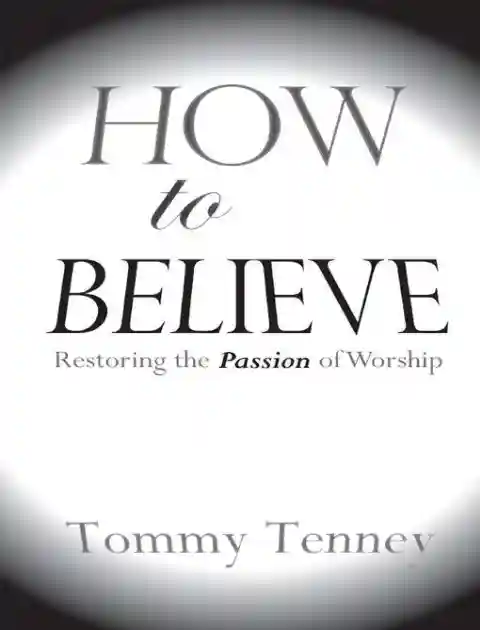

How To Believe - Restoring The Passion Of Worship Order Printed Copy
- Author: Tommy Tenney
- Size: 620KB | 112 pages
- |
Others like how to believe - restoring the passion of worship Features >>
About the Book
"How To Believe" by Tommy Tenney explores the importance of restoring passion in worship. Tenney discusses the significance of belief in achieving true worship and offers practical advice on how to rekindle one's passion for God. Through personal anecdotes and Biblical examples, he encourages readers to deepen their faith and experience deeper connections with God through worship.
John Owen
John Owenâs life was incredibly difficult.
Born in 1616 and dying in 1683, Owen lived through the deaths of his first wife and all of his children, several of whom died in very early childhood. He supported his last surviving daughter when her marriage broke down. He contributed to a political revolution, watched it fail, saw the monarchy restored and wreak a terrible revenge on republicans, and lived in and around London during the persecution that followed. For twenty years he would have seen the decapitated heads of his friends on display around the city. He died fearing that the dissenting churches had largely abandoned the doctrine of the Trinity and justification by grace alone through faith alone in Christ alone; and, with Charles II about to be replaced by his openly Catholic brother James, believing that the English Reformation was almost over.
Owen was one of the most published writers in the seventeenth century.
He published around 8 million words. These writings included books on theology and spirituality, politics and economics, and ranged in length from the largest commentary ever published on the epistle to the Hebrews to a short Latin poem that has never been reprinted. For not all of Owenâs works have been kept in print. The most widely circulating nineteenth-century edition, most of which is published by the Banner of Truth, did not include Owenâs sermon manuscripts that are kept in various English libraries, nor the book for children that Owen published in 1652.
Owen was one of Englandâs earliest childrenâs authors.
The catechisms that Owen published (1645) outlined what he expected children in his congregation to know. These catechisms were published before the Westminster Assembly published its better-known examples. But Owenâs catechisms are in many ways simpler. The Primer (1652), which Owen prepared after the death of several of his children during the years of poor harvests and disease at the end of the 1640s, showed what Owen expected of an ideal Christian home. Its routine would be built around Bible reading and prayer, he believed, and his little book included sample prayers that children could learn to pray in mornings, evenings, and at meals. Owen argued that those who led church services should take account of the needs of children. Services that were too long, he believed, did no one any good. Adult believers should not need written prayers, he believed, and these should be banned from public worship. But children were different and needed all the help they could get.
Owen enjoyed many warm friendships.
His social network included many of the most famous writers in seventeenth-century England. Among his friends and rivals were John Milton, Andrew Marvell, John Bunyan, and Lucy Hutchinson. Owen fell out with Milton and became the subject of one of his sonnets. Owen helped Marvell publish one of his most controversial political pamphlets. He encouraged his publisher, Nathanial Ponder, to publish Bunyanâs Pilgrimâs Progress. And he appears to have supported Lucy Hutchinson during her move into London, when she attended and took notes upon his preaching and translated large parts of his Theologoumena Pantodapa (1661)âa translation of which has been published with the title Biblical Theology. Owenâs letters reveal his kindness and care as a pastor, especially to mothers grieving their childrenâs death.
Owen was deeply political.
He preached to Members of Parliament on the day after the execution of Charles I, and pinned his hopes for the reformation of church and society on their efforts to transform England into a protestant republic. During the 1650s, under the leadership of Oliver Cromwell, Owen served on important committees that sought to establish a religious foundation for the new regime. But he grew dismayed by the ways in which the Cromwell family, and the administration they led, seemed to turn away from godly values. In 1658, he worked with leading army officers to create a crisis that, he likely hoped, would call the regime back to its earlier ideals. It failed, and instead created the crisis that was resolved by the restoration of the monarchy, the return of Charles II, and the persecution of dissenters that followed. During the Restoration, Owen kept his head down, and, as persecution slackened in the later 1660s, published pamphlets that argued that dissenters were the economic lifeblood of the English nation. But he was chastened by his attempts at political intervention and came increasingly to realize that his focus should be on things eternal.
Owen often changed his mind.
As his developing attitudes to political intervention suggest, Owen committed himself to some beliefs and behaviors that he came to regret. In his early years, he changed his churchmanship from Presbyterianism to Congregationalism. He innovated as a Congregationalist, installing as a co-elder and preacher a man who would not be ordained for several years. He argued for the weekly celebration of the Lordâs Supper, though it is not clear that he ever persuaded any of his congregations to practice it. He thought carefully about the end times and came to believe that, in the latter days, a large number of Jewish people would be converted to Christianity and would return to live in the Promised Land. He dismissed a great deal of discussion about the millennium, but became convinced that the binding of Satan had yet to be achieved. Owen changed his mind because he kept on studying the Bible.
Owen was biblical, through and through, and depended just as much on the Holy Spirit.
He certainly believed in a learned ministryâafter all, he had taught theology at Oxford and done his best to promote godliness within the student body. But he also trusted the Holy Spirit to guide ordinary Christians in small group Bible studies that did not need to be policed by a formally trained expert. Aside from his own Bible study, which advanced on the serious scholarship represented by the three thousand titles that were included in the catalog of his library published soon after his death, Owen encouraged church members to meet together to study Scripture in private.
Owen trusted the Bible and the work of the Spirit after writing about both.
Owen was not a philosophically-driven, rationalist theologian. His writing abounds in biblical citations. It is molded and contoured by biblical revelation. But he warned that Christians could approach their study of the Bible with absolutely no spiritual advantage to themselves. Christians who approached the study of the Bible without absolute dependence upon the Spirit who inspired and preserved it would gain no more benefit than Jewish readers did from their Scriptures, he argued. Christians should never choose between entire dependence upon the Bible and the Spirit.
Owen believed that the goal of the Christian life was knowing God.
Before Owen, no one had ever shown clearly how Christians relate to each person of the Trinity. Owen described the goal of the gospel as revealing the love of the Father, who sent the Son as a redeemer of his people, who would be indwelt, provided with gifts, and united together by the Spirit. Owenâs Communion with God is among his most celebrated achievementsâand no wonder. It is the exhalation of his devotion to Father, Son, and Spirit, and the discovery of the limitless love of God.
Owen is much easier to read than many people imagine.
There is a mystique to Owenâa widespread feeling that his books are too difficult and best left to expert theologians. But Owenâs greatest books were written as sermons for an audience of teenagers. Publishers have begun to modernize Owenâs language in new editions of his works. Now more than ever, itâs time to pick up Owen and find his encouragement for the Christian life.
Am I Really a Christian
Am I really a Christian? Perhaps for you, that question looms like a shadow in the back of the soul, threatening your dearest hopes and peace. Others may struggle to understand why. You bear all the outward marks of a Christian: You read, pray, and gather with your church faithfully. You serve and sacrifice your time. You look for opportunities to share Christ with neighbors. You hide no secret sins. But âthe heart knows its own bitternessâ (Proverbs 14:10), and so too its own darkness. No matter how much you obey on the outside, when you look within you find a mass of conflicting desires and warring ambitions. Every godly impulse seems mixed with an ungodly one; every holy desire with something shameful. You canât pray earnestly without feeling proud of yourself afterward. You canât serve without some part of you wanting to be praised. You remember Judas and Demas, men whose outward appearance deceived others and deceived themselves. You know that on the last day many will find themselves surprised, knocking on the door of heaven only to hear four haunting words: âI never knew youâ (Matthew 7:23; 25:11â12). And so, in the stillness before sleep, in quiet moments of the day, and sometimes in the middle of worship itself, the shadow returns: Am I real â or am I just deceiving myself? âWith You There Is Forgivenessâ Sometimes, the most apt answers to our most pressing questions are buried hundreds of years ago. And when it comes to assurance in particular, we may never surpass the pastoral wisdom of those seventeenth-century soul physicians, the Puritans. Assurance proved to be a common struggle for the Christians of that era, such that John Owen devoted over three hundred pages to the topic in his masterful Exposition of Psalm 130, most of which addresses a single verse: âWith you there is forgiveness, that you may be fearedâ (Psalm 130:4). âWhen it comes to assurance, what matters most is not sinâs persistence, but our resistance.â With God there is forgiveness â free forgiveness, abundant forgiveness, glad forgiveness, based on the blood and righteousness of Jesus Christ. But Owen knew that some Christians would hesitate to believe that forgiveness was for them. He knew that some introspective believers, bruised with a sense of their indwelling sin, would respond, âYes, there is forgiveness with God, but I see so much darkness within myself â is there forgiveness for me?â In a way, Owenâs entire book is his answer to that question. But he devotes special attention to such believers in one brief section â not aiming, necessarily, to remove every doubt (something only God can do), but merely to help readers see themselves from a new, more gracious angle. Grief can be a good sign. When some Christians search their hearts, they have eyes only for their sin. Their highest worship seems tainted with self-focus; their best obedience seems spoiled by strains of insincerity. They are ready to sigh with David, âMy iniquities have overtaken me, and I cannot see; they are more than the hairs of my head; my heart fails meâ (Psalm 40:12). But such grief can be a good sign. Owen asks us to imagine a man with a numb leg. As long as his leg has lost sensation, the man âendures deep cuts and lancings, and feels them not.â Yet as soon as his nerves awake, he âfeels the least cut, and may think the instruments sharper than they were before, when all the difference is, that he hath got a quickness of senseâ (Works of John Owen, 6:604). Outside of Christ, our souls are numb to the evil of sin. The guilt and the consequences of sin may have wounded us from time to time, but its evil we could hardly feel (if at all) â no matter how often it thrust us through. But once our souls come alive, we need only a paper cut to wince. Sin burdens us, oppresses us, grieves us, not because we are worse than we were before, but because we finally feel sin for what it is: the thorns that crowned our Saviorâs head, the spear that pierced our Lord. So, Owen writes, ââOh wretched man that I am! who shall deliver me from the body of this death?â [Romans 7:24] is a better evidence of grace and holiness than âGod, I thank thee I am not as other menâ [Luke 18:11]â (601). Grief over our sin, far from disqualifying us from the kingdom, suggests that comfort is on the way (Matthew 5:4). Your resistance, not sinâs persistence, matters most. Temptation is frustratingly persistent. Sin would grieve us less if it left us alone more often: if pride were not ready to rise on all occasions, if anger did not flame up from the smallest sparks, if foolish thoughts did not fill our minds so often. Can we have any confidence of assurance if we find sin so relentlessly tempting? Owen takes us to 1 Peter 2:11, where the apostle writes, âAbstain from the passions of the flesh, which wage war against your soul.â He comments, âNow, to war is not to make faint or gentle opposition, . . . but it is to go out with great strength, to use craft, subtlety, and force, so as to put the whole issue to a hazard. So these lusts warâ (605). âGodâs âwell doneâ says less about the worth of our works than about the wonder of his mercy.â Sin wars â and not against those whom it holds captive, but against those who have been rescued from its authority and now fight below Christâs banner. When it comes to assurance, then, what matters most is not sinâs persistence, but our resistance. Or as Owen puts it, âYour state is not at all to be measured by the opposition that sin makes to you, but by the opposition you make to itâ (605). Sin may burden and tempt you, oppose and oppress you. Every army does. But do you, for your part, resist? Do you run up the watchtower and raise an alarm? Do you grip your shield and swing your sword? Do you labor, strive, watch, pray, and keep close to your Captain? Then sinâs warfare against you may be a sign that you are in Christâs service. Christ purifies our obedience. The most sensitive Christians, Owen writes, often âfind their hearts weak, and all their duties worthless. . . . In the best of them there is such a mixture of self, hypocrisy, unbelief, vain-glory, that they are even ashamed and confounded with the remembrance of themâ (600). Whatever fruit they bear seems covered with the mold of indwelling sin. But often, God sees more grace in his sin-burdened people than they see in themselves. Remember Sarah, Owen says: even when she was walking in unbelief, God took notice of the fact â a trifle in our eyes â that she called her husband âlordâ (Genesis 18:12; 1 Peter 3:6). So too, on the last day, Jesus will commend his people for good works they have long forgotten and struggle even to recognize (Matthew 25:37â40). Of course, Godâs âwell doneâ says less about the worth of our works than about the wonder of his mercy. Our Father hangs our pictures upon his wall because Christ adorns them with the jewels of his own crown. Owen writes, Jesus Christ takes whatever is evil and unsavoury out of them, and makes them acceptable. . . . All the ingredients of self that are in them on any account he takes away, and adds incense to what remains, and presents it to God. . . . So that God accepts a little, and Christ makes our little a great deal. (603) The only works that God accepts are those that have been washed in the blood of Jesus (Revelation 7:14). And any work that is washed in the blood of Jesus becomes transfigured, a small but resplendent reflection of âChrist in you, the hope of gloryâ (Colossians 1:27). And therefore God, in unspeakable grace, âremembers the duties which we forget, and forgets the sins which we rememberâ (603). Assurance arises from faith. Owenâs final piece of counsel may feel counterintuitive to the unassured heart. Many who struggle with assurance hesitate to rest their full weight on Christâs saving promises until they feel some warrant from within that the promises belong to them. They wait to come boldly to the throne of grace until they find something to bring with them. But this gets the order exactly backward. Owen writes, âDo not resolve not to eat thy meat until thou art strong, when thou hast no means of being strong but by eatingâ (603). When we wait to focus our gaze on Christâs promises until we are holy enough, we are like a man waiting to eat until he becomes strong, or waiting to sleep until he feels energized, or waiting to study until he grows wise. Sinclair Ferguson, a modern-day pupil of Owen, puts it this way: Believing [gives] rise to obedience, not obedience . . . to assurance irrespective of believing. Such faith cannot be forced into us by our efforts to be obedient; it arises only from larger and clearer views of Christ. (The Whole Christ, 204) The faith that nourishes both obedience and assurance arises only from larger and clearer views of Christ. If we stay away from Jesus until we are holy enough, we will stay away forever. But if we come to him right now and every morning hereafter, no matter how dead we feel, looking for welcome on the basis of his blood rather than our efforts, then we can hope, in time, to find faith flowering in fuller obedience and deeper assurance. But we will come only if we know, with Owen, that âwith you there is forgiveness, that you may be fearedâ (Psalm 130:4). All who come to Christ, trust in Christ, and embrace Christ find the forgiveness that is with Christ. And you are no exception. Article by Scott Hubbard