
Others like god's will is prosperity Features >>
About the Book
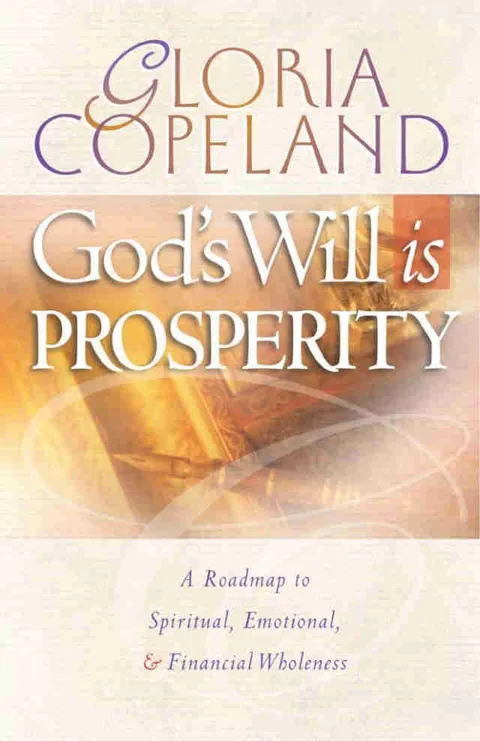
In "God's Will is Prosperity," Gloria Copeland argues that it is God's desire for all believers to experience prosperity in all areas of their lives. She challenges readers to have faith, speak positive words, and take action to achieve abundance and success. Copeland uses biblical principles and personal testimonies to support her message that God wants his followers to be wealthy and prosperous.
Steven Curtis Chapman
Steven Curtis Chapman is an American Christian musician, singer, song writer, record producer, actor, author and social activist. He is the only artist in the history of music to have won 56 Gospel Music Association Dove Awards and is also a proud receiver of 5 Grammy Awards. His music is known for being a unique cross between country music, soft rock and orchestrated pop, which made him a prominent artist in the contemporary Christian music circuit of the 1980s. Chapman grew up in a humble environment where he found his calling for music, owing to his fatherâs inclination towards country music. He learnt to play instruments like guitar and piano just by hanging around in his fatherâs music store, listening to him play along with his friends. He took up music seriously when he moved to Nashville and got recognized by Sparrow Records, a company he stayed with for a long period in his career. He has released 19 studio albums and has sold over 10 million albums until now. Chapman is a family oriented person just like his father and has a big family comprising of his wife Mary Beth and 3 biological and 2 adopted children. He is a vocal advocate for adoption and has worked socially to eradicate the problem of youth violence.
Childhood & Early Life
Steven Curtis Chapman was born on November 21, 1962 in Paducah, Kentucky, to Herb and Judy Chapman. His father was a country singer and songwriter, who turned down opportunities to become a successful singer to concentrate on his family. His mother was a stay-at-home mom.
His father owned a music store, a business he managed from his basement and used to play music with his friends. Such creative environment at home influenced Chapmanâs life from very early on and he bought his first guitar at 6.
Chapman joined as a pre-med student at Georgetown College in Kentucky but after few semesters he moved to Anderson College, Indiana. But he ultimately dropped the idea of studying and went to Nashville to pursue his first love, music.
During 1980s, he wrote a song âBuilt to Lastâ, which gained huge popularity after getting recorded by a gospel group âThe Imperialsâ. The success of the song fetched Chapman a songwriting deal with Sparrow Records.
Career
Chapmanâs first official album âFirst Handâ was released in 1987. The album was an instant hit with singles like âWeak Daysâ and topped at number 2 on the Contemporary Christian Music chart. The album had a mix of country music with soft rock and pop.
In 1988, following the success of his first album, Chapman released âReal Life Conversationsâ. Its hit single âHis Eyesâ received the âContemporary Recorded Song of the Yearâ award from the âGospel Music Associationâ. He co-wrote it with James Isaac Elliot.
After a few years, he made a swift turn to mainstream music with his album âThe Great Adventureâ in 1992. It earned him two Grammy awards for the album and for the title song of the album.
After gaining consistent success with albums like âHeaven in the Real World (1994), âSigns of Life (1996) and âSpeechless (1999), Chapmanâs next great album âDeclarationâ came out in 2001, for which he toured 70 cities.
In 2003, âAll About Loveâ was released and it ranked at Top 15 on the Christian Music charts. It was released under Sparrow Records and Chapman very humbly credited his wife Mary Beth for being the inspiration for his album.
âAll Things Newâ was released in 2004 and the album added another Grammy to Chapmanâs proud award collection. This time he received it in the category of Best Pop/Contemporary Gospel Album. It was also nominated for the Dove Award.
In 2005, âAll I Really Want for Christmasâ was released, which was Chapmanâs another successful Christmas album after âThe Music of Christmasâ. It had traditional holiday tunes and favorites like âGo Tell It on the Mountainâ and Silver Bellsâ.
Chapman took his music to greater levels by taking his concert to South Korea for the U.S. troops who were serving there in 2006. It was the first Christian concert that ever performed for the American army in that country.
In 2007, he released âThis Momentâ which included hit singles like âCinderellaâ, for which he was chosen for WOW Hits 2009. He also went on his âWinter Jamâ tour and took his sonsâ, Caleb and Willâs band along.
âBeauty Will Riseâ, Chapmanâs seventeenth album, was released in 2009. It is said that he wrote the songs of the album after getting inspired by his daughter Maria Sueâs sad and untimely demise. It included songs like âMeant to Beâ and âRe:creationâ.
In 2012, Chapman finally parted ways with Sparrow Records, the record company that he remained loyal to for so many years. He was signed on by Sonyâs Provident Label Group and came out with a Christmas album called âJOYâ.
âThe Glorious Unfoldingâ was released in 2013 under Reunion Records and it peaked on number 27 on the Billboard 200 and was number 1 Top Christian Album. The album was produced by Chapman himself and Brent Milligan.
Major Works
Chapmanâs âThe Great Adventureâ in 1992 was a turning point in his musical career because until now he was making soft and contemporary country music but with âThe Great Adventureâ he targeted the mainstream audience and tasted huge commercial success for the first time.
Awards & Achievements
Chapman is the winner of five Grammy awards for albums like âFor the Sake of the Callâ âThe Great Adventureâ âThe Live Adventureâ, âSpeechlessâ and âAll Things Newâ. He has also received 56 Gospel Music Association Dove Awards, more than any other artist.
Personal Life & Legacy
Chapman got married to Mary Beth in 1984 after they first met at Anderson University in Indiana. They have three biological children: Emily, Caleb and Will and three adopted children: Shaohannah, Stevey and Maria, together.
In 2008, Chapmanâs youngest son Will ran over his car by accident on his adopted daughter Maria Sue Chunxi Chapman. She was running towards him to meet him but he did not see her and she was pronounced dead on arrival at the hospital.
Trivia
Chapmanâs wife Mary Beth Chapman has written and released a book about losing her youngest daughter called âChoosing to SEE: A Journey of Struggle and Hopeâ.
Chapman and his wife have written three children's books with adoption themes: âShaoey And Dot: Bug Meets Bundleâ (2004), âShaoey and Dot: The Christmas Miracleâ (2005), and âShaoey and Dot: A Thunder and Lightning Bug Storyâ (2006).
He has received an Honorary Doctorate of Music from Anderson University.
Death Is Not the End
âAnd they lived happily ever after. The end.â Thatâs a common way to end a story that begins âOnce upon a time.â We call those stories fairy tales. Fairy tales are imaginary stories for children, filled with magic and with fanciful people and places. We love a good fairy tale because it echoes the real story of the Bible. God has wired us to love stories that resolve â stories that end with not only justice but with exuberant joy. âGod will transform your natural, earthly body into a supernatural, heavenly body.â This conviction was held by two friends who wrote some of the most iconic fiction of the twentieth century: C.S. Lewis and J.R.R. Tolkien. After the great battle at the end of Lewisâs Chronicles of Narnia, the characters discover that the new Narnia has been their real country the whole time, and they have nothing left now but to travel further up and further in. Tolkien, in Lord of the Rings, enlists Sam Gamgee to ask, after the ring has been destroyed, whether everything sad would come untrue. Tolkien even coined a term for a sudden happy turn in the story toward this blissful resolve: eucatastrophe. We can summarize the story line of the Bible as âKill the dragon, and get the girl.â That joyful resolution is what the final two phrases of the Apostlesâ Creed capture: âthe resurrection of the bodyâ and âthe life everlasting.â Resurrection of the Body God will raise the corpses of Christians. That is the main point of 1 Corinthians 15, the Bibleâs most famous passage on the resurrection of believers. âHow can some of you say,â Paul asks the Corinthians, âthat there is no resurrection of the dead?â (1 Corinthians 15:12). The Corinthians believed that God resurrected Christ (1 Corinthians 15:1â2, 4, 11), but some of them denied that God will resurrect the corpses of Christians. âResurrectionâ translates the Greek word anastasis (1 Corinthians 15:12â13, 21, 42), which does not ambiguously refer to âlife after death,â as if it could be a non-bodily existence. It specifically refers to bodily life after a person has died. The idea that God would resurrect a human corpse revolted Greco-Roman pagans (Acts 17:32). They believed that the material body has no future beyond the grave and that only the immaterial soul is immortal. They valued the soul over the physical body. Consequently, some applied that philosophy to ethics â namely, that what you do now in your physical body does not matter (1 Corinthians 15:32â34). So, Paul corrects the Corinthians who had adopted worldly assumptions about resurrection from their pagan culture. He asserts that God will certainly resurrect the corpses of believers (1 Corinthians 15:12â34). Such a belief is reasonable given two analogies from nature: seeds that die and rise to life, and different kinds of bodies, like the sun and the moon, heavenly and earthly (1 Corinthians 15:35â44). He argues that the analogy of Adam and Christ proves that resurrecting the corpses of believers is certain (1 Corinthians 15:45â49). Finally, he writes that God must transform the perishable, mortal bodies of dead and living believers into imperishable, immortal bodies to triumphantly defeat death (1 Corinthians 15:50â58). God created a material universe. He created humans with physical bodies. Jesus took on flesh and will have his physical, resurrected body forever. God will transform the current physical earth into a new and better one. And God will transform your natural, earthly body into a supernatural, heavenly body. ââThe life everlastingâ is so glorious and satisfying because we get to enjoy the triune God more and more. Forever!â That is wonderful news for us believers in earthly bodies, because our bodies are deteriorating and groaning (1 Corinthians 15:42â44; Romans 8:18â25). Your earthly body is perishable, but your heavenly body will be âimperishableâ (1 Corinthians 15:42, 50, 52â54). Christâs resurrection guarantees that death will die. So, we look forward to enjoying a supernatural body like Christâs resurrected body: âOur citizenship is in heaven, and from it we await a Savior, the Lord Jesus Christ, who will transform our lowly body to be like his glorious body, by the power that enables him even to subject all things to himselfâ (Philippians 3:20â21). Life Everlasting All humans will exist forever, but only some will enjoy what the Apostlesâ Creed calls âthe life everlasting.â That refers specifically to the resurrection life of the age to come, which believers experience in some measure now (John 3:15; 17:3). We will fully experience âthe life everlastingâ after Jesus says to each of us, âWell done, good and faithful servant. . . . Enter into the joy of your masterâ (Matthew 25:23). In his book God Is the Gospel, John Piper asks a piercing question, If you could have heaven, with no sickness, and with all the friends you ever had on earth, and all the food you ever liked, and all the leisure activities you ever enjoyed, and all the natural beauties you ever saw, all the physical pleasures you ever tasted, and no human conflict or any natural disasters, could you be satisfied with heaven, if Christ were not there? (15) The gospel is good news not merely because God will rescue us from hell and because we can enjoy the pleasures of heaven. It is good news ultimately because we can enjoy God himself like we never could in our shackles of sin. âThe life everlastingâ is so glorious and satisfying because we get to enjoy the triune God more and more. Forever! We can experience now what David wrote in Psalm 16:11, You make known to me the path of life; in your presence there is fullness of joy; at your right hand are pleasures forevermore. We long for the resurrection of the body and the life everlasting because then we will eternally and increasingly experience Psalm 16:11 like never before. Only the Beginning In C.S. Lewisâs The Last Battle (the seventh and final book of The Chronicles of Narnia), Aslan explains, âThe term is over: the holidays have begun. The dream is ended: this is the morning.â Lewis continues, And as He spoke He no longer looked to them like a lion; but the things that began to happen after that were so great and beautiful that I cannot write them. And for us this is the end of all the stories, and we can most truly say that they all lived happily ever after. But for them it was only the beginning of the real story. All their life in this world and all their adventures in Narnia had only been the cover and the title page: now at last they were beginning Chapter One of the Great Story which no one on earth has read: which goes on forever: in which every chapter is better than the one before. (210â11) âThe endâ of the story of the Bible is âthe beginning of a never-ending, ever-increasing happiness in the hearts of the redeemed, as God displays more and more of his infinite and inexhaustible greatness and glory for the enjoyment of his peopleâ (Desiring God: An Affirmation of Faith 14.3). For now, we need not fear death. Indeed, we should be able to say with the apostle Paul, âMy desire is to depart and be with Christ, for that is far betterâ (Philippians 1:23). And if it is far better even now than remaining in a natural, earthly, non-glorified body, it will be far better still to experience the resurrection of the body and the life everlasting with Christ in the new heavens and new earth. So, we pray, âNow to him who is able to keep [us] from stumbling and to present [us] blameless before the presence of his glory with great joy, to the only God, our Savior, through Jesus Christ our Lord, be glory, majesty, dominion, and authority, before all time and now and forever. Amenâ (Jude 24â25). Article by Andy Naselli Professor, Bethlehem College & Seminary