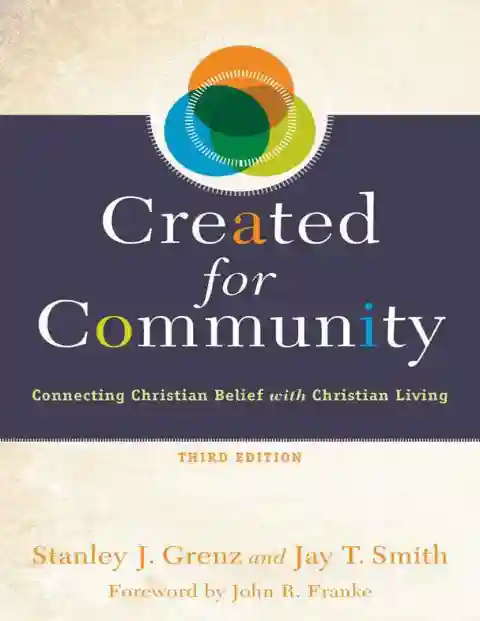

Created For Community - Connecting Christian Belief With Christian Living Order Printed Copy
- Author: Stanley J. Grenz, Jay T. Smith
- Size: 2.89MB | 374 pages
- |
Others like created for community - connecting christian belief with christian living Features >>

The Consecrated Way To Christian Perfection
_by__A.B.%20Bruce_-160.webp)
Training Of The Twelve (Principles For Christian Leadership)

Basic Elements Of The Christian Life Vol II

Unbroken Curses: Hidden Source Of Trouble In The Christian’s Life

Seated In Heavenly Places

The Torch And The Sword

How To Pass God's Test

Who Am I: Identity In Christ

The Problem Of Pain
-1-160.webp)
Shifting Shadows Of Supernatural Power: A Prophetic Manual For Those Wanting To Move In God's Supernatural Power
About the Book
"Created For Community" explores the relationship between Christian belief and Christian living, emphasizing the importance of community in the life of believers. The authors argue that Christianity is not just a set of beliefs, but a way of living in community with others. They offer practical advice on how to cultivate and maintain meaningful relationships within the church, demonstrating that true spirituality is found in loving and serving others.
John Owen

Romance After Kids
“Romance is the privilege of the rich, not the profession of the unemployed,” wrote Oscar Wilde. “The poor should be practical and prosaic.” I can partially relate to this sentiment. While I am not, in any estimation, to be numbered among the financially poor, I may be considered more impoverished in the currencies of independence and time. I am a father of five. My wife is currently recovering from COVID-19, and we are rounding out our second extended quarantine of the last two months. And in the last few days, two of our children’s stomachs have decided to expel their contents. Our world orbits around need; and needs call for a more practical and prosaic season of life that all but excludes the possibility of romance, right? Quality time — undistracted and full of energy — seems like the privilege of the bourgeois. But is it? Should we pause romance in this season? Should we simply acknowledge that we are shoulder-to-shoulder, not face-to-face, as we battle for the kindness and cleanliness of our kids? Why Romance Is Worth Pursuing I don’t believe we should pause romance in the demanding and chaotic world of parenting. Consider at least three reasons why. First, delight in beauty is the sustaining substance of life. The battlefield of child-rearing is not for the faint of heart. Without consistent moments to be refueled together by the beauty of God in his creation (I’m thinking Psalm 19-style sunrises and sunsets, rich flavors, unforgettable melodies, and especially the divine image in each other), we will succumb to fatigue and forget why we’re raising the children to begin with. Second, children need their parents’ affection for each other. God created parenting to be a completion of joy, an overflow of it. It is a Trinitarian image, whereby the mutual delight of the parents spills itself into creation. To quote thirteenth-century theologian Meister Eckhart (speaking in human terms and however imprecisely), “God laughed and begot the Son. Together they laughed and begot the Holy Spirit. And from the laughter of the Three, the universe was born.” The nourishing and cherishing of Ephesians 5 doesn’t simply transfer to your children. “No one ever hated his own flesh, but nourishes and cherishes it, just as Christ does the church” (Ephesians 5:29) — I am convicted as I type. Spouses (with a special emphasis on husbands) are called to invest deeply into one another, with the nourishing and cherishing of one’s own body, implying more than mere functional living or co-laboring. “Cherish,” after all, is not a prosaic word. It is infused with deep delight, the kind of word husbands search for to express their affection in a poem or song. Practical Advice for Married Couples So, let’s get practical (but not prosaic). What might romance look like in the season of survival on the Serengeti that is parenting? What follows is a list that mingles my own successes, failures, sin, and idealism, ranging from the mundane to the magical. Okay, mostly mundane. Most of it lives miles from a gondola in Venice, but placed on the battle for the souls of your children, every intentional face-to-face moment really helps. Take what helps. 1. Wake up together. Most husbands need less sleep than their wives, but trying to coordinate either sleep or wake time can be good for your marriage. For us, it’s been wake time most recently. We get up most mornings before the kids are stirring. Yes, it’s dark. It feels like the middle of the night (because it is) and our eyes are bleary. But the world is quiet and we rehearse the mercies of God out loud to one another, and of course to him, as we paraphrase the Psalms. We directly thank him for the undeserved gift of one another — boom, romance. 2. Take a few minutes to connect. This must be intentional, and it usually can’t be during dinner. Dinner is a wonderful opportunity to shepherd your children, but in most larger families, it is likely too chaotic to be a face-to-face moment with a spouse. The moment I’m speaking of is right after the kids are in bed. The reason it must be intentional is that you are likely drifting into a trance of fatigue, and some form of unwinding seeks your attention. But so does your spouse’s soul. And to turn to one another, without the television on or the phone in hand, and simply say, “Tell me about your day,” is fresh wind for your marriage. I might even recommend a few fun questions to pull from a hat in order to engage one another with more intrigue and substance. 3. Play. After ten o’clock on most nights, my wife loses much of her filter to weariness and goes into full sass mode. She throws playful jabs my way and laughs until she cries, and I tend to amplify her delight with my over-the-top responses. It would probably look to the outsider like two middle school kids flirting, but it is an ironic display of marital safety and affection that is probably indispensable in this season. I would be hard-pressed to overstate the value of humor as a means of romantic connection. 4. Write to one another. Even if you say you’re not a “words of affirmation” person, you are more than you realize. Your spouse is too. And when the words are written rather than simply spoken, they affect us powerfully. I think it’s because those words reflect deeper thought, deeper consideration, and deeper investment of time than something more spontaneous. That’s why a text message stating affection is good, but a sonnet is better. Or even a limerick if you’re not into iambic pentameter. 5. Get out into creation. The heavens declare the romantic heart of God. The sun exclaims the joy and love of the Bridegroom (Psalm 19:1–5). A breeze whispers his gentleness, and the autumn leaves remind us of the beauty of Christ’s death. It doesn’t take the reservation of an Airbnb in Montana to engage the created world together. We sat on the back porch for a few minutes this week and marveled at the sudden bright yellows of the leaves behind the house. Consistent peeks outside or regular walks around the neighborhood, especially hand in hand, can bring peace to chaos. Speaking of hand in hand . . . 6. Show physical affection. Keep holding hands in public. Or start holding hands in public. Half-mindlessly rub her back while you’re sitting on the couch. Don’t let the heckling of your teenagers keep you from a spontaneous hug in the kitchen. There was a moment, likely when you were dating, when the brush of your now-spouse’s hand was electric. The same desire, albeit without the giddiness, still resides in you. Touch is connection, and connection between two desire-laden, God-imaging souls is at the heart of romance. 7. Recall the wonders of God in your family’s life. This is a clear command and practice in Scripture (see Psalm 136), and it is a poetic moment when practiced well. It ought to be a normative part of your prayer life, but we find it helpful to also formalize the practice. Each year on our anniversary, we pull out a journal and jog our memories about all the big events and sweet moments of the previous year. It is a connecting moment of sentiment, laughter, and gratitude. 8. Get away and dream. This is a privilege that not all parents have the resources to enact. It requires willing babysitters (often family because of the sizable commitment) and sometimes money. We went three years without a night away at one point. And again, it doesn’t have to be in some exotic bungalow in Fiji. But one of our fonder marital memories was a simple switching of houses with my parents for a night so that we could come out of the winds and talk uninterruptedly about what the Lord might have for our future. 9. Play music. I don’t mean that you need to turn your family into the Von Trapps. If anyone in your family can conjure a melody with voice or violin, all the better, but I am here referring to a simple song in the background. Whether it’s a hymn (Indelible Grace gets a lot of air time in our household), a soundtrack, or a beat to dance to, music awakens the soul. It allows easier access to emotion and meaning in the mundane moments. Use the gift of Spotify or a phonograph. 10. Speak the delights of God to your spouse. While this is an admittedly shoulder-to-shoulder activity (since your collective gaze is elsewhere), it is akin to watching a sunset or a play, only with deeper relational weight. After all, you are fostering the romance between your spouse and the true Bridegroom. To speak the wonders of God’s holiness, his fatherly delight, and the wonders of his love, is to kindle the soul. So don’t just memorize Scripture. Memorize it in order to tell her of the dimensions of the love of Christ, and so fill her with the fullness of God (Ephesians 3:19). Life, even the life of a child-chasing parent, is magical. And marriage, even the mostly shoulder-to-shoulder kind that is stretched to its limit by fatigue and chaos, is still a picture of Christ and the church. Ask your heavenly Bridegroom for eyes to see that afresh and the energy to enact a bit of intentional romance. Article by Matt Reagan