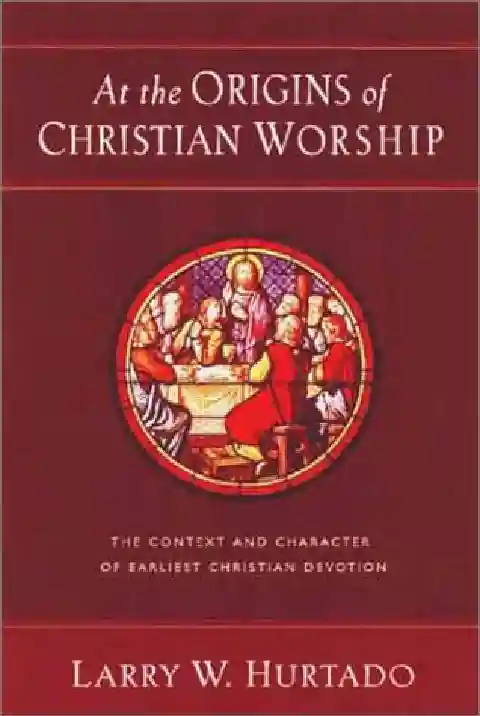

At The Origins Of Christian Worship Order Printed Copy
- Author: Larry W. Hurtado
- Size: 598KB | 151 pages
- |
Others like at the origins of christian worship Features >>
The Coming Of God's Kingdom
An Exposition Of The Seven Church Ages
Truth And The New Kind Of Christian
The Canon Of Scripture

Manual Of Christian Doctrine
%20(Library%20of%20Christian%20Classics)%20by%20John%20Calvin-160.webp)
Library Of Christian Classics
An Outline Of The Christian Faith

A Testimony Of Jesus Christ: A Commentary On The Book Of Revelation, Vol. 2

A Testimony Of Jesus Christ: A Commentary On The Book Of Revelation, Vol. 1
Supremacy Of Christ In A Post Modern World
About the Book
"At the Origins of Christian Worship" by Larry W. Hurtado examines the early development of Christian worship practices and the ways in which they shaped the theology and beliefs of the early church. Hurtado explores the transition from Jewish to Christian forms of worship, the central role of Jesus in Christian liturgy, and the impact of worship on the identity and mission of the early Christian community. Overall, the book provides valuable insights into the foundational aspects of Christian worship and their significance for the development of the early church.
Steven Curtis Chapman
 Steven Curtis Chapman is an American Christian musician, singer, song writer, record producer, actor, author and social activist. He is the only artist in the history of music to have won 56 Gospel Music Association Dove Awards and is also a proud receiver of 5 Grammy Awards. His music is known for being a unique cross between country music, soft rock and orchestrated pop, which made him a prominent artist in the contemporary Christian music circuit of the 1980s. Chapman grew up in a humble environment where he found his calling for music, owing to his father’s inclination towards country music. He learnt to play instruments like guitar and piano just by hanging around in his father’s music store, listening to him play along with his friends. He took up music seriously when he moved to Nashville and got recognized by Sparrow Records, a company he stayed with for a long period in his career. He has released 19 studio albums and has sold over 10 million albums until now. Chapman is a family oriented person just like his father and has a big family comprising of his wife Mary Beth and 3 biological and 2 adopted children. He is a vocal advocate for adoption and has worked socially to eradicate the problem of youth violence.
Childhood & Early Life
Steven Curtis Chapman was born on November 21, 1962 in Paducah, Kentucky, to Herb and Judy Chapman. His father was a country singer and songwriter, who turned down opportunities to become a successful singer to concentrate on his family. His mother was a stay-at-home mom.
His father owned a music store, a business he managed from his basement and used to play music with his friends. Such creative environment at home influenced Chapman’s life from very early on and he bought his first guitar at 6.
Chapman joined as a pre-med student at Georgetown College in Kentucky but after few semesters he moved to Anderson College, Indiana. But he ultimately dropped the idea of studying and went to Nashville to pursue his first love, music.
During 1980s, he wrote a song ‘Built to Last’, which gained huge popularity after getting recorded by a gospel group ‘The Imperials’. The success of the song fetched Chapman a songwriting deal with Sparrow Records.
Career
Chapman’s first official album ‘First Hand’ was released in 1987. The album was an instant hit with singles like ‘Weak Days’ and topped at number 2 on the Contemporary Christian Music chart. The album had a mix of country music with soft rock and pop.
In 1988, following the success of his first album, Chapman released ‘Real Life Conversations’. Its hit single ‘His Eyes’ received the ‘Contemporary Recorded Song of the Year’ award from the ‘Gospel Music Association’. He co-wrote it with James Isaac Elliot.
After a few years, he made a swift turn to mainstream music with his album ‘The Great Adventure’ in 1992. It earned him two Grammy awards for the album and for the title song of the album.
After gaining consistent success with albums like ‘Heaven in the Real World (1994), ‘Signs of Life (1996) and ‘Speechless (1999), Chapman’s next great album ‘Declaration’ came out in 2001, for which he toured 70 cities.
In 2003, ‘All About Love’ was released and it ranked at Top 15 on the Christian Music charts. It was released under Sparrow Records and Chapman very humbly credited his wife Mary Beth for being the inspiration for his album.
‘All Things New’ was released in 2004 and the album added another Grammy to Chapman’s proud award collection. This time he received it in the category of Best Pop/Contemporary Gospel Album. It was also nominated for the Dove Award.
In 2005, ‘All I Really Want for Christmas’ was released, which was Chapman’s another successful Christmas album after ‘The Music of Christmas’. It had traditional holiday tunes and favorites like ‘Go Tell It on the Mountain’ and Silver Bells’.
Chapman took his music to greater levels by taking his concert to South Korea for the U.S. troops who were serving there in 2006. It was the first Christian concert that ever performed for the American army in that country.
In 2007, he released ‘This Moment’ which included hit singles like ‘Cinderella’, for which he was chosen for WOW Hits 2009. He also went on his ‘Winter Jam’ tour and took his sons’, Caleb and Will’s band along.
‘Beauty Will Rise’, Chapman’s seventeenth album, was released in 2009. It is said that he wrote the songs of the album after getting inspired by his daughter Maria Sue’s sad and untimely demise. It included songs like ‘Meant to Be’ and ‘Re:creation’.
In 2012, Chapman finally parted ways with Sparrow Records, the record company that he remained loyal to for so many years. He was signed on by Sony’s Provident Label Group and came out with a Christmas album called ‘JOY’.
‘The Glorious Unfolding’ was released in 2013 under Reunion Records and it peaked on number 27 on the Billboard 200 and was number 1 Top Christian Album. The album was produced by Chapman himself and Brent Milligan.
Major Works
Chapman’s ‘The Great Adventure’ in 1992 was a turning point in his musical career because until now he was making soft and contemporary country music but with ‘The Great Adventure’ he targeted the mainstream audience and tasted huge commercial success for the first time.
Awards & Achievements
Chapman is the winner of five Grammy awards for albums like ‘For the Sake of the Call’ ‘The Great Adventure’ ‘The Live Adventure’, ‘Speechless’ and ‘All Things New’. He has also received 56 Gospel Music Association Dove Awards, more than any other artist.
Personal Life & Legacy
Chapman got married to Mary Beth in 1984 after they first met at Anderson University in Indiana. They have three biological children: Emily, Caleb and Will and three adopted children: Shaohannah, Stevey and Maria, together.
In 2008, Chapman’s youngest son Will ran over his car by accident on his adopted daughter Maria Sue Chunxi Chapman. She was running towards him to meet him but he did not see her and she was pronounced dead on arrival at the hospital.
Trivia
Chapman’s wife Mary Beth Chapman has written and released a book about losing her youngest daughter called ‘Choosing to SEE: A Journey of Struggle and Hope’.
Chapman and his wife have written three children's books with adoption themes: ‘Shaoey And Dot: Bug Meets Bundle’ (2004), ‘Shaoey and Dot: The Christmas Miracle’ (2005), and ‘Shaoey and Dot: A Thunder and Lightning Bug Story’ (2006).
He has received an Honorary Doctorate of Music from Anderson University.
Steven Curtis Chapman is an American Christian musician, singer, song writer, record producer, actor, author and social activist. He is the only artist in the history of music to have won 56 Gospel Music Association Dove Awards and is also a proud receiver of 5 Grammy Awards. His music is known for being a unique cross between country music, soft rock and orchestrated pop, which made him a prominent artist in the contemporary Christian music circuit of the 1980s. Chapman grew up in a humble environment where he found his calling for music, owing to his father’s inclination towards country music. He learnt to play instruments like guitar and piano just by hanging around in his father’s music store, listening to him play along with his friends. He took up music seriously when he moved to Nashville and got recognized by Sparrow Records, a company he stayed with for a long period in his career. He has released 19 studio albums and has sold over 10 million albums until now. Chapman is a family oriented person just like his father and has a big family comprising of his wife Mary Beth and 3 biological and 2 adopted children. He is a vocal advocate for adoption and has worked socially to eradicate the problem of youth violence.
Childhood & Early Life
Steven Curtis Chapman was born on November 21, 1962 in Paducah, Kentucky, to Herb and Judy Chapman. His father was a country singer and songwriter, who turned down opportunities to become a successful singer to concentrate on his family. His mother was a stay-at-home mom.
His father owned a music store, a business he managed from his basement and used to play music with his friends. Such creative environment at home influenced Chapman’s life from very early on and he bought his first guitar at 6.
Chapman joined as a pre-med student at Georgetown College in Kentucky but after few semesters he moved to Anderson College, Indiana. But he ultimately dropped the idea of studying and went to Nashville to pursue his first love, music.
During 1980s, he wrote a song ‘Built to Last’, which gained huge popularity after getting recorded by a gospel group ‘The Imperials’. The success of the song fetched Chapman a songwriting deal with Sparrow Records.
Career
Chapman’s first official album ‘First Hand’ was released in 1987. The album was an instant hit with singles like ‘Weak Days’ and topped at number 2 on the Contemporary Christian Music chart. The album had a mix of country music with soft rock and pop.
In 1988, following the success of his first album, Chapman released ‘Real Life Conversations’. Its hit single ‘His Eyes’ received the ‘Contemporary Recorded Song of the Year’ award from the ‘Gospel Music Association’. He co-wrote it with James Isaac Elliot.
After a few years, he made a swift turn to mainstream music with his album ‘The Great Adventure’ in 1992. It earned him two Grammy awards for the album and for the title song of the album.
After gaining consistent success with albums like ‘Heaven in the Real World (1994), ‘Signs of Life (1996) and ‘Speechless (1999), Chapman’s next great album ‘Declaration’ came out in 2001, for which he toured 70 cities.
In 2003, ‘All About Love’ was released and it ranked at Top 15 on the Christian Music charts. It was released under Sparrow Records and Chapman very humbly credited his wife Mary Beth for being the inspiration for his album.
‘All Things New’ was released in 2004 and the album added another Grammy to Chapman’s proud award collection. This time he received it in the category of Best Pop/Contemporary Gospel Album. It was also nominated for the Dove Award.
In 2005, ‘All I Really Want for Christmas’ was released, which was Chapman’s another successful Christmas album after ‘The Music of Christmas’. It had traditional holiday tunes and favorites like ‘Go Tell It on the Mountain’ and Silver Bells’.
Chapman took his music to greater levels by taking his concert to South Korea for the U.S. troops who were serving there in 2006. It was the first Christian concert that ever performed for the American army in that country.
In 2007, he released ‘This Moment’ which included hit singles like ‘Cinderella’, for which he was chosen for WOW Hits 2009. He also went on his ‘Winter Jam’ tour and took his sons’, Caleb and Will’s band along.
‘Beauty Will Rise’, Chapman’s seventeenth album, was released in 2009. It is said that he wrote the songs of the album after getting inspired by his daughter Maria Sue’s sad and untimely demise. It included songs like ‘Meant to Be’ and ‘Re:creation’.
In 2012, Chapman finally parted ways with Sparrow Records, the record company that he remained loyal to for so many years. He was signed on by Sony’s Provident Label Group and came out with a Christmas album called ‘JOY’.
‘The Glorious Unfolding’ was released in 2013 under Reunion Records and it peaked on number 27 on the Billboard 200 and was number 1 Top Christian Album. The album was produced by Chapman himself and Brent Milligan.
Major Works
Chapman’s ‘The Great Adventure’ in 1992 was a turning point in his musical career because until now he was making soft and contemporary country music but with ‘The Great Adventure’ he targeted the mainstream audience and tasted huge commercial success for the first time.
Awards & Achievements
Chapman is the winner of five Grammy awards for albums like ‘For the Sake of the Call’ ‘The Great Adventure’ ‘The Live Adventure’, ‘Speechless’ and ‘All Things New’. He has also received 56 Gospel Music Association Dove Awards, more than any other artist.
Personal Life & Legacy
Chapman got married to Mary Beth in 1984 after they first met at Anderson University in Indiana. They have three biological children: Emily, Caleb and Will and three adopted children: Shaohannah, Stevey and Maria, together.
In 2008, Chapman’s youngest son Will ran over his car by accident on his adopted daughter Maria Sue Chunxi Chapman. She was running towards him to meet him but he did not see her and she was pronounced dead on arrival at the hospital.
Trivia
Chapman’s wife Mary Beth Chapman has written and released a book about losing her youngest daughter called ‘Choosing to SEE: A Journey of Struggle and Hope’.
Chapman and his wife have written three children's books with adoption themes: ‘Shaoey And Dot: Bug Meets Bundle’ (2004), ‘Shaoey and Dot: The Christmas Miracle’ (2005), and ‘Shaoey and Dot: A Thunder and Lightning Bug Story’ (2006).
He has received an Honorary Doctorate of Music from Anderson University.
Will You Lose Your Faith in College
Will you keep your faith in college? Odds are you won’t, at least according to Barna Research. Barna estimates that roughly 70% of high school students who enter college as professing Christians will leave with little to no faith. These students usually don’t return to their faith even after graduation, as Barna projects that 80% of those reared in the church will be “disengaged” by the time they are 29. Will you be one of the 80%? Will you abandon your faith when surrounded by peers who don’t know God? Most people assume their early faith will carry them through their lives. King Joash probably did. He began to reign at age 7 (2 Chronicles 24:1), and he “did what was right in the eyes of the Lord all the days of Jehoiada the priest” (2 Chronicles 24:2), King Joash’s mentor and most trusted advisor. When Jehoiada was alive, Joash faithfully followed God’s laws and made sure others did as well. He even inspired others to give joyfully to God: “All the princes and all the people rejoiced and brought their tax and dropped it into the chest until they had finished” (2 Chronicles 24:10). Joash’s faith certainly seemed genuine. Far Too Easily Swayed But when Jehoiada died, Joash turned to his peers. When the princes of Judah came to visit Joash soon after Jehoiada’s death, the king listened to them. After the princes “paid homage to the king” (2 Chronicles 24:17), which probably meant they flattered him, Joash abandoned the house of the Lord and turned to serve idols. These “friends” may have convinced him that they were open-minded and in touch with popular culture, and that Jehoiada had been too strict and old-fashioned. Joash listened to them and reversed all the good things he had done earlier, even murdering Jehoiada’s son Zechariah when he was questioned. This behavior seems like a shocking turnaround, but it shows that King Joash had likely been trusting in Jehoiada and not God. His faith was not his own. Since he lacked personal conviction, he was easily swayed by faithless people around him. God judged him for his wickedness and he was soon murdered by his own servants. Joash shows us that it doesn’t matter how well we start in the Christian life; it matters how we finish. For Freshmen and Seniors Many of us started strong. We assumed that if we were raised with the right values and involved in church, we would always stay faithful. I believed that. I had a passion for the Lord in high school and college, but as I immersed myself in my career, my church attendance became sporadic and my time with God infrequent and rushed. I found that the less time I spent with the Lord, the less I wanted to know him. My unbelieving coworkers were my closest friends. Originally, I hoped to share my faith with them, but instead they passed on their spiritual indifference to me. They had a subtle but profound influence on my priorities. As my faith was getting watered down, reading the Bible and going to church felt more legalistic than life-giving. It was only when I faced real suffering that my faith became important again. Whether you are a freshman or a senior, if you are heading off to college, you’re in a vulnerable place. It’s easy to assume you’ll develop better spiritual disciplines and get involved in Christian community later on. But as you juggle life’s challenges, it’s tempting to put off pursuing God until you feel more settled, unintentionally falling into the habits of lost people around you. The shift is gradual and often unnoticeable. Three Ways Not to Wander So, what can you do, with God’s help, to be one of the 20% raised in the church who remain faithful through college and into their twenties? First, don’t assume that you won’t drift away — or that if you do drift away, you will eventually come back. We are all vulnerable. Ask God daily for an enduring passion for him. Ask him to give you joy in him alone. Ask him right now to keep your heart from wandering. Second, stay closely connected to God. It may sound trite, or even legalistic, but reading the Bible and praying really are the simple keys to the Christian life. As you read, focus and pay attention rather than mindlessly skimming words to “check off the box.” I love using a Bible reading plan because it takes the guesswork out of what to read each morning. I recommend the Discipleship Journal plan. If you’re reading the Bible regularly for the first time, begin by just reading the New Testament sections each day. Try reading with a pen and paper, jotting down insights, questions, and observations, asking God to open your eyes to see truth and to breathe life into his words (Psalm 119:18). Third, find real Christian fellowship. Plug into a church and a small group or on-campus ministry. Intentionally make Christian friends and spend time with them. Having good Christian friends in college reduces the pressure to conform. The people around us influence us far more than we realize. King Joash is a vivid example of how easy it is to abandon your faith when surrounded by the wrong people. Makeshift Saints Charles Spurgeon, a London preacher in the 1800s, once said, Oh, what a sifter the city of London has been to many like Joash! Many do I remember whose story was like this: they had been to the house of God always . . . and everybody reckoned them to be Christians — and then they came to London. At first, they went . . . to some humble place where the gospel was preached. But after time they thought . . . they worked so hard all the week that they must go out a little into the fresh air on Sunday; and by degrees they found companions who led them, little by little, from the path of integrity and chastity, until the “good young man” was as vile as any on the streets of London; and he who seemed to be a saint, became not only a sinner, but the maker of sinners. None of us is immune from slowly drifting from God. As we see from King Joash’s life, even when we’ve lived an outwardly Christian life, it’s easy to start living like those around us. Yet those who truly know Christ cannot fall away. As 1 John 2:19 says, “If they had been of us, they would have continued with us.” Those who leave the faith never truly possessed it but, as John Calvin said, merely “had only a light and a transient taste of it.” Will You Fall Away? Will you fall away in college? You can fight the current, and hold fast to God. First, “Examine yourselves, to see whether you are in the faith. Test yourselves. Or do you not realize this about yourselves, that Jesus Christ is in you? — unless indeed you fail to meet the test!” (2 Corinthians 13:5). Ask yourself if Jesus is your treasure or if you are only borrowing the faith of those around you. If you have any doubt, commit yourself now to pursue Christ as hard as you pursue anything. But if you genuinely know the Lord, and see evidences of transforming grace in your life, don’t be afraid that you’ll fall away. He will hold you fast. He will strengthen you and help you. He will uphold you with his righteous right hand (Isaiah 41:10). If you are his, then you can be sure “that he who began a good work in you will bring it to completion at the day of Jesus Christ” (Philippians 1:6). Article by Vaneetha Rendall Risner