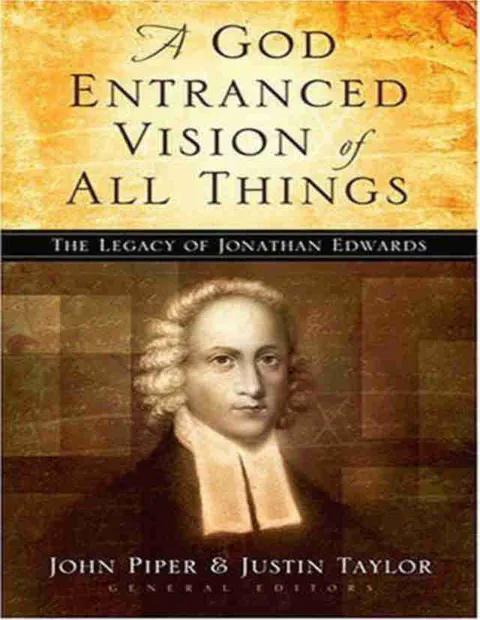

A God Entranced Vision Of All Things: The Legacy Of Jonathan Edwards Order Printed Copy
- Author: John Piper, Justin Taylor
- Size: 1.3MB | 394 pages
- |
Others like a god entranced vision of all things: the legacy of jonathan edwards Features >>

The Great Visions Of Ellen G White

The True History Of The Early Christian Church

God's Generals: A. A. Allen
-160.webp)
God's Generals (A. A. Allen)
-160.webp)
50 Women Every Christian Should Know: Learning From Heroines Of The Faith
-160.webp)
The Myth Of The Twelve Tribes Of Israel (New Identities Across Time And Space)

Just As I Am: The Autobiography Of Billy Graham
The Spirit Of Prophecy Volume 3
Missionary Travels

Dr. David Yonggi Cho
About the Book
"A God Entranced Vision of All Things: The Legacy of Jonathan Edwards" is a collection of essays by various authors that explores the life, thought, and impact of the theologian Jonathan Edwards. The book delves into Edwards' views on God, revival, happiness, and the Christian life, offering insights into his lasting influence on evangelical theology and spirituality.
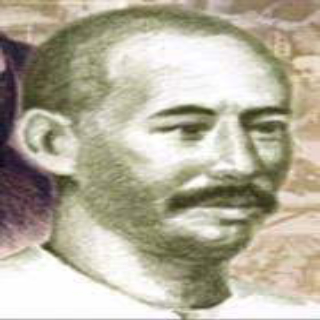
Xi Shengmo
What Cravings Will Take from You
We spend our lives with hands out and mouths open, looking for what we might consume. This is our experience as humans, in part because of how God designed us: we eat because our bodies require energy, and we reach with gentle affection for those we love out of a shared hunger for relationships. We’re born in need, and our desires, implanted by God himself (Acts 17:24–27), send us on a search for fullness of joy. Our desires, however, so easily turn into obsessions, leading us into wild over-consumption (James 4:1–3). Our desires become cravings, the ultimate pursuit and point of life itself. Rather than signals meant to send us off in exploration for the original source of joy (Psalm 16:11), they instead become taskmasters, demanding our undivided loyalty and taking our peace and joy right along with them. In our unchecked drive to consume, we ourselves become the ones consumed. My Primary (False) Allegiance When we don’t allow our desires to send us seeking fullness of joy from the source of all joy — God himself — we develop an allegiance to false kings. My primary false allegiance is to the love and admiration that come from other people. I crave validation, and I find myself performing for it like a circus animal. This is how I’ve come to know just how much I’ve allowed this false king to rule over me: the past few years have been brutal, full of confusion and emotional pain. Somewhere along the way, my heart, bowing before this false king, started aching for belonging. I started wondering if my presence mattered as a person and not as a performance. I started wondering if I was truly known. I started wondering if anyone might notice my need. My deep self-focus drew me further and further inside, and at some point I simply disengaged my heart. If I couldn’t have what I craved, I would not give of myself any longer. I began to look back at who I once was and how passionately I’d loved others, and I wanted so badly to be that person again. But I couldn’t manufacture love, and I started to believe that joy would never come again. My heart instead felt hard and apathetic, looking to be served, noticing every slight, envying the belonging of others. False Kings Only Take The trouble for an idolatrous heart (and the gift for the repentant heart) is that God will stubbornly interrupt and intercept our pursuit of joy as we seek it in anything less than him. He will not give us lasting peace in our false allegiances, because he is jealous for us to have the actual peace we’re pursuing. In those years of struggle, a chorus of people could have sung my praises, and it never would have settled as peace in my heart. Anytime a friend offered a word of encouragement, my mind immediately turned to panic: “What must I do to keep that love?” Or I’d think, “What about the one who didn’t voice encouragement? How do I win her over?” I was so hungry and thirsty that I was withering away, consumed by what I was trying to consume. False kings never give; they only take. Kings Who Take When the prophet Samuel was growing old, the Israelites worried about their future. Samuel had mediated for them well as both priest and prophet before God, but they needed a new leader, and humanly speaking, there were no options available. Samuel’s sons, the next sure thing for the nation, didn’t walk in the ways of the Lord, so the elders sought answers by looking around at how other nations were structured. They approached Samuel with their solution: “Now appoint for us a king to judge us like all the nations” (1 Samuel 8:5). At first glance, this doesn’t seem like such a bad request, but Scripture says it displeased Samuel, and it also displeased God, because the elders hadn’t thought to bring God into their calculations (1 Samuel 8:6–9). Did they not already have a King? They had, in effect, spurned the perfect rule of the One who’d delivered, provided for, led, and protected them, and they’d turned in their desire toward another option. They weren’t ready to reject God entirely. They just wanted him plus a safe, tangible plan B king like everyone else around them. Samuel’s response is a fair warning to us as well about plan B kings: they will only take from you. Samuel warns that a king appointed by people takes sons and sends them to war, takes children and turns them into slave labor, takes daughters into his service, and takes crops in order to feed his servants (1 Samuel 8:10–17). Samuel knows what false kings do: they take our best and then make us their slaves. Kingdoms with Two Kings We tend to believe the same as the Israelite elders: What will it hurt to have God and also hedge our bets a little? We want to believe we can pledge allegiance to King Jesus and also throw our heart to human kings or human things. But the Bible is plain: No one can serve two masters (Matthew 6:24). A divided kingdom cannot stand (Matthew 12:25). Jesus is our king, not merely a wise consultant we turn to when we need to know what to do. And as the Israelite leaders show us, a divided heart is actually not divided at all: it has already chosen sides. A divided heart is one that’s spurned God. We turn toward false kings who we think will give us comfort, security, belonging, approval, validation, love, sexual gratification — but in the end they only take. They promise life but give death. Consumed to Satisfy But God. Through Jesus Christ, he made a way for us out of this death spiral, giving us a direction to point our desires, providing something we can consume that doesn’t consume us in return. Jesus came saying, Repent and believe (Mark 1:15). His words were an invitation, a stretched-out hand, an open door for us to enter with him into the kingdom of God. Jesus came saying, This is my body, broken for you. This is my blood, poured out for you (Luke 22:19–20). Feed on me (John 6:51–58). Jesus was consumed by death precisely so that we would feast on him. This king is called Bread of Life (John 6:35) and Living Water (John 4:13–14), so we might know we can, in our hunger, eat, and in our thirst, drink. When we consume him, we find ourselves consuming his good rule, loving provision, and peaceful reign. We cannot reach the end of him, but in him we can certainly satisfy the longing underlying all of our desires: the longing for joy. The King Who Gives The Israelites placed a mirror before my heart, helping me see my false allegiances clearly. My actions were their actions: turning toward kings who couldn’t fulfill their promises. Like them, my desires and needs weren’t all wrong; what had been wrong was where I turned with them. I turned in repentance to Jesus and found joy again in allegiance to him. Do you have a need? A desire? Submit it totally to King Jesus. He doesn’t just require our allegiance, as if obedience is a form of punishment or something through which we grit our teeth. His demand of wholeheartedness is an invitation to receive what is his: the very kingdom (Matthew 5:3). He opens his treasury to us, sharing his peace, love, joy, life, and fruitfulness. And perhaps best of all, we receive his allegiance in return (Romans 8:38–39; Matthew 28:20; Hebrews 13:5). He is a king who gives. Article by Christine Hoover