
GIP Library icon

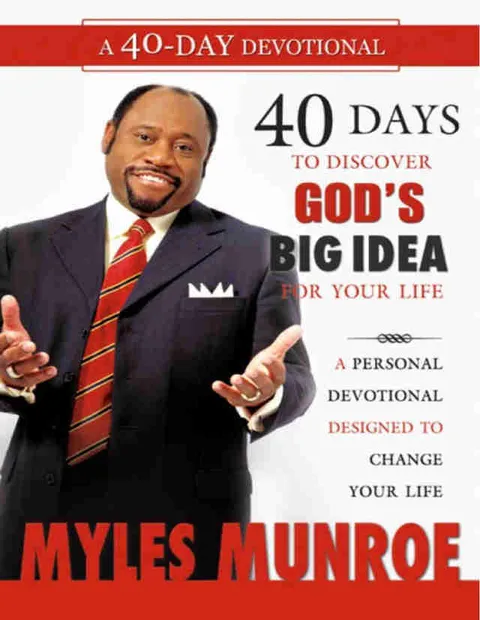
40 Days To Discovering God's Big Idea For Your Life 40 Days To Discovering God's Big Idea For Your Life

40 Days To Discovering God's Big Idea For Your Life Order Printed Copy

  • Author: Myles Monroe
  • Size: 765KB | 145 pages
  • |
Continue with
Google Twitter
LOG IN TO REVIEW
About the Book


In "40 Days to Discovering God's Big Idea for Your Life," Myles Monroe outlines a step-by-step process to help readers uncover their purpose and fulfill their potential. Through daily reflections and exercises, Monroe guides readers to connect with God's plan for their lives and live with intentionality and passion. The book offers practical advice and spiritual guidance to inspire readers to live a life aligned with their true calling.

Keith Green

Keith Green Born on October 21, 1953, in Sheepshead Bay, NY; died on July 28, 1982, in Lindale, TX; married Melody Steiner, 1973; children: Josiah (deceased), Keith, Bethany (deceased), Rebekah. Addresses: Record company--Sparrow Records, P.O. Box 5085, Brentwood, TN 37024. Website--Keith Green Official Website: http://www.lastdaysministries.org. Known for his uncompromising approach to both his faith and his music, Keith Green has become a legendary figure in Contemporary Christian music since his death in 1982. Taking on the role of a modern-day prophet, he earned a fervent following thanks to his explicit evangelical message and buoyant brand of pop-rock. Green was a critic both of secular society and of commercial tendencies within the Christian community. Since his passing, he has been the subject of several tribute albums and was inducted into the Gospel Music Hall of Fame in 2001. From early childhood onward, it seemed certain that Green would become a musician. Born in New York, he relocated to the San Fernando Valley area of California with his family not long after. At age eight, he began to perform in stage musicals, appearing in such notable roles as Kurt Von Trapp in a local production of The Sound of Music. In 1965 he published his first song, "The Way I Used to Be," and became the youngest member of the American Society of Composers, Authors, and Publishers. That same year he signed a five-year recording contract with Decca Records and released his first single, "Cheese and Crackers." Though Green was groomed to be a teenage idol, he never quite achieved success. The late 1960s found him experimenting with drugs and dabbling in various Eastern religions. His life began to turn around after he met (and eventually married) songwriter Melody Steiner in the early 1970s. Under Steiner's guidance, Green began to explore fundamentalist Christianity. Before fully embracing the faith, he began keeping company with singer/songwriters Larry Norman and Randy Stonehill, two of Southern California's best-known Christian rock artists. His skills as a singer and composer began to develop as he edged closer to religious conversion. Finally, in 1975 he became a committed Christian after becoming involved with the Vineyard, a well-known San Fernando Valley church. With a convert's fervor, Green became involved in a series of Christian music projects, including the band Good News and the stage musical Firewind. He also began writing spiritually themed songs, among them "Your Love Broke Through," which went on to become a Christian pop standard recorded by Randy Stonehill, Phil Keaggy, and others. Dedicating his reawakened creativity to glorifying God, Green founded Last Days Ministries in 1977. He and his followers evangelized to young rock music fans, street people, and others not being reached by conventional churches. At the same time, he made his debut as a Christian recording artist, signing with Sparrow Records and releasing the album For Him Who Has Ears to Hear. This song collection displays the essentials of Green's musical style: exuberant singing, piano-based melodies, and well-crafted pop/rock production. Among the best-known tracks on Green's first album are "You Put This Love in My Heart," "No One Believes Me Anymore," and "Your Love Broke Through." Balancing the warm-hearted testimony of these tunes are some humorous moments, including "No One Believes Me Anymore," a mock lament sung from the Devil's point of view. Overall, For Him Who Has Ears to Hear introduced Green to the Christian music market as a gifted musical evangelist of enormous potential. As his audience grew, Green made clear that his focus was on spreading Christian teaching rather than providing entertainment. He sought to challenge the assumptions of his fellow believers, criticizing Christians who took their faith for granted. Some compared him with the Old Testament prophet Ezekiel, who decried the loose morals and weak faith of his generation. A number of the songs on Green's 1978 album No Compromise were addressed to the spiritually lazy. Most important among these is "Asleep at the Light," a ringing call for Christian activism sung by Green with palpable emotion. Less intense but still effective is the playful "Dear John (Letter to the Devil)" and the country-tinged "Soften Your Heart." All three of these songs received considerable airplay on Christian music stations. Green was uneasy in his role as an emerging celebrity. He spoke out against the Christian music industry's increasing tendency to imitate secular show business ways. "Why do we idolize Christian singers and speakers?," he asked in a statement issued through Last Days Ministries. "We go from glorifying musicians in the world, to glorifying Christian musicians. It's all idolatry! ... It's true that there are many men and women of God who are greatly anointed to call down the Spirit of God on His people and the unsaved. But Satan is getting a great victory as we seem to worship these ministers on tapes and records...." Turning away from the California Christian music scene, Green relocated to Lindale, a small east Texas community, in 1978. In addition to maintaining Last Days Ministries, he decided to launch his own record company, Pretty Good Records. Through this label, he released his next album, So You Wanna Go Back to Egypt, in 1980. This eclectic effort pokes fun at weak-spirited believers in its title track and offers a personal confession of need in "I Want to Be More Like Jesus." The most enduringly popular track proved to be "Oh Lord You're Beautiful," a powerful hymn that became a favorite at Christian worship services. In a bold move, Green announced that So You Wanna Go Back to Egypt would be sold for a variable price, even given away for free to those unable to pay. This decision sent shock waves through the Christian music industry, causing other artists to reconsider their album and concert pricing policies. An estimated 200,000 copies of the album were eventually distributed on a "pay what you can afford" basis. Unlike some of his Christian music peers, Green showed little desire to dilute his message in hopes of reaching a wider audience. His 1982 album Songs to the Shepherd concentrates on worshipful material, praising the Lord in musical settings ranging from uplifting pop ("You Are the One") to blues-seasoned rock ("O God Our Lord") to old-fashioned country ("Draw Me"). While these songs were little-heard outside the Christian community, they helped fire Green's already-committed audience to a greater level of devotion. Fusing his work as a performer and evangelist, he toured actively during the early 1980s, mixing personal testimonials and heartfelt exhortations in between his musical numbers. Green's life was cut short just as he began to hit his stride as a musician and minister. On July 28, 1982, he boarded a small Cessna aircraft for a brief sightseeing flight around his property in Lindale. Also on board were his son Josiah and daughter Bethany, along with the pilot and eight other passengers. Overloaded, the plane crashed shortly after takeoff, killing everyone on board. Recovering from her loss, Melody Green decided to carry on with Last Days Ministries and Pretty Good Records. Recordings of her husband's music were released posthumously, beginning with Prodigal Son and Jesus Commands Us to Go in 1983. Though lacking the cohesiveness of the albums released during his lifetime, both these song collections capture Green in strong creative moments. Prodigal Son's dramatic title track is a particular highpoint. Melody Green continued to guide Last Days Ministries through the coming years and, in 1985, also took on the directorship of Americans against Abortion. Green's musical legacy remained vital as well, with many of his best-known recordings repackaged in compilation albums by Sparrow during the 1980s and 1990s. Multi-artist tribute albums also began to appear, starting with 1992's No Compromise: Remembering the Music of Keith Green. 2001 saw the release of Start Right Here: Remembering the Life of Keith Green, featuring spirited interpretations of his songs by such notable Christian rock acts as MxPx, Joy Electric, and Starflyer 59. Your Love Broke Through: The Worship Songs of Keith Greencontains covers of Green tunes by Michael W. Smith, Twila Paris, Rebecca St. James, and other top-rank Christian pop/rock talents. On November 27, 2001, Green was inducted into the Gospel Music Hall of Fame. The honor served as an acknowledgment of his continuing influence in Contemporary Christian music some 20 years after his death. Green's intensity and dedication have continued to make him a role model for younger Christian performers, such as Rebecca St. James, who paid tribute to him in a Sparrow Records press biography. "I think what touches me most about him was that he was so committed to loving God and living for Him," she said of Green. "I know he was very strong-willed and people were sometimes offended at what he did and said, but it all came out of a pure motive of trying to be committed to Him in every part of his life. He wasn't going to back down just because of what people thought of him. That, to me, says that he was more focused on pleasing God than on pleasing man, something I think we should all try to focus on." Keith Green's Career Began career as child stage actor and composer, early 1960s; signed with Decca, released debut single, "Cheese and Crackers," 1965; began writing Christian songs, mid-1970s; founded Last Days Ministries, released first album, For Him Who Has Ears to Hear, 1977; founded Pretty Good Records, released album So You Wanna Go Back to Egypt, 1980. Keith Green's Awards Induction (posthumous), Gospel Music Hall of Fame, 2001. Famous Works For Him Who Has Ears To Hear , Sparrow, 1977. No Compromise , Sparrow, 1978. So You Wanna Go Back to Egypt , Pretty Good, 1980. The Keith Green Collection , Sparrow, 1981. Songs for the Shepherd , Pretty Good, 1982. The Prodigal Son , Pretty Good, 1983. Jesus Commands Us to Go , Pretty Good, 1984. Because of You--Songs of Testimony , Sparrow, 1998. Here I Am, Send Me--Songs of Evangelism , Sparrow, 1998. Oh Lord, You're Beautiful--Songs of Worship , Sparrow, 1998. Make My Life a Prayer to You--Songs of Devotion , Sparrow, 1998.

ready to commit, slow to compare - a recipe for real community

Months ago a young couple visited our church, and we had them over to our home for lunch. As we ate and conversed over meatloaf and mashed potatoes, the young woman peppered me with questions. “So what is community like at your church?” “How many people are in discipleship relationships?” In between questions, she gave us a glowing review of the church they had been a part of in another state. I felt expectations rise as she shared about her close relationship with the pastor’s wife, who happened to live in the apartment above them, and how she popped in on their family at all different times of day. I was beginning to feel like a job description was being offered to me, and our church was being evaluated as to whether we fit the bill. I’m thankful this couple had such a wonderful experience at their former church, but I couldn’t help but wonder how helpful it was to measure everything against their previous experience. Yes, we learn from our past and are blessed when we have great models, but is it helpful to compare communities of faith and assume that one is the ideal model and all others should strive to look the same? “Relationships deepen and grow only when we’re willing to commit time and energy to fostering them.” The conversation about what church community should look like caused me to reflect on different issues I’ve noticed emerging around this important debate. Community Without Commitment Despite all the hype about the importance of community in the body of Christ, there can be a tendency to want all the feelings of community without a firm commitment to a local body of believers. Relationships deepen and grow only when we’re willing to commit time and energy to fostering them (Hebrews 10:24–25). Committing to a Bible study or small group or discipleship relationship often provides the setting to establish community. But if you always have a list of reasons why you don’t have the time, how will the body of Christ you belong to know how to minister to your needs? If having babies or being tired or working late keeps you from faithfully serving your church or being served through a ministry of the church, you’re likely not going to feel well-connected. How will we know how to pray for each other when there isn’t a regular time to meet in a smaller setting and share our joys and burdens of life? If your travel plans or children’s sports schedules consistently have you missing corporate times of worship, you’ll be deprived of not just hearing the word proclaimed, but the interactions that happen in the pews before and after the service. We will never experience true community without a firm, sacrificial commitment to a local body of believers. Community Without Accountability True community also means being transparent enough with your own struggles so that others in the body know how to pray for you (James 5:16). Not everyone in your church needs to know your darkest moments of despair, but do a select few know your battles? Are others free to ask you how you’re faring in your war with pornography, binge eating, or gossip? Or do you meet them with a high wall of defense when they try to speak truth into your life? “We will never experience true community without a firm, sacrificial commitment to a local body of believers. ” When another member in the body has the courage to confront our inconsistency or hold us accountable in a struggle we’re facing, we should ask God to give us grace to receive their words with humility and meekness. Our own pride can tempt us to surround ourselves with people who will affirm our words and actions, instead of challenge us when we turn down the wrong path. There is a temptation to shut people out who are speaking truth into our life by avoiding communication with them: unfriending them on Facebook, turning the other way when you see them at church, or conveniently never finding the time to meet them for coffee. But we’re missing out on what could be a primary means of sanctification in our lives when we refuse to be held accountable by our community of faith. No Perfect Community So, in your search for the church with the perfect community, be willing to accept that community will look different from church to church. Maybe your community was established by a strong relationship with the pastor’s wife at your former church, but be willing to see that your close relationships at your new church could come through an unexpected way: a single woman longing for companionship or perhaps a gray-haired grandma willing to meet you for coffee each week. Instead of sitting on the sidelines comparing and critiquing what your church does or doesn’t have, commit to a ministry of the church to both serve in and be served. Find a smaller group within the body to share life with, study Scripture with, and pray for one another with. And keep the commitments you make. If you sign up for a Bible study that lasts twelve weeks, do your best to commit for the long haul. If you’re feeling disconnected from others within your church, evaluate your own level of involvement. True community is established through faithfulness, commitment, and a humility to both share your struggles and receive counsel. You honor God when you commit to the saints and sinners he has placed in your church family. We Need Each Other “One day we’ll see Jesus together, but we’ll only make it if we push each other to cling to him today.” We might not ever find the perfect community this side of heaven, but our church families are essential for our walk with Jesus. Like Hebrews says, the state of our very souls depends on our community of faith: Take care, brothers, lest there be in any of you an evil, unbelieving heart, leading you to fall away from the living God. But exhort one another every day, as long as it is called “today,” that none of you may be hardened by the deceitfulness of sin. (Hebrews 3:12–13) We need community. We need our brothers and sisters in Christ. However imperfect our church may be, we need our family to point us to the gospel. One day we’ll see Jesus together, but we’ll only make it if we push each other to cling to him today.

Feedback
Suggestionsuggestion box
x