




About the Book
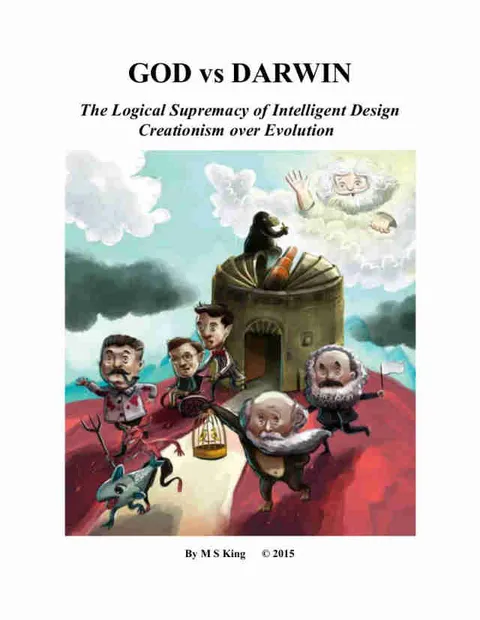
"God vs Darwin" by M. S. King is a comparative analysis of the ideologies of creationism and evolution. The book presents arguments from both perspectives, examining the scientific evidence for evolution and the theological arguments for creationism. Ultimately, it explores the ongoing debate between religion and science and challenges readers to consider the implications for their own beliefs.
John Alexander Dowie
By John Alexander Dowie (1847 – 1907)
I sat in my study in the parsonage of the Congregational Church at Newtown, a suburb of the beautiful city of Sydney, Australia. My heart was very heavy, for I had visited the sick and dying beds of more than thirty of my flock, and I had cast the dust to its kindred dust into more than forty graves within a few weeks. Where, oh where, was He Who used to heal His suffering children? No prayer for healing seemed to reach His ear, and yet I knew His hand had not been shortened. Still it did not save from death even those for whom there was so much in life to live for God and others. Strong men, fathers, good citizens, and more than all, true Christians sickened with a putrid fever, suffered nameless agonies, passed into delirium, sometimes with convulsions, and then died.
Oh, what aching voids were left in many a widowed or orphaned heart. There were many homes where, one by one, the little children, the youths and the maidens lay stricken, and after a hard struggle with the foul disease, they too, lay cold and dead. It seemed sometimes as if I could almost hear the triumphant mockery of evil ringing in my ear whilst I spoke to the bereaved ones the words of Christian hope and consolation. Disease, the foul offspring of its father, Satan, and its mother Sin, was defiling and destroying the earthly temples of God’s children and there was no deliverance.
There I sat with sorrow-bowed head for my afflicted people, until the bitter tears came to relieve my burning heart. Then I prayed for some message, and oh, how I longed to hear some words from Him Who wept and sorrowed for the suffering long ago, a Man of Sorrows and Sympathies. The words of the Holy Ghost inspired In Acts 10:38, stood before me all radiant with light, revealing Satan as the Defiler, and Christ as the Healer. My tears were wiped away, my heart strong, I saw the way of healing, and the door thereto was opened wide, so I said, “God help me now to preach the Word to all the dying around, and tell them how Satan still defiles, and Jesus still delivers, for He is just the same today.”
A loud ring and several raps at the outer door, a rush of feet, and there at my door stood two panting messengers who said, “Oh, come at once, Mary is dying; come and pray. “With just a feeling as a shepherd has who hears that his sheep are being torn from the fold by a cruel wolf, I rushed from my house, ran without my hat down the street, and entered the room of the dying maiden. There she lay groaning and grinding her clenched teeth in the agony of the conflict with the destroyer. The white froth, mingled with her blood, oozing from her pale and distorted mouth. I looked at her and then my anger burned. “Oh,” I thought, “for some sharp sword of heavenly temper keen to slay this cruel foe who is strangling that lovely maiden like an invisible serpent, tightening his deadly coils for a final victory.”
In a strange way, It came to pass; I found the sword I needed was in my hands, and in my hand I hold it still and never will I lay It down. The doctor, a good Christian man, was quietly walking up and down the room, sharing the mother’s pain and grief. Presently he stood at my side and said, “Sir, are not God’s ways mysterious?” Instantly the sword was flashed in my hand, the Spirit’s sword, the Word of God. “God’s way?!” I said, pointing to the scene of conflict, “How dare you call that God’s way of bringing His children home from earth to Heaven? No sir, that is the devil’s work and it is time we called on Him Who came to destroy the work of the devil, to slay that deadly foul destroyer, and to save this child. Can you pray, Doctor, can you pray the prayer of faith that saves the sick?” At once, offended at my words, my friend was changed, and saying,” You are too much excited, sir, it is best to say ‘God’s will be done,’” and he left the room.
Excited?! The word was quite inadequate for I was almost frenzied with divinely imparted anger and hatred of that foul destroyer, disease, which was doing Satan’s will. “It is not so,” I exclaimed, “no will of God sends such cruelty, and I shall never say ‘God’s will be done’ to Satan’s works, which God’s own Son came to destroy, and this is one of them.” Oh, how the Word of God was burning in my heart: “Jesus of Nazareth went about doing good, and healing all that were oppressed of the devil; for God was with Him.” And was not God with me? And was not Jesus there and all His promises true? I felt that it was even so, and turning to the mother I inquired,” Why did you send for me?” To which she answered, “Do pray, oh pray for her that God may raise her up.” So we prayed.
What did I say? It may be that I cannot recall the words without mistake, but words are in themselves of small importance. The prayer of faith may be a voiceless prayer, a simple heartfelt look of confidence into the face of Christ. At such moment, words are few, but they mean much, for God is looking at the heart. Still, I can remember much of that prayer unto this day, and asking God to aid, I will attempt to recall it. I cried, “Our Father, help! and Holy Spirit, teach me how to pray. Plead Thou for us, oh, Jesus, Savior, Healer, Friend, our Advocate with God the Father. Hear and heal, Eternal One! From all disease and death, deliver this sweet child of yours. I rest upon the Word. We claim the promise now. The Word is true, ‘I am the Lord that heals thee.’ Then heal her now. The Word is true, ‘I am the Lord, I change not.’ Unchanging God, then prove Yourself the healer now. The Word is true. ‘These signs shall follow them that believe in My Name, they shall lay hands on the sick, and they shall recover.’ And I believe and I lay hands in Jesus’ Name on her and claim this promise now. Your Word is true. ‘The prayer of faith shall save the sick. Trusting in You alone. I cry. Oh, save her now, for Jesus’ sake. Amen!”
Then, the maid lay in sleep so deep and sweet that the mother asked in a low whisper, “Is she dead?” “No,” I answered, in a whisper lower still. “Mary will live; the fever is gone. She is perfectly well and sleeping as an infant sleeps.” I was smoothing the long dark hair from her now peaceful brow, and feeling the steady pulsation of her heart and cool moist hands. I saw that Christ had heard, and that once more, as long ago in Peter’s house, “He touched her and the fever left her.” Turning to the nurse, I said, “Get me at once, please, a cup of cocoa and several slices of bread and butter.” Beside the sleeping maid we sat quietly and almost silently until the nurse returned, and then I bent over her and snapping my fingers called, “Mary!”
Instantly she woke, smiled and said, “Oh, sir, when did you come? I have slept so long;” then stretching her arms out to meet her mother’s embrace, she said, “Mother, I feel so well.” “And hungry, too?” I asked, pouring some of the cocoa in a saucer and offering it to her when cooled by my breath. “Yes, hungry too,” she answered with a little laugh, and drank and ate again, and yet again until all was gone. In a few minutes, she fell asleep, breathing easily and softly. Quietly thanking God. We left her bed and went to the next room where her brother and sister also lay sick of the same fever. With these two, we prayed and they were healed too. The following day all three were well and in a week or so they brought me a little letter and a gift of gold, two sleeve links with my monogram, which I wore for many years. As I went away from the home where Christ as the Healer had been victorious, I could not but have somewhat in my heart of the triumphant song that rang through Heaven, and yet I was not a little amazed at my own strange doings, and still more at my discovery that He is just the same today.
Excerpt from the Sermons of John Alexander Dowie Champions of Faith by Gordon Lindsay
Trade Self-Help for God-Help
They set out to get help from a higher power. The lion needed courage. The tinman needed a heart. The scarecrow needed a brain. The little girl longed to return home. But at journey’s end, they came to the unfortunate discovery: The Wizard of Oz was no wizard at all. He relied on screens and microphones. His wand was broken. He had only pins and needles to give. Yet, all was not lost. Our four heroes realized that what each had sought, each already possessed. Along the way, Tinman loved, Lion risked, Scarecrow thought. Dorothy carried the ability to travel home wherever she went. They discovered that they did not need an all-powerful Oz behind the curtain. What each truly needed he already held within. Whether or not Frank Baum meant it or not, Wizard of Oz is an apt parable of the generations-old self-help movement in our increasingly post-Christian West. The Oz, many say, has nothing to offer. God, the wisdom of modern man finally confirms, is a fraud. Yet, some rush to tell us, all is not lost. After sobering from the opiate of the masses, they tell us to awaken to reality: what we’ve needed all along already resides within each of us. Truth in Self-Help Some professing Christians are promoting self-help resources at alarming rates. As can happen when biting into that pizza roll too quickly, we can lose the ability to taste differences. We chew pop-psychology’s ideology of self-reliance and discern no real difference from Christianity, which builds upon God-dependence. We swallow both indiscriminately and wonder why our stomachs hurt. Before we look at the differences between the ideologies, first a question: Can we learn anything from the self-help movement? Why does this placebo help some? Many will line up to testify of its cure-all power. What’s in the snake oil? At least one true ingredient: self-help acknowledges our personal agency. Self-help assumes that you can indeed do something to help yourself. It too rejects the deceit that we drift helplessly downstream from our past or current circumstances. We are not leaves floating down from trees. The me of yesterday doesn’t have to be the me of tomorrow. We can learn discipline. We can “take control” of various aspects of our lives, escape addictions, and overcome fears. At least self-help affirms what God always has: we can, even now, reap a different harvest by sowing a different crop. It properly highlights the truth that we can — and must — own some measures of responsibility for our lives. We each can choose, as Luther once said, many things under heaven. And each decision will have consequences. Self-help advice rescues some from the fatalistic, paternalistic, dehumanizing worldviews (so common today) that deny a crucial component of God’s world: “So God created man in his own image, in the image of God he created him; male and female he created them” (Genesis 1:27). Diagnosing the Difference The ineptitude of the self-help philosophy becomes apparent when we contrast it with God-help. Note three differences, among others. 1. On Whom Do You Rely? Self-help gurus have little to sell us other than ourselves. In stopping at mere personal agency, they send us to build a new life while denying us straw for our bricks. Sure, they interject themselves to get us going (for a small fee, of course), but the real power resides within. The god they point to stoops down to fit into every mirror we see. Returning to our childhood optimism, “I think I can, I think I can,” this endless search to find your true potential borrows from the oldest heresy: “And you will be like God” (Genesis 3:5). Claiming to be wise, these gurus exchange the glory of the immortal God for images of successful man. Believe in yourself. Clutch the scepter of your life. You can do all things through you who gives you strength. As if God, looking down from heaven without any mercy, thundered, “Just figure it out!” Promoters of self-help have not been tutored in that school that Paul had: We were so utterly burdened beyond our strength that we despaired of life itself. Indeed, we felt that we had received the sentence of death. But that was to make us rely not on ourselves but on God who raises the dead. (2 Corinthians 1:8–9) The illusions of self-help shatter when suffering weighs so heavily on our backs that we despair of life itself. Pain reminds us that we are still but creatures — for the gods do not bleed. But all affliction is a choice friend when it teaches us to sing, “I lift up my eyes to the hills. From where does my help come? My help comes from the Lord, who made heaven and earth” (Psalm 121:1–2). The shoulders of him alone, who carried the cross and willingly bled for the treason of our self-reliance, can bear all of our further needs. 2. What Help Do You Get? When we look within for help, we receive only temporal solutions to what amounts to eternal problems. That alcohol addiction is not first and foremost a sin because it destroys one’s family and poisons oneself. All transgression, as we shall all soon discover, is against God: “Against you, you only, have I sinned and done what is evil in your sight” (Psalm 51:4). God has the first grievance, though the shrapnel certainly strikes others as well. Self-dependence may subdue some of the symptoms of sin — you stop drinking, overeating, or committing adultery — but a life of sin against God remains unaddressed and ultimately unaltered. Whereas self-help can tidy a sinking ship, “godliness is of value in every way, as it holds promise for the present life and also for the life to come” (1 Timothy 4:8). Grace trains the Christian to say “No!” to theft, anger-issues, pornography, pride, laziness, and say, “Yes!” to self-control, uprightness, and godly lives in the present (Titus 2:11–12) — all while steering us home and preparing us for heaven, not hell. 3. Who Gets the Glory? When we trust in self — and actually succeed— we get the glory. I am smarter, more disciplined, better. When we become self-made men and women, and not God-made men and women, we run from disordered lives into the arms of pride. Having escaped the cobra, we encounter the bear. And this tempts the self-reliant to look down on others who aren’t successful, and, whether they ever succumb to temptation or not, they never bother looking up to God. But the man who makes God his trust has a very different victory song: Not in my bow do I trust, nor can my sword save me. But you have saved us from our foes and have put to shame those who hate us. In God we have boasted continually, and we will give thanks to your name forever. (Psalm 44:6–8) The Christian, awake to the reality that he has no good apart from his God (Psalm 16:2), speaks repeatedly, “Not to me, O God, not to me, but to your name give glory” (Psalm 115:1). Christ is his boast. Christ is his refrain. He wants every triumph to add another jewel to the crown of his King. Make the Trade Self-help gives me my own small, fleeting glory. God-help offers us deep, everlasting joy, secure in his unfading glory. Self-help offers a temporal good (at best). God-help gives eternal good with the temporal thrown in. Self-help relies on my discipline, my resolve, and my effort. God-help builds upon a child’s cry to his father, leaning on one’s eternal family, and trusting God’s unfailing promises. God-help sustains me with daily bread from heaven. Self-help cannibalizes me, for it can find no other food. God-help ends in salvation, glory, and the conquering of the world, the flesh, and the devil. Self-help addresses the coughs and sneezes of this life but leaves me, at the end of it, without hope, without forgiveness, and without God in this world. So, trade self-help for God-help. God does not help those who, unmindful of him, help themselves. He works for those who wait for him (Isaiah 64:4). In the end, self-help is sheer folly. It sends us to work on Babel, rent a room in Gomorrah, eat grass with the mad king, and speak over ourselves, “Take up your bed and rise.” The placebo works only for so long, but all shall fall eventually — and “great shall be the fall.” But those who trust in Christ have Almighty God working in them, unsearchable promises to guide them, a heaven to journey to, and a Savior to glorify along the way. Article by Greg Morse