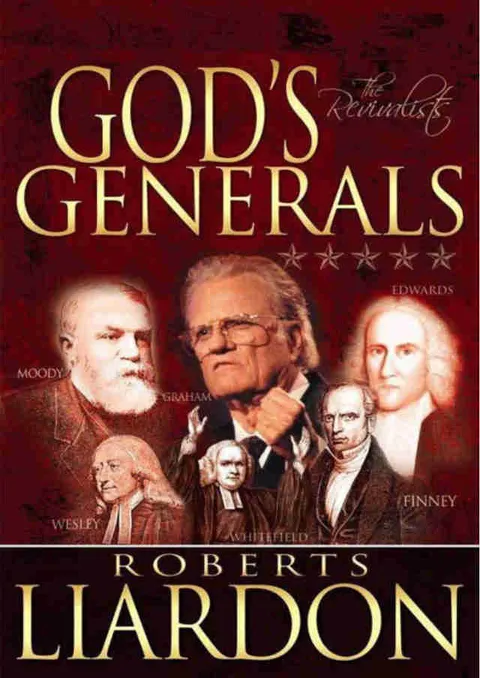

God's Generals - The Revivalists Order Printed Copy
- Author: Roberts Liardon
- Size: 1.59MB | 427 pages
- |
Others like god's generals - the revivalists Features >>
-160.webp)
God's Generals (A. A. Allen)
God's Generals: The Revivalists

Fire On The Earth - Eyewitness Reports From The Azusa Street Revival
God's Generals: The Roaring Reformers

God’s Generals: John Alexander Dowie
God's Generals - The Martyrs
God's Generals: Jack Coe
-160.webp)
God's Generals (William Branham)
God's Generals: The Martyrs
-160.webp)
God's Generals (Maria Woodworth)
About the Book
"God's Generals: The Revivalists" by Roberts Liardon is a comprehensive look at the lives and ministries of some of the most influential revivalists in Christian history. The book explores the lives of figures such as John Wesley, Charles Finney, and Smith Wigglesworth, detailing their struggles, triumphs, and the impact they had on the Christian faith. Liardon delves into their unique gifts, spiritual encounters, and the powerful revivals they led, inspiring readers to pursue a deeper relationship with God and a passion for spreading the Gospel.
John G. Lake
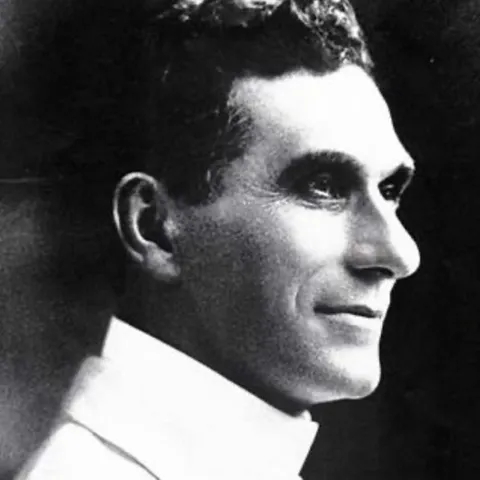 John G. Lake was born in Ontario, Canada on March 18th, 1870. He was a family man, person of integrity, honor, a savvy businessman and a good father. If you knew him you wouldn’t otherwise know that he would soon become one of the greatest men of God the world would ever know. He had a genuine love for the Lord Jesus and was known by his friends as a man who dedicated himself to intimacy with The Lord. It was out of this place that he loved his wife, was a man of integrity and built a very successful business career. To give you perspective, by 1905 John G Lake was making $50,000 per year this sum would be like upwards of 1.3 million dollars per year annually today. John grew up in a family environment which was plagued with sickness and death, it is said that his earliest memories were of sickness, death and funerals. Lake was from a large family, he had 16 siblings, 8 of which tragically died of various diseases. It is no coincidence that “the man of healing” was tormented from a young age with death and disease. The enemy will often oppose destinies with radical circumstances through a distortion of the very thing that we are called to walk in. Lake Was exposed to dramatic healing when he visited John Alexander Dowie’s ministry and was, in prayer, instantly healed of a rheumatism which had caused his legs to grow incorrectly. Just two short years into their marriage, Jennie Lake was diagnosed with tuberculosis and heart disease. Over the next couple of years, the condition worsened and the doctors resigned to the fact that it was only a matter of time before she would die. John allowed this situation to provoke him into faith, after being exposed to such death and disease from a young age he had a hatred for such things. When he would read the word of God he saw that his Christian experience was less than the promised “power of the Holy Spirit”. As Jennie was on her deathbed and perhaps taking her final breaths Lake was overcome with anger over sickness and threw his bible against the fireplace mantle! When he went to pick up his bible it was opened to Acts chapter 10:38 which says: "God anointed Jesus of Nazareth with the Holy Ghost and with power: who went about doing good, and healing all that were oppressed of the devil; for God was with him.” Lake had a surge of faith in that moment and sent a telegram to Dowie asking him to pray. Within an hour of Dowie praying she was fully healed! Not long after Jennie was healed, God began to speak to Lake about going into full time ministry. After some time of contemplation and seeking the Lord, God confirmed to John and Jennie separately that they were to move to South Africa to begin their life of ministry. John and Jennie then gave away all that they had, John forsook his mega-salary and they went on their way alongside some of their friends as ministry partners.
When they arrived in South Africa, they had no money. The problem was, that they needed at least $125 in order to clear customs. they nervously waited for their turn in line, rehearsing what they would say to the immigration officer They were in desperate need of a miracle, as the law read that they would be subject to deportation as quickly as they arrived in South Africa. Just as they were about the get to the front of the line, John felt a tap on his shoulder… A man was standing behind John and said “excuse me sir, can I have a word with you?” John nervously steps out of line at the man’s request and the man said “when I saw you and your family in line, the Lord told me to give you $200 cash”. The Lord provided just enough money for John and his family to enter the country. But their needs didn’t stop there. The Lakes and their crew had no ministry contact in Johannesburg. Soon after they cleared customs, a woman approached John’s friends and asked how many people are in their family, when they told her, she responded “no, not you” and went over to John and asked the same question. John replied “9” and she said “you’re the ones!” She went on to tell John that the Lord had spoken to her last night that she was to give her home to a family of 9 people who are coming from America to do God’s work. John, Jennie and their crew rejoiced in the dramatic provision of the Lord. Their time in South Africa was marked with waves of revival, there were multitudes saved, healed and delivered over the course of their 5 year ministry tour in South Africa.
By far my favorite story from this season of Revival takes place shortly after the Lake family and their team arrived in South Africa. A mighty plague was sweeping through the nation, the death count was climbing dramatically. So much so that there was a surplus of corpses who were victims of the plague and there was no one to bury the dead; if someone was to come in contact with a dead body they would most certainly become infected and their death sentence would immediately begin. John G. Lake astounded the medical officials because he, without any gloves or protective clothing began burying the dead. Physicians in a panic approached John and rebuked him for coming in contact with the dead, John boldly responded "when the disease comes in contact with my skin, you can watch it die". The doctors thought he was insane, so he challenged them to put a drop of the plague on his skin and watch it under a microscope. When they did so, John was right! The plague cells literally burned up the second they came in contact with his skin!
It is tough to understand what would happen towards the end of the Lake’s missionary journey in Africa. One day while John was away on a ministry trip, his wife Jennie suddenly passed away. The cause of her death was malnutrition and exhaustion. It wasn’t uncommon for the sick and broken to line the lawn of John G Lake’s home and Jennie, as an act of sacrifice, gave away all their food and any resources she could to the broken which frequented their house.
Although John and Jennie’s faith and sacrifice is commendable we must learn from this fatal mistake. John’s priorities clearly became altered as the demand for ministry raged on. He failed to guard and keep the very precious gift that God had given him, he allowed the demands of ministry to distract him from the needs of his family unto the tragic and preventable death of his wife. In the wake of Jennie’s death their children became bitter with John and subsequently God. Some of his children left the faith and the most recent accounts of them suggest that they died not following Christ. To this day some of John’s great grandchildren do not follow the Lord. John’s failure to obey the basic command of scripture for “husbands to love their wives as Christ loves the church” and his preoccupation with the demands of ministry opened up the door for the enemy to ravage his family. After Jennie’s death John moved back to the United States and remarried. He would then pioneer his famous healing ministry based out of Spokane Washington. Unfortunately John did not learn his lesson the first time, in the midst of more flames of revival he continued to be a poor father, emotionally disconnected from his children.
John G. Lake was born in Ontario, Canada on March 18th, 1870. He was a family man, person of integrity, honor, a savvy businessman and a good father. If you knew him you wouldn’t otherwise know that he would soon become one of the greatest men of God the world would ever know. He had a genuine love for the Lord Jesus and was known by his friends as a man who dedicated himself to intimacy with The Lord. It was out of this place that he loved his wife, was a man of integrity and built a very successful business career. To give you perspective, by 1905 John G Lake was making $50,000 per year this sum would be like upwards of 1.3 million dollars per year annually today. John grew up in a family environment which was plagued with sickness and death, it is said that his earliest memories were of sickness, death and funerals. Lake was from a large family, he had 16 siblings, 8 of which tragically died of various diseases. It is no coincidence that “the man of healing” was tormented from a young age with death and disease. The enemy will often oppose destinies with radical circumstances through a distortion of the very thing that we are called to walk in. Lake Was exposed to dramatic healing when he visited John Alexander Dowie’s ministry and was, in prayer, instantly healed of a rheumatism which had caused his legs to grow incorrectly. Just two short years into their marriage, Jennie Lake was diagnosed with tuberculosis and heart disease. Over the next couple of years, the condition worsened and the doctors resigned to the fact that it was only a matter of time before she would die. John allowed this situation to provoke him into faith, after being exposed to such death and disease from a young age he had a hatred for such things. When he would read the word of God he saw that his Christian experience was less than the promised “power of the Holy Spirit”. As Jennie was on her deathbed and perhaps taking her final breaths Lake was overcome with anger over sickness and threw his bible against the fireplace mantle! When he went to pick up his bible it was opened to Acts chapter 10:38 which says: "God anointed Jesus of Nazareth with the Holy Ghost and with power: who went about doing good, and healing all that were oppressed of the devil; for God was with him.” Lake had a surge of faith in that moment and sent a telegram to Dowie asking him to pray. Within an hour of Dowie praying she was fully healed! Not long after Jennie was healed, God began to speak to Lake about going into full time ministry. After some time of contemplation and seeking the Lord, God confirmed to John and Jennie separately that they were to move to South Africa to begin their life of ministry. John and Jennie then gave away all that they had, John forsook his mega-salary and they went on their way alongside some of their friends as ministry partners.
When they arrived in South Africa, they had no money. The problem was, that they needed at least $125 in order to clear customs. they nervously waited for their turn in line, rehearsing what they would say to the immigration officer They were in desperate need of a miracle, as the law read that they would be subject to deportation as quickly as they arrived in South Africa. Just as they were about the get to the front of the line, John felt a tap on his shoulder… A man was standing behind John and said “excuse me sir, can I have a word with you?” John nervously steps out of line at the man’s request and the man said “when I saw you and your family in line, the Lord told me to give you $200 cash”. The Lord provided just enough money for John and his family to enter the country. But their needs didn’t stop there. The Lakes and their crew had no ministry contact in Johannesburg. Soon after they cleared customs, a woman approached John’s friends and asked how many people are in their family, when they told her, she responded “no, not you” and went over to John and asked the same question. John replied “9” and she said “you’re the ones!” She went on to tell John that the Lord had spoken to her last night that she was to give her home to a family of 9 people who are coming from America to do God’s work. John, Jennie and their crew rejoiced in the dramatic provision of the Lord. Their time in South Africa was marked with waves of revival, there were multitudes saved, healed and delivered over the course of their 5 year ministry tour in South Africa.
By far my favorite story from this season of Revival takes place shortly after the Lake family and their team arrived in South Africa. A mighty plague was sweeping through the nation, the death count was climbing dramatically. So much so that there was a surplus of corpses who were victims of the plague and there was no one to bury the dead; if someone was to come in contact with a dead body they would most certainly become infected and their death sentence would immediately begin. John G. Lake astounded the medical officials because he, without any gloves or protective clothing began burying the dead. Physicians in a panic approached John and rebuked him for coming in contact with the dead, John boldly responded "when the disease comes in contact with my skin, you can watch it die". The doctors thought he was insane, so he challenged them to put a drop of the plague on his skin and watch it under a microscope. When they did so, John was right! The plague cells literally burned up the second they came in contact with his skin!
It is tough to understand what would happen towards the end of the Lake’s missionary journey in Africa. One day while John was away on a ministry trip, his wife Jennie suddenly passed away. The cause of her death was malnutrition and exhaustion. It wasn’t uncommon for the sick and broken to line the lawn of John G Lake’s home and Jennie, as an act of sacrifice, gave away all their food and any resources she could to the broken which frequented their house.
Although John and Jennie’s faith and sacrifice is commendable we must learn from this fatal mistake. John’s priorities clearly became altered as the demand for ministry raged on. He failed to guard and keep the very precious gift that God had given him, he allowed the demands of ministry to distract him from the needs of his family unto the tragic and preventable death of his wife. In the wake of Jennie’s death their children became bitter with John and subsequently God. Some of his children left the faith and the most recent accounts of them suggest that they died not following Christ. To this day some of John’s great grandchildren do not follow the Lord. John’s failure to obey the basic command of scripture for “husbands to love their wives as Christ loves the church” and his preoccupation with the demands of ministry opened up the door for the enemy to ravage his family. After Jennie’s death John moved back to the United States and remarried. He would then pioneer his famous healing ministry based out of Spokane Washington. Unfortunately John did not learn his lesson the first time, in the midst of more flames of revival he continued to be a poor father, emotionally disconnected from his children.
my times are in your hand - learning to trust the speed of god
Did you know your head ages faster than your feet? Scientists have confirmed this, proving again that Albert Einstein was spot-on in his theories of relativity: the speed of time is relative to a particular frame of reference. For us terrestrials, that frame of reference is earth’s gravitational force. The higher up from the earth something is, the weaker the gravitational pull and the faster time moves. An implication of this is that we frequently put our trust in a frame of reference on time different from the one we experience. For instance, the Global Positioning System (GPS) we rely on to accurately and safely guide us as we pilot our cars, ships, planes, and spaceships only works because it’s programmed, based on Einstein’s theories of relativity, to compensate for the distance between earth and space. Without those formulas, our computers and smartphones would soon get disastrously out of sync with the GPS satellites, which orbit in a different time. Stick with me; I am going somewhere with this. How we experience time depends on our frame of reference. And our particular frame of reference is not always the one we should trust. In fact, sometimes it’s critically important that we trust another framing more than our own. One Day with the Lord For Christians, this concept is nothing new. Over three millennia ago, Moses wrote, A thousand years in your sight are but as yesterday when it is past, or as a watch in the night. (Psalm 90:4) And some two millennia ago, Peter wrote, Do not overlook this one fact, beloved, that with the Lord one day is as a thousand years, and a thousand years as one day. (2 Peter 3:8) In other words, time in God’s eyes moves at different speeds from time in our ours. And in the life of faith, it’s critically important that we learn to rely on God’s timing more than our own — to learn to trust the speed of God. How Long, O Lord? Learning to trust God’s timing is not easy, to say the least. This is partly due to our sin and unbelief. But it’s also because trusting a frame of reference different from ours is, by definition, counterintuitive. Since we can’t calculate God’s time, his timing often doesn’t make sense to us. That’s why after Peter described one God-day as being like a thousand years for us, he went on to say, “The Lord is not slow . . . as some count slowness” (2 Peter 3:9). The “some” he referred to were “scoffers” who mocked Christians’ hope in the return of Christ (2 Peter 3:3–4). But the truth is that all of us fit into the “some” category at times. I don’t mean as scoffers, but as children of God painfully perplexed by our heavenly Father’s apparent slowness. We cry out, “How long, O Lord?” (Psalm 13:1), wondering when he will finally fulfill some promise to which we’re clinging. So, Peter exhorts us, the “beloved” of God, not to “overlook” the fact that God-time is not man-time; therefore, God “is not slow” as man counts slowness (2 Peter 3:8–9) — as I sometimes count slowness. Indeed, he is not. God Is Not Slow Someone who has created such a thing as light speed, and who knows what’s happening in every part of a universe spanning some 93 billion light-years across, is clearly not slow. “It’s critically important that we learn to rely on God’s timing more than our own.” It’s also clear, however, that such a being as God operates on a very different timeline than we do — if timeline is even the right word. For God is not constrained by time. He is the Father of time (Genesis 1:1; Colossians 1:16). He is “the Ancient of Days” (Daniel 7:9), existing “from everlasting to everlasting” (Psalm 90:2). God is not in time ; time is in God (Acts 17:28; Colossians 1:17). The “thousand years” of Psalm 90:4 and 2 Peter 3:8 is just a metaphor, using a timeframe we can somewhat comprehend to communicate a reality we can’t. So, when the speed of God seems slow to us, or when his timing doesn’t make sense, we must “not overlook this one fact”: God-time is different from man-time. God-time is relative to his purposes, which is his frame of reference. And God, according to his wise purposes, makes everything beautiful in its time — the time he purposefully chooses for it. Time for Everything Everything beautiful in its time . I get that from Ecclesiastes 3:11: [God] has made everything beautiful in its time. Also, he has put eternity into man’s heart, yet so that he cannot find out what God has done from the beginning to the end. This verse captures like no other both the mysterious nature of our experience of time, and the pointers God has placed within our frame of reference to help us trust the wisdom of his timing. In designing us with eternity in our hearts, the “eternal God” made us to know him (Deuteronomy 33:27). But in limiting the scope of our perspective and comprehension, he also made us to fundamentally trust him and not ourselves (Proverbs 3:5–6). This is how he means for us to know him: I am God, and there is no other; I am God, and there is none like me, declaring the end from the beginning and from ancient times things not yet done, saying, “My counsel shall stand, and I will accomplish all my purpose.” (Isaiah 46:9–10) He is “the everlasting God” (Isaiah 40:28), “who works all things,” including all time everywhere, “according to the counsel of his will” (Ephesians 1:11). One clear way he reveals the wisdom of his purposes is how he has created, in our frame of reference, “a time for every matter under heaven” (Ecclesiastes 3:1): a time to be born, and a time to die; a time to plant, and a time to pluck up what is planted; a time to kill, and a time to heal; a time to break down, and a time to build up; a time to weep, and a time to laugh; a time to mourn, and a time to dance. (Ecclesiastes 3:2–4) God “made everything beautiful in its time.” The Hebrew word translated “beautiful” means appropriate , fitting , right . God’s “invisible attributes” can be “clearly perceived” in the created order we observe and experience (Romans 1:20). They reveal the wisdom of his purposes — a wisdom far beyond ours. And God intends them to teach us that his “beautiful” timing can be trusted, even when we don’t understand it. In the Fullness of Time God did not merely leave us to deduce his character and wisdom from nature. For “when the fullness of time had come, God sent forth his Son” (Galatians 4:4). In Jesus, the Creator of all stepped into terrestrial time, into our frame of reference (John 1:2). In fully human form, he “dwelt among us,” directly revealing the divine attributes with a “glory as of the only Son from the Father, full of grace and truth” (John 1:14). “Time in God’s eyes moves at different speeds than time in our ours.” While here, he performed many signs and wonders and proclaimed, “The time is fulfilled, and the kingdom of God is at hand; repent and believe in the gospel” (Mark 1:14–15). As he did so, he displayed the marvelous wisdom of the timing of God, often in ways that surprised and confused his followers (John 4:1–42; 11:1–44). Then, when his time had come (John 12:23), Jesus obeyed his Father to the point of death on a cross, “offer[ing] for all time a single sacrifice for sins.” And then he was raised from the dead and “sat down at the right hand of God, waiting from that time until his enemies should be made a footstool for his feet” (Hebrews 10:12–14). As his followers, we also wait. We wait for the Father to “send the Christ appointed for [us], Jesus, whom heaven must receive until the time for restoring all the things about which God spoke by the mouth of his holy prophets long ago” (Acts 3:20–21). Trust the Speed of God As we wait, two thousand years later (or two God-days), we help each other remember, The Lord is not slow to fulfill his promise as some count slowness, but is patient toward [us], not wishing that any should perish, but that all should reach repentance. (2 Peter 3:9) Yes, we must frequently help each other remember: God-time moves at different speeds than ours. God works all things, at all times, in all places, in all dimensions, after the counsel of his will to accomplish all his purpose. God has a purposeful time for everything, and he makes everything beautiful in its time. However God chooses to use our times, it’s critically important that we learn to trust his timing over the relative and unreliable earthbound perspective that shapes our expectations. Our times, like all times, are in God’s hand (Psalm 31:15). This is what it means to live by faith in relation to time. In choosing to trust the speed of God, we humble ourselves under his mighty, time-holding hand. According to 1 Peter 5:6–7, the amazing reward of choosing to embrace such joyful, peaceful, childlike trust in God is that he will exalt us at the proper time.