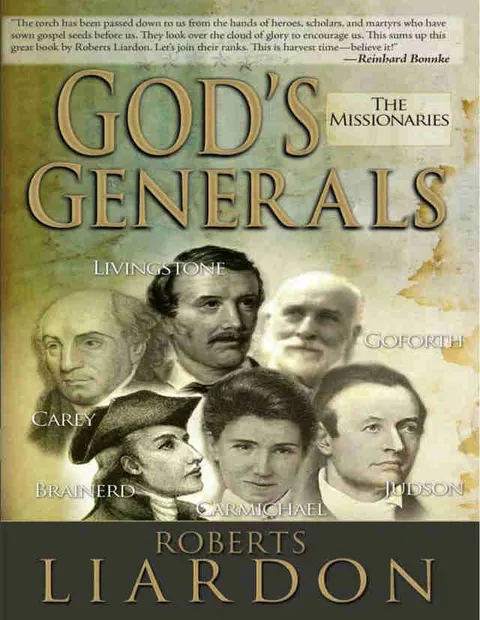

God's Generals - The Missionaries Order Printed Copy
- Author: Roberts Liardon
- Size: 3.23MB | 358 pages
- |
Others like god's generals - the missionaries Features >>
God's Generals: The Missionaries
-160.webp)
God's Generals (Charles F. Parham)

God's Generals: Evan Roberts

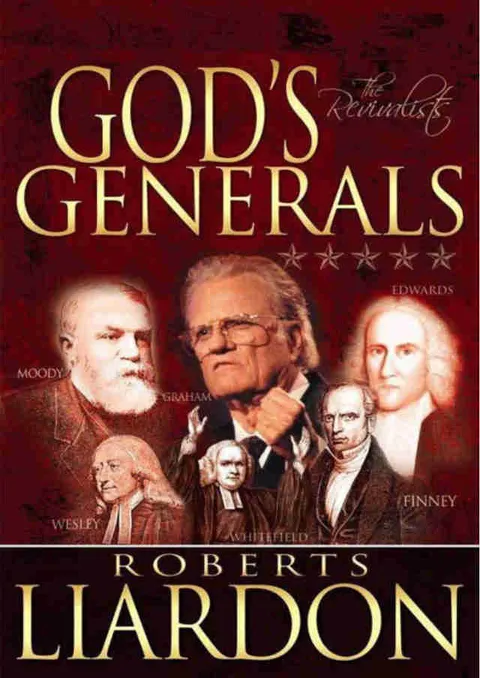
God's Generals: The Revivalists
God's Generals: The Martyrs
-160.webp)
God's Generals (Aimee Semple Mcpherson)
God's Generals - The Martyrs

God's Generals: A. A. Allen
A God Entranced Vision Of All Things: The Legacy Of Jonathan Edwards

God's Generals: The Healing Evangelists
About the Book
"God's Generals - The Missionaries" by Roberts Liardon provides a powerful and inspiring look at the lives and faith of some of the most influential missionaries throughout history. From William Carey to Amy Carmichael, this book explores the sacrifices and struggles these individuals faced as they spread the message of Christianity and worked to bring hope and healing to people around the world. Through their stories, readers are encouraged to deepen their own faith and find inspiration to carry out their own missions and callings.
Amy Carmichael
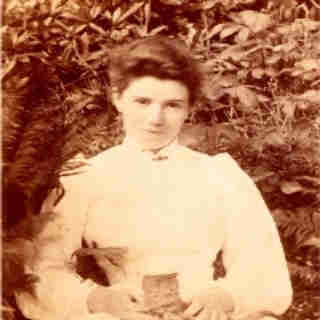 Born in Belfast Ireland, to a devout family of Scottish ancestry, Carmichael was educated at home and in England, where she lived with the familt of Robert Wilson after her father’s death. While never officially adopted, she used the hyphenated name Wilson-Carmichael as late as 1912. Her missionary call came through contacts with the Keswick movement. In 1892 she volunteered to the China Inland Mission but was refused on health grounds. However, in 1893 she sailed for Japan as the first Keswick missionary to join the Church Missionary Society (CMS) work led by Barclay Buxton. After less than two years in Japan and Ceylon, she was back in England before the end of 1894. The next year she volunteered to the Church of England Zenana Missionary Society, and in November 1895 she arrived in South India, never to leave. While still learning the difficult Tamil language, she commenced itinerant evangelism with a band of Indian Christian women, guided by the CMS missionary Thomas Walker. She soon found herself responsible for Indian women converts, and in 1901, she, the Walkers, and their Indian colleagues settled in Dohnavur. During her village itinerations, she had become increasingly aware of the fact that many Indian children were dedicated to the gods by their parents or guardians, became temple children, and lived in moral and spiritual danger. It became her mission to rescue and raise these children, and so the Dohnavur Fellowship came into being (registered 1927). Known at Dohnavur as Amma (Mother), Carmichael was the leader, and the work became well known through her writing. Workers volunteered and financial support was received, though money was never solicited. In 1931 she had a serious fall, and this, with arthritis, kept her an invalid for the rest of her life. She continued to write, and identified leaders, missionary and Indian, to take her place. The Dohnavur Fellowship still continues today.
Jocelyn Murray, “Carmichael, Amy Beatrice,” in Biographical Dictionary of Christian Missions, ed. Gerald H. Anderson (New York: Macmillan Reference USA, 1998), 116.
This article is reprinted from Biographical Dictionary of Christian Missions, Macmillan Reference USA, copyright © 1998 Gerald H. Anderson, by permission of Macmillan Reference USA, New York, NY. All rights reserved.
“Ammai” of orphans and holiness author
Amy Carmichael was born in Ireland in 1867, the oldest of seven children. As a teen, she attended a Wesleyan Methodist girls boarding school, until her father died when she was 18. Carmichael twice attended Keswick Conventions and experienced a holiness conversion which led her to work among the poor in Belfast. Through the Keswick Conventions, Carmichael met Robert Wilson. He developed a close relationship with the young woman, and invited her to live with his family. Carmichael soon felt a call to mission work and applied to the China Inland Mission as Amy Carmichael-Wilson. Although she did not go to China due to health reasons, Carmichael did go to Japan for a brief period of time. There she dressed in kimonos and began to learn Japanese. Her letters home from Japan became the basis for her first book, From Sunrise Land. Carmichael left Japan due to health reasons, eventually returning to England. She soon accepted a position with the Church of England’s Zenana Missionary Society, serving in India. From 1895 to 1925, her work with orphans in Tinnevelly (now Tirunelveli) was supported by the Church of England. After that time, Carmichael continued her work in the faith mission style, establishing an orphanage in Dohnavur. The orphanage first cared for girls who had been temple girls, who would eventually become temple prostitutes. Later the orphanage accepted boys as well.
Carmichael never returned to England after arriving in India. She wrote prolifically, publishing nearly 40 books. In her personal devotions, she relied on scripture and poetry. She wrote many of her own poems and songs. Carmichael had a bad fall in 1931, which restricted her movement. She stayed in her room, writing and studying. She often quoted Julian of Norwich when she wrote of suffering and patience. Many of Carmichael’s books have stories of Dohnavur children, interspersed with scripture, verses, and photographs of the children or nature. Carmichael never directly asked for funding, but the mission continued to be supported through donations. In 1951 Carmichael died at Dohnavur. Her headstone is inscribed “Ammai”, revered mother, which the children of Dohnavur called Carmichael.
Carmichael’s lengthy ministry at Dohnavur was sustained through her strong reliance upon scripture and prayer. Her early dedication to holiness practices and her roots in the Keswick tradition helped to guide her strong will and determination in her mission to the children of southern India.
by Rev. Lisa Beth White
Born in Belfast Ireland, to a devout family of Scottish ancestry, Carmichael was educated at home and in England, where she lived with the familt of Robert Wilson after her father’s death. While never officially adopted, she used the hyphenated name Wilson-Carmichael as late as 1912. Her missionary call came through contacts with the Keswick movement. In 1892 she volunteered to the China Inland Mission but was refused on health grounds. However, in 1893 she sailed for Japan as the first Keswick missionary to join the Church Missionary Society (CMS) work led by Barclay Buxton. After less than two years in Japan and Ceylon, she was back in England before the end of 1894. The next year she volunteered to the Church of England Zenana Missionary Society, and in November 1895 she arrived in South India, never to leave. While still learning the difficult Tamil language, she commenced itinerant evangelism with a band of Indian Christian women, guided by the CMS missionary Thomas Walker. She soon found herself responsible for Indian women converts, and in 1901, she, the Walkers, and their Indian colleagues settled in Dohnavur. During her village itinerations, she had become increasingly aware of the fact that many Indian children were dedicated to the gods by their parents or guardians, became temple children, and lived in moral and spiritual danger. It became her mission to rescue and raise these children, and so the Dohnavur Fellowship came into being (registered 1927). Known at Dohnavur as Amma (Mother), Carmichael was the leader, and the work became well known through her writing. Workers volunteered and financial support was received, though money was never solicited. In 1931 she had a serious fall, and this, with arthritis, kept her an invalid for the rest of her life. She continued to write, and identified leaders, missionary and Indian, to take her place. The Dohnavur Fellowship still continues today.
Jocelyn Murray, “Carmichael, Amy Beatrice,” in Biographical Dictionary of Christian Missions, ed. Gerald H. Anderson (New York: Macmillan Reference USA, 1998), 116.
This article is reprinted from Biographical Dictionary of Christian Missions, Macmillan Reference USA, copyright © 1998 Gerald H. Anderson, by permission of Macmillan Reference USA, New York, NY. All rights reserved.
“Ammai” of orphans and holiness author
Amy Carmichael was born in Ireland in 1867, the oldest of seven children. As a teen, she attended a Wesleyan Methodist girls boarding school, until her father died when she was 18. Carmichael twice attended Keswick Conventions and experienced a holiness conversion which led her to work among the poor in Belfast. Through the Keswick Conventions, Carmichael met Robert Wilson. He developed a close relationship with the young woman, and invited her to live with his family. Carmichael soon felt a call to mission work and applied to the China Inland Mission as Amy Carmichael-Wilson. Although she did not go to China due to health reasons, Carmichael did go to Japan for a brief period of time. There she dressed in kimonos and began to learn Japanese. Her letters home from Japan became the basis for her first book, From Sunrise Land. Carmichael left Japan due to health reasons, eventually returning to England. She soon accepted a position with the Church of England’s Zenana Missionary Society, serving in India. From 1895 to 1925, her work with orphans in Tinnevelly (now Tirunelveli) was supported by the Church of England. After that time, Carmichael continued her work in the faith mission style, establishing an orphanage in Dohnavur. The orphanage first cared for girls who had been temple girls, who would eventually become temple prostitutes. Later the orphanage accepted boys as well.
Carmichael never returned to England after arriving in India. She wrote prolifically, publishing nearly 40 books. In her personal devotions, she relied on scripture and poetry. She wrote many of her own poems and songs. Carmichael had a bad fall in 1931, which restricted her movement. She stayed in her room, writing and studying. She often quoted Julian of Norwich when she wrote of suffering and patience. Many of Carmichael’s books have stories of Dohnavur children, interspersed with scripture, verses, and photographs of the children or nature. Carmichael never directly asked for funding, but the mission continued to be supported through donations. In 1951 Carmichael died at Dohnavur. Her headstone is inscribed “Ammai”, revered mother, which the children of Dohnavur called Carmichael.
Carmichael’s lengthy ministry at Dohnavur was sustained through her strong reliance upon scripture and prayer. Her early dedication to holiness practices and her roots in the Keswick tradition helped to guide her strong will and determination in her mission to the children of southern India.
by Rev. Lisa Beth White
jesus is coming again
Reader, do you know that Jesus is coming again? He said, "I will come again" (John 14:3) and His word endureth forever (1 Pet. 1:25), for He is the truth (John 14:6). The angels said He would come again. "This same Jesus," and "in like manner" (Acts 1:11), and they were not mistaken when they announced His first coming (Luke 1:26-33; see also Luke 2:8-18). The Holy Spirit, by the mouth of the apostles, hath repeatedly said He would come again (1 Thess. 4:16; Heb. 9:28, Heb. 10:37). Is not such an event, stated upon such authority, of vital importance to us? At His first coming, the world rejected Him. He was the despised Nazarene. But when He comes again, He will appear as "the blessed and only Potentate, the King of Kings and Lord of Lords" (1 Tim. 6:13-15). He is coming to sit upon the throne of His glory (Matt. 25:31), and to be admired in all them that believed (2 Thess. 1:10), and to rule, in judgment and equity, all the nations of the earth (Psa. 2:9; Isa. 9:6-7; Rev. 2:25-27). How glorious it will be to see the King in His beauty (Isa. 33:17). Perhaps you are not a Christian, and say— "I Don't Care Anything About It." Then, dear friend, we point you to the crucified Savior as the only hope of salvation. We beg of you to "kiss the Son," lest ye perish from the way. Blessed are all they that put their trust in Him (Psalm 2:12). What shall it profit you if you gain the whole world and lose your own soul? (Matt. 16:26-27) He is coming, and we know neither the day, nor the hour, when He may come (Matt. 25:13). What if He should come now? Would you be found of Him in peace (2 Pet. 3:14), or would you be left behind to endure the terrible things which shall come upon the world (Luke 21:25-26), while the church is with Christ in the air (Luke 21:36; 1 Thess. 4:17), and be made at His appearing (2 Thess. 1:7-10) to mourn (Matt. 24:30) and pray to the mountains and rocks to hide you from His face? (Rev. 6:16). "Prepare to meet thy God," was the solemn injunction to Israel (Amos 4:12), and every one of us, both Jew and Gentile, must meet Him, either in grace or in judgment. We, then, as ambassadors for Christ, beseech you: be ye reconciled to God (2 Cor. 5:20), now, in the accepted time, in the day of salvation (2 Cor. 6:2; Luke 14:31-33). Do let us entreat you to repent and be converted, that your sins may be blotted out (Acts 10:42-43; Acts 17:30-31), and that you may turn "to serve the living and true God; and to wait for his Son from Heaven" (1 Thess. 1:9-10), and be unblamable at the coming of our Lord Jesus Christ (1 Thess. 3:13). But if you are a Christian, then we point you to His coming again, as The True Incentive to a Holy Life.(1 John 3:2-3) Jesus is coming, therefore mortify your members which are upon the earth, that you may appear with Him in glory (Col. 3:4-5). Strive and pray for purity of heart, that you may be like Him and see Him as He is (Matt. 5:18; 1 John 3:2-3). Search the Word, that you may be sanctified and cleansed thereby (Eph. 5:26), and that your whole spirit, and soul, and body may be preserved blameless unto the coming of our Lord Jesus Christ (1 Thess. 5:23). But possibly you say, with contempt, "Oh, That's Second Adventism." Beloved, have you considered that Moses (Deut. 33:2), so David (Psa. 102:16), Isaiah (Isa. 59:20; Isa. 60:1), Jeremiah (Jer. 23:5-6), Daniel (Dan. 7:13), Zechariah (Zech. 14:4-5), all the prophets and apostles (Acts 15:15-17), were believers in the second advent of Christ? And because some, by setting dates, and other errors, have brought disrepute upon this doctrine, shall we cast it aside altogether? But it may be you say (as we have been pained to hear from so many even earnest Christians): "Well, I Don't Think It Concerns Me Much, Anyway: I've always thought that in most cases it meant death, and if I'm prepared for death, that's enough; and there is too much speculation about it to suit me; and I don't believe it's a practical doctrine; and, more than that, I think it's a mistake to pay so much attention to it." Yes, even thus do many Christians, — who profess to be members of the body of Christ (1 Cor. 12:27), and who have been espoused unto one husband, that they may be presented to Him (2 Cor. 11:2) — summarily dispose of this precious truth, that Jesus is coming, to take unto Himself His bride (John 14:3; Eph. 5:23, 32). O, beloved, do not thus deprive yourself of this comforting truth. Please take your pencil and mark in your Bible the passages that pertain to it; and see How Large a Portion of the Word Is Devoted to It. If the Holy Ghost has deemed it so important, is it not worthy of our attention? The Word exhorts us (1 Thess. 4:18; 1 Cor. 1:7) to give attention to it (Rev. 1:3); and the danger of condemnation is to them who do not (Luke 12:45-46; Luke 21:34-36; 1 Thess. 5:1-7). Again, please examine the passages cited under the heading, A Practical Doctrine, and see how Jesus and the apostles used this doctrine to incite us to watchfulness, repentance, patience, ministerial faithfulness, brotherly love, etc., and then decide whether anything could be more practical. Surely no doctrine, in the Word of God, presents a deeper motive for crucifying the flesh, and for separation unto God, and to work for souls, as our hope and joy and crown of rejoicing (1 Thess. 2:19; Dan. 12:3) than this does. For the whole teaching of it is, that our conversation (citizenship) is in heaven; from whence also we look for the Savior, the Lord Jesus Christ; who shall change our vile body, that it may be fashioned like unto His glorious body (Phil. 3:20-21). It awakens groaning for the adoption, to wit, the redemption of our body (Rom. 8:23; Luke 21:28). It gives us a view of the world, as a wrecked vessel (Matt. 7:13-14; 1 Thess. 5:3; 2 Pet. 2:3-9; 2 Pet. 3:5-12), and stimulates us to work with all our might that we may save some (1 Cor. 9:22). Most, if not all, of the evangelists of our day are animated by this doctrine, and surely their work is practical. Again, Peter says, "We have also a more sure word of prophecy; whereunto ye do well that ye take heed, as unto a light that shineth in a dark place, until the day dawn, and the day star arise in your hearts:" (2 Pet. 1:19); and he exhorts us to be mindful of these words (2 Pet. 3:1-2). Therefore we are not speculating when we prayerfully study prophecy. From Jesus is Coming by W. E. B. 3rd. rev. New York: Fleming H. Revell, ©1908. Chapter 1.