
Kenneth E. Hagin
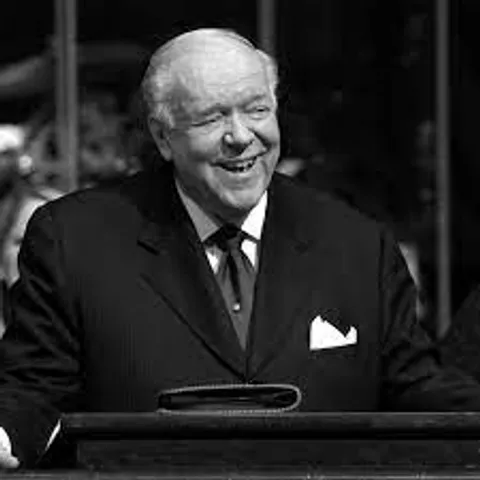 Rev. Kenneth Erwin Hagin was born on Aug. 20, 1917, in McKinney, Texas. Rev. Hagin was sickly as a child, suffering from a deformed heart and an incurable blood disease. He was not expected to live and became bedfast at age 15. In April 1933 during a dramatic conversion experience, he reported dying three times in 10 minutes, each time seeing the horrors of hell and then returning to life.
In August 1934, Rev. Hagin was miraculously healed, raised off a deathbed by the power of God and the revelation of faith in God’s Word. Jesus appeared to Rev. Hagin eight times over the next several years in visions that changed the course of his ministry. In 1967, he began a regular radio broadcast that continues today as Rhema for Today.
In 1968 Rev. Hagin published the first issues of The Word of Faith. That magazine, now produced nine times a year, has a circulation of over 200,000. The publishing outreach he founded, Faith Library Publications, has circulated worldwide more than 75 million copies of books by Rev. Hagin, Kenneth W. Hagin, Lynette Hagin, Craig W. Hagin, and several other authors. Faith Library Publications also has produced millions of audio and video teachings.
Other outreaches of Kenneth Hagin Ministries include Rhema Praise, a weekly television broadcast hosted by Revs. Kenneth and Lynette Hagin; Rhema Correspondence Bible School; Rhema Alumni Association; Rhema Ministerial Association International; the Rhema Prayer and Healing Center; and the Rhema prison ministry.
In 1974 Rev. Hagin founded what is now Rhema Bible Training College. The school has campuses all over the world and continues to expand.
Until shortly before his death, Rev. Hagin continued to travel and teach throughout the United States and into Canada conducting All Faiths’ Crusades and other special meetings.
Known as the “father of the modern faith movement,” Rev. Hagin was a dynamic preacher, teacher, and prophet. His teachings and books are filled with vivid stories that show God’s power and truth working in his life and the lives of others. He will be remembered not only as a great minister but as a great family man—for his family was his heart. He was there at every milestone ready to talk, to answer, to pray. He was a man whose belly laugh filled the room at the sight of one of his grandchildren or great-grandchildren.
Rev. Kenneth Erwin Hagin was born on Aug. 20, 1917, in McKinney, Texas. Rev. Hagin was sickly as a child, suffering from a deformed heart and an incurable blood disease. He was not expected to live and became bedfast at age 15. In April 1933 during a dramatic conversion experience, he reported dying three times in 10 minutes, each time seeing the horrors of hell and then returning to life.
In August 1934, Rev. Hagin was miraculously healed, raised off a deathbed by the power of God and the revelation of faith in God’s Word. Jesus appeared to Rev. Hagin eight times over the next several years in visions that changed the course of his ministry. In 1967, he began a regular radio broadcast that continues today as Rhema for Today.
In 1968 Rev. Hagin published the first issues of The Word of Faith. That magazine, now produced nine times a year, has a circulation of over 200,000. The publishing outreach he founded, Faith Library Publications, has circulated worldwide more than 75 million copies of books by Rev. Hagin, Kenneth W. Hagin, Lynette Hagin, Craig W. Hagin, and several other authors. Faith Library Publications also has produced millions of audio and video teachings.
Other outreaches of Kenneth Hagin Ministries include Rhema Praise, a weekly television broadcast hosted by Revs. Kenneth and Lynette Hagin; Rhema Correspondence Bible School; Rhema Alumni Association; Rhema Ministerial Association International; the Rhema Prayer and Healing Center; and the Rhema prison ministry.
In 1974 Rev. Hagin founded what is now Rhema Bible Training College. The school has campuses all over the world and continues to expand.
Until shortly before his death, Rev. Hagin continued to travel and teach throughout the United States and into Canada conducting All Faiths’ Crusades and other special meetings.
Known as the “father of the modern faith movement,” Rev. Hagin was a dynamic preacher, teacher, and prophet. His teachings and books are filled with vivid stories that show God’s power and truth working in his life and the lives of others. He will be remembered not only as a great minister but as a great family man—for his family was his heart. He was there at every milestone ready to talk, to answer, to pray. He was a man whose belly laugh filled the room at the sight of one of his grandchildren or great-grandchildren.
when they hurt you with words
The spirit of the old adage “words will never harm me” is not the sentiment of the Scriptures. Words can hurt, even when directed from an unknown profile online. God made a world in which words are powerful. “Death and life are in the power of the tongue” (Proverbs 18:21). And as public discourse falls to new lows in the digital age, God has not left us without a guide for how to respond to the pain when we are persecuted with words. Leaf through the New Testament, and you’ll find verbal attacks on Jesus, his apostles, and his church on nearly every page. At times, these attacks escalate to physical persecution — the stoning of Stephen, the martyrdom of James, the imprisonments of Peter and Paul, the crucifixion of Christ — but what remains constant, and significant, is a torrent of verbal persecution against Jesus and his people. And verbal persecution is not less than persecution because it’s verbal. Have You Been Reviled? Slander and revile are two of the main words for verbal attack in the English New Testament, and both occur frequently. Early Christians were so accustomed to being spoken against that they developed a rich vocabulary (if you call it that) of being slandered, reviled, insulted, maligned, mocked, and spoken evil against (at least six different Greek verbs, along with several related nouns and adjectives). Of the English terms, revile may be the least common in normal usage today. One dictionary defines it as “to criticize in an abusive or angrily insulting manner.” To take our cues from specific biblical texts, revile can mean “to speak evil against” (Matthew 5:11; Mark 9:39; Acts 19:9; 23:4); it is the opposite of verbally honoring someone (Mark 7:10). Reviling is an attempt to injure with words (1 Peter 3:16). We see it at Jesus’s crucifixion, where “those who passed by derided him” with their words, and the chief priests, scribes, and elders “mocked him,” and “the robbers who were crucified with him also reviled him in the same way” (Matthew 27:39–44). But Jesus not only endured it; he prepared us for it as well. He and his apostles, and the early church, model for us how to receive and respond to slander and reviling. 1. Expect the world to say the worst. Amid this rich vocabulary of verbal attack, the New Testament sends no mixed signals as to whether Christians will be maligned. We will. Jews and Gentiles together bombarded Jesus and his disciples with verbal attacks. Physical persecution came and went, but reviling remained constant. When Paul arrived in Rome, the Jews reported to him, about Christianity, “With regard to this sect we know that everywhere it is spoken against” (Acts 28:22). For Christians, being reviled is not a matter of if but when : “when they speak against you” (1 Peter 2:12). Unbelievers “are surprised when you do not join them in the same flood of debauchery” — so what do they do? “They malign you” (1 Peter 4:4). After all, should we not expect the world, under the power of the devil (1 John 5:19; Ephesians 2:2), to lie about us? The Greek for devil ( diabolos ) actually means slanderer (1 Timothy 3:11; Titus 2:3). As Jesus said to his revilers in John 8:44, “You are of your father the devil, and your will is to do your father’s desires. . . . When he lies, he speaks out of his own character, for he is a liar and the father of lies.” 2. Consider the cause. We should not assume that all verbal opposition we receive is good. Being reviled for Jesus’s sake and for his gospel is one thing; being reviled for our own folly and sin is another (1 Peter 3:17; 4:15–16). As far as it depends on us, we want to “give the adversary no occasion for slander” (1 Timothy 5:14). Slander itself is no win for the church. We want to do what we can, within reason and without compromise, to keep God’s name and word and teaching from reviling (1 Timothy 6:1; Titus 2:5). “Do not let what you regard as good be spoken of as evil” (Romans 14:16). But when the world speaks evil against us because of Jesus, we embrace it. “If you are insulted for the name of Christ , you are blessed, because the Spirit of glory and of God rests upon you” (1 Peter 4:14). 3. Do not revile in return. Christ’s calling to his church is crystal clear: Do not respond in kind. Do not stoop to the level of your revilers. “Keep your conduct honorable” (1 Peter 2:12). “Speak evil of no one” (Titus 3:2), including those who have spoken evil of you. Do not become a verbal vigilante, but “entrust yourself to him who judges justly” (1 Peter 2:23). And as his redeemed, taste the joy of walking in his steps: “When he was reviled, he did not revile in return” (1 Peter 2:23). Paul took up the same mantle: “When reviled, we bless; when persecuted, we endure; when slandered, we entreat” (1 Corinthians 4:12–13). So also Peter charges us to respond “with gentleness and respect, having a good conscience, so that, when you are slandered, those who revile your good behavior in Christ may be put to shame” (1 Peter 3:15–16). When we do not “revile in return,” we put our revilers to shame. Christians do not respond in kind. We lose the battle, and undermine our commission, when we let revilers make us into revilers. And it’s not just a matter of strategy, but of spiritual life and death. “Revilers,” 1 Corinthians 6:10 warns, “will not inherit the kingdom of God,” and Christians are instructed “not to associate with anyone who bears the name of brother if he is . . . a reviler” (1 Corinthians 5:11). Christ expects, even demands, that our speech be different from the world’s, even when we respond to the world’s mean words. 4. Leap for joy. Leap for joy? That might seem way over the top. Can’t we just take our cues from the apostles in Acts 5:41? “They left the presence of the council, rejoicing that they were counted worthy to suffer dishonor for the name.” Amen, rejoice. Yes. Jesus’s own words in the Sermon on the Mount guide us: “Blessed are you when others revile you and persecute you and utter all kinds of evil against you falsely on my account. Rejoice and be glad , for your reward is great in heaven, for so they persecuted the prophets who were before you.” (Matthew 5:11–12). But Luke 6:22–23 doesn’t leave it at simply rejoicing: “Blessed are you when people hate you and when they exclude you and revile you and spurn your name as evil, on account of the Son of Man! Rejoice in that day, and leap for joy , for behold, your reward is great in heaven; for so their fathers did to the prophets.” Whether you’re just rejoicing in God deep down, or finding the emotional wherewithal, in the Spirit, to “leap for joy,” the point is clear: When others dishonor you, and exclude you, and utter all manner of evil against you, and even spurn your name as evil — and that on Jesus’s account , not on the account of your own folly — this is not new, and you are not alone (“so their fathers did to the prophets”). You have a great cause for joy. Their reviling you for his sake means you are with him! And you will know him more as you share in the verbal persecution he endured (Philippians 3:10). 5. On the contrary, bless. There is one more shocking possibility for Christians, even more astounding than leaping for joy: “Do not repay evil for evil or reviling for reviling, but on the contrary, bless , for to this you were called, that you may obtain a blessing” (1 Peter 3:9). This indeed is the spirit of Christ, and gives the most striking testimony of the Spirit of Christ at work in us. The grace and power of God not only enable us to expect and evaluate reviling, and not respond in kind but even rejoice, but also repay reviling with blessing . This is Christlikeness. This is Christian maturity (Matthew 5:48). This reflects the magnanimous heart of our Father in heaven (Matthew 5:45). This is the enemy-love to which Jesus not only calls us but works in us by his Spirit. “Love your enemies and pray for those who persecute you” (Matthew 5:44). In Christ, we have found ourselves blessed when we deserved to be cursed. We have come to know a Father who does not revile those who humbly seek him (James 1:5). When reviled, we now have the opportunity to bless undeserving revilers, just as we have been blessed from above — and will be further blessed for doing so (“that you may obtain a blessing,” 1 Peter 3:9). The swelling ocean of reviling in our day is not just an obstacle to be endured. It is an opportunity for gospel advance — and for deeper joy.