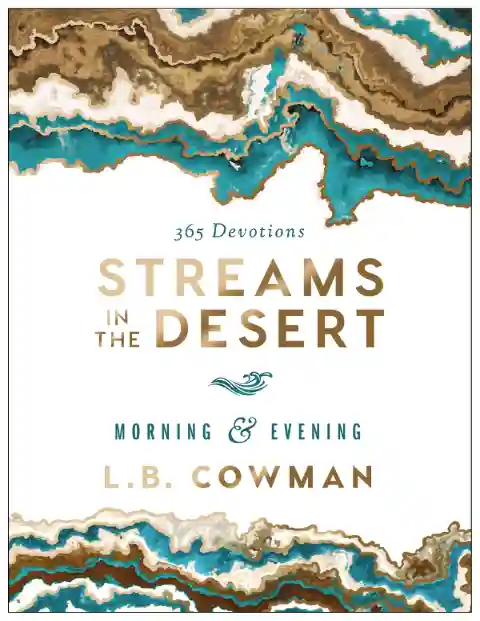

Streams In The Desert: Morning And Evening. 365 Devotions Order Printed Copy
- Author: L. B. Cowman
- Size: 12.88MB | 1389 pages
- |
Others like streams in the desert: morning and evening. 365 devotions Features >>

Streams In The Desert
-160.webp)
A Gentle Thunder: Hearing God Through The Storm

God's Favorite House

God Will Carry You Through

Double Diamond Daily Devotional
Soaking In God's Presence

Having A Mary Heart In A Martha World - Finding Intimacy With God In The Busyness Of Life
Winged Life
A Grief Observed

A Life Of Worship
About the Book
"Streams in the Desert: Morning and Evening" is a devotional book that offers daily reflections, prayers, and scriptures for each day of the year. The author, L.B. Cowman, draws on her personal experiences and observations to provide readers with inspiration, encouragement, and spiritual guidance to help navigate life's challenges and find solace in God's presence. This book is designed to offer comfort and hope in times of uncertainty and to help readers deepen their faith and trust in God.
Helen Roseveare

do you wish to be pure
Life calls us to do hard things. Athletes push through tremendous pain to gain victories. Doctors perform long, delicate surgeries to save lives. Soldiers overcome insurmountable odds to protect nations. Mothers endure excruciating pain to bring babies into the world. And Jesus calls us to do even harder things — actually, impossible things. He commanded Peter to step out of the boat, and Peter obeyed and walked on water (Matthew 14:29). Jesus commanded Lazarus, who had been dead for four days, “Come out,” and Lazarus rose and came out, still wrapped in burial clothes (John 11:38–44). When Jesus commands, he also empowers believers to obey. Now, consider Jesus’s call for you to be pure (Matthew 5:8). At times, does it feel impossible to win the battle for purity? We can feel so discouraged that Jesus’s question to a lame man might be asked of us, “Do you want to be healed?” (John 5:6). Seems like a strange question to ask someone who had been lame for almost forty years, right? But perhaps after waiting all those years, the lame man was losing hope of ever being made well. Jesus asked because he wanted everyone to know that as the Messiah, the Savior of the world, the Son of God, he could make anyone well. Jesus could do the impossible. Jesus then commanded the lame man to pick up his pallet and walk, and he did . The point for us is clear: No matter how hard or impossible Jesus’s commands seem to us, Jesus as Lord can empower us to obey. This is encouraging news. So, if you are struggling to stop looking at porn, to finally quit masturbating, to repent of living in an impure relationship, Jesus wants you to honestly answer this question: “Do you want to be pure?” Because he can set you free. As a Christian striving to live purely, arm yourself with the following three biblical admonitions in your war against lust. 1. Hate Your Sin No one who still loves sin will genuinely ask Jesus to empower him to slay it. And Jesus doesn’t answer double-minded prayers. He hears and answers cries from broken, contrite hearts. So, pray that the Spirit will convict you (John 16:7–8) and show you the depth of your sin (Psalm 139:23–24). Pray that the Spirit will help you grow in hatred of what God hates: “Through your precepts I get understanding; therefore I hate every false way” (Psalm 119:104). In his chapter of Secret Sex Wars: A Battle Cry for Purity , H.B. Charles tells the following story: A little child was playing with a very valuable vase that he should not have even been touching. And, of course, he put his hand into it and could not get it out. His father also tried in vain to get the boy’s hand free. His parents considered breaking the vase until the father said, “Son, let’s try one more time to get you free. On the count of three, open your hand and hold your fingers as straight as you can, and then pull.” To their astonishment the little fellow said, “Oh no, Daddy, I can’t put my fingers out like that. If I do, I’ll drop my pennies!” The Holy Spirit stirs in the hearts of believers’ hearts to hate our sin so that we renounce it. This hatred is not a hatred that leaves a person self-loathing and longing to do penance. This hatred of sin produced by the Spirit turns us from the grips of sin to the fountain filled with blood drawn from Immanuel’s veins. It is there that Jesus cleanses our hearts and affections so that we lose all our filthy stains. Spirit-convicted Christians cry out to Jesus, like Paul, “Wretched man that I am! Who will deliver me from this body of death?” (Romans 7:24). From that well of despair, we find soul-rejoicing hope in the forgiveness and victory over sin won by Christ. There, we will exclaim with Paul, “Thanks be to God through Jesus Christ our Lord!” (Romans 7:25). So, don’t be self-deceived. No one can repent of a sin and cherish it at the same time. That is the eternal, profound difference between worldly sorrow and genuine, life-giving repentance (2 Corinthians 7:10). 2. Satisfy Your Soul in Christ The Spirit makes the good news real to convicted sinners. He convinces us that through Jesus’s death and resurrection, Christ has become our Lord, that he saves broken sinners, that his death atoned for our sin, that he does not cast away bruised reeds and flickering wicks. He convinces his chosen people that Jesus has saved us and that he empowers us to become more like him (Galatians 5:22–25). “No one who still loves sin will genuinely ask Jesus to empower him to slay it.” He does this by satisfying us through worship. Jesus saved the immoral Samaritan woman, and in doing so, he gave her the living water that would satisfy her thirst so that she wouldn’t have to yield to the desire for immoral relationships again (John 4:13–14). This same Jesus is alive today. He sits at the right hand of the Father with all authority in heaven and on earth. He still gives his Spirit to all whom he saves (1 Corinthians 12:13) and through the Spirit satisfies the souls of repentant sinners. Jesus says, “These things I speak in the world, that they may have my joy fulfilled in themselves” (John 17:13). Therefore, relish and delight your soul in Christ’s gracious, gospel-purchased gifts. If you are a child of God, delight that you have been reconciled to God. You are forgiven. You have eternal life. You have been born again. You have been delivered from the power of the kingdom of darkness. You have overcome the world. You are loved by God. You will never be left alone or separated from his love. You will be made like him when you see him as he is. And in the meantime, you will be purified by fixing your mind on the hope he offers. “Everyone who has this hope fixed on Him purifies himself, just as He is pure” (1 John 3:3 NASB). The Spirit daily wants to fix your hope on Jesus and his gospel. He daily wants to satisfy your soul with the banquet of all these gospel blessings and more. So, eat at the banquet of the redeemed, freely. 3. Put to Death the Deeds of the Flesh The word of God commands that we “put to death . . . what is earthly in you: sexual immorality, impurity, passion, evil desire, and covetousness, which is idolatry” (Colossians 3:5). “This is the will of God, your sanctification: that you abstain from sexual immorality” (1 Thessalonians 4:3). But saying “No!” to sexual temptation might sound as easy as walking on water. So, we must believe that Jesus commands, and empowers, us to do the impossible. Let the Helper help you. Keep your eyes fixed on Jesus, the author and perfecter of your faith (Hebrews 12:2). When Peter took his eyes off of Jesus, he started to sink. But dear saint of God, Peter didn’t drown. He cried out to our Lord, “Save me,” and “Jesus immediately reached out his hand and took hold of him.” Then rebuking him, Jesus said, “O you of little faith, why did you doubt?” (Matthew 14:30–31). Don’t doubt that the Spirit empowers you to do what he calls you to do, and don’t believe he will reject you when you need his help. Fighting for your purity isn’t supposed to be easy; it is war. Picking up your cross and dying daily (Luke 9:23) is a slow, painful process. Yet born-again believers can (and will) because Jesus died our death for us (Romans 6:6–7) and gave us his Spirit to empower us (Romans 8:13). Our War Is Winnable Let’s end by asking our opening question in a slightly different way: Do you believe that Jesus’s death and resurrection and the gift of his Spirit can make you pure? I pray that you do. In an infinitely greater way than D-Day, Jesus’s cross turned the tide for every believer in our war against sin. This is a winnable war — not perfectly winnable, but truly winnable — because of Jesus. Therefore, seek to live by the power of the Spirit today, get accountability, and put to death the deeds of the flesh. Then bask again in Jesus’s gospel-grace tomorrow, and fight for your purity again and for every tomorrow that he gives you. You can win the war for sexual purity.