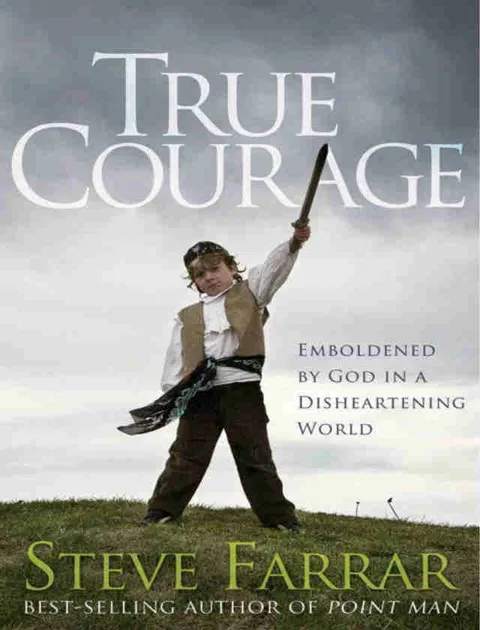

Others like true courage - emboldened by god Features >>




About the Book
In "True Courage - Emboldened by God" Steve Farrar explores the concept of courage in the Christian life. He offers practical advice and Biblical wisdom on how to cultivate true courage by relying on God's strength and guidance. Farrar encourages readers to step out in faith and be bold in facing the challenges and trials of life with God by their side. The book emphasizes the importance of trusting in God's power and promises as the source of courage and strength.
C.S. Lewis
 C.S. Lewis was a prolific Irish writer and scholar best known for his 'Chronicles of Narnia' fantasy series and his pro-Christian texts.
Who Was C.S. Lewis?
Writer and scholar C.S. Lewis taught at Oxford University and became a renowned Christian apologist writer, using logic and philosophy to support the tenets of his faith. He is also known throughout the world as the author of The Chronicles of Narnia fantasy series, which have been adapted into various films for the big and small screens.
Early Life
Clive Staples Lewis was born in Belfast, Ireland, on November 29, 1898, to Flora August Hamilton Lewis and Albert J. Lewis. As a toddler, Clive declared that his name was Jack, which is what he was called by family and friends. He was close to his older brother Warren and the two spent much time together as children.
Lewis was enraptured by fantastic animals and tales of gallantry, and hence the brothers created the imaginary land of Boxen, complete with an intricate history that served them for years. Lewis' mother died when he was 10, and he went on to receive his pre-college education at boarding schools and from a tutor. During WWI, he served with the British army and was sent home after being wounded by shrapnel. He then chose to live as a surrogate son with Janie Moore, the mother of a friend of Lewis' who was killed in the war.
Teaching Career at Oxford and Wartime Broadcasts
Lewis graduated from Oxford University with a focus on literature and classic philosophy, and in 1925 he was awarded a fellowship teaching position at Magdalen College, which was part of the university. There, he also joined the group known as The Inklings, an informal collective of writers and intellectuals who counted among their members Lewis' brother Warren and J.R.R. Tolkien. It was through conversations with group members that Lewis found himself re-embracing Christianity after having become disillusioned with the faith as a youth. He would go on to become renowned for his rich apologist texts, in which he explained his spiritual beliefs via platforms of logic and philosophy.
Lewis began publishing work including Spirits in Bondage in 1919 and the satirical Dymer in 1926. After penning other titles — including The Allegory of Love (1936), for which he won the Hawthornden Prize — he released in 1938 his first sci-fi work, Out of the Silent Planet, the first of a space trilogy which dealt sub-textually with concepts of sin and desire. Later, during WWII, Lewis gave highly popular radio broadcasts on Christianity which won many converts; his speeches were collected in the work Mere Christianity.
Books and Film Legacy
Lewis was a prolific author of fiction and nonfiction who wrote dozens of books over the course of his career. His faith-based arguments as seen in texts like The Great Divorce (1946) and Miracles (1947) are held in high regard by many theologians, scholars and general readers. His satirical fiction novel The Screwtape Letters (1942) is also a beloved classic. Lewis also continued his love affair with classic mythology and narratives during his later years: His book Till We Have Faces: A Myth Retold (1956) featured the story of Psyche and Cupid. He also penned an autobiography, Surprised by Joy: The Shape of My Early Life (1955).
Lewis' landmark series, The Chronicles of Narnia, has seen a number of on-screen iterations, including a cartoon version of The Lion, The Witch and the Wardrobe that was released in 1979 and a 1989 film series. Additionally, in 2005, a big-screen adaptation of The Lion, The Witch and the Wardrobe hit movie theaters, starring Tilda Swinton as the witch Jadis and Liam Neeson as the voice of Aslan. Two more Narnia films were brought to theaters as well: Prince Caspian (2008) and The Voyage of the Dawn Treader (2010). A movie version of The Silver Chair was slated to hit theaters in the near future, with filming starting in the winter of 2018.
Lewis' relationship with his wife, Joy, has also been depicted in Shadowlands, presented as a play and two films; one of the film versions was directed by Richard Attenborough and starred Anthony Hopkins as Lewis.
'The Chronicles of Narnia'
During the 1940s, Lewis began writing the seven books that would comprise The Chronicles of Narnia children's series, with The Lion, The Witch and the Wardrobe (1950) being the first release. The story focused on four siblings who, during wartime, walk through an armoire to enter the magical world of Narnia, a land resplendent with mythical creatures and talking animals. Throughout the series, a variety of Biblical themes are presented; one prominent character is Aslan, a lion and the ruler of Narnia, who has been interpreted as a Jesus Christ figure. (Lewis would assert that his Narnia stories weren't a direct allegory to the real world.)
Though the book received some negative reviews, it was generally well-received by readers, and the series retained its international popularity over the following decades.
Marriage
In 1954, Lewis joined the faculty of Cambridge University as a literature professor, and in 1956 he married an American English teacher, Joy Gresham, with whom he had been in correspondence. Lewis was full of happiness during the years of their marriage, though Gresham died of cancer in 1960. Lewis grieved deeply for his wife and shared his thoughts in the book A Grief Observed, using a pen name.
Death
In 1963, Lewis resigned from his Cambridge position after experiencing heart trouble. He died on November 22, 1963, in Headington, Oxford.
C.S. Lewis was a prolific Irish writer and scholar best known for his 'Chronicles of Narnia' fantasy series and his pro-Christian texts.
Who Was C.S. Lewis?
Writer and scholar C.S. Lewis taught at Oxford University and became a renowned Christian apologist writer, using logic and philosophy to support the tenets of his faith. He is also known throughout the world as the author of The Chronicles of Narnia fantasy series, which have been adapted into various films for the big and small screens.
Early Life
Clive Staples Lewis was born in Belfast, Ireland, on November 29, 1898, to Flora August Hamilton Lewis and Albert J. Lewis. As a toddler, Clive declared that his name was Jack, which is what he was called by family and friends. He was close to his older brother Warren and the two spent much time together as children.
Lewis was enraptured by fantastic animals and tales of gallantry, and hence the brothers created the imaginary land of Boxen, complete with an intricate history that served them for years. Lewis' mother died when he was 10, and he went on to receive his pre-college education at boarding schools and from a tutor. During WWI, he served with the British army and was sent home after being wounded by shrapnel. He then chose to live as a surrogate son with Janie Moore, the mother of a friend of Lewis' who was killed in the war.
Teaching Career at Oxford and Wartime Broadcasts
Lewis graduated from Oxford University with a focus on literature and classic philosophy, and in 1925 he was awarded a fellowship teaching position at Magdalen College, which was part of the university. There, he also joined the group known as The Inklings, an informal collective of writers and intellectuals who counted among their members Lewis' brother Warren and J.R.R. Tolkien. It was through conversations with group members that Lewis found himself re-embracing Christianity after having become disillusioned with the faith as a youth. He would go on to become renowned for his rich apologist texts, in which he explained his spiritual beliefs via platforms of logic and philosophy.
Lewis began publishing work including Spirits in Bondage in 1919 and the satirical Dymer in 1926. After penning other titles — including The Allegory of Love (1936), for which he won the Hawthornden Prize — he released in 1938 his first sci-fi work, Out of the Silent Planet, the first of a space trilogy which dealt sub-textually with concepts of sin and desire. Later, during WWII, Lewis gave highly popular radio broadcasts on Christianity which won many converts; his speeches were collected in the work Mere Christianity.
Books and Film Legacy
Lewis was a prolific author of fiction and nonfiction who wrote dozens of books over the course of his career. His faith-based arguments as seen in texts like The Great Divorce (1946) and Miracles (1947) are held in high regard by many theologians, scholars and general readers. His satirical fiction novel The Screwtape Letters (1942) is also a beloved classic. Lewis also continued his love affair with classic mythology and narratives during his later years: His book Till We Have Faces: A Myth Retold (1956) featured the story of Psyche and Cupid. He also penned an autobiography, Surprised by Joy: The Shape of My Early Life (1955).
Lewis' landmark series, The Chronicles of Narnia, has seen a number of on-screen iterations, including a cartoon version of The Lion, The Witch and the Wardrobe that was released in 1979 and a 1989 film series. Additionally, in 2005, a big-screen adaptation of The Lion, The Witch and the Wardrobe hit movie theaters, starring Tilda Swinton as the witch Jadis and Liam Neeson as the voice of Aslan. Two more Narnia films were brought to theaters as well: Prince Caspian (2008) and The Voyage of the Dawn Treader (2010). A movie version of The Silver Chair was slated to hit theaters in the near future, with filming starting in the winter of 2018.
Lewis' relationship with his wife, Joy, has also been depicted in Shadowlands, presented as a play and two films; one of the film versions was directed by Richard Attenborough and starred Anthony Hopkins as Lewis.
'The Chronicles of Narnia'
During the 1940s, Lewis began writing the seven books that would comprise The Chronicles of Narnia children's series, with The Lion, The Witch and the Wardrobe (1950) being the first release. The story focused on four siblings who, during wartime, walk through an armoire to enter the magical world of Narnia, a land resplendent with mythical creatures and talking animals. Throughout the series, a variety of Biblical themes are presented; one prominent character is Aslan, a lion and the ruler of Narnia, who has been interpreted as a Jesus Christ figure. (Lewis would assert that his Narnia stories weren't a direct allegory to the real world.)
Though the book received some negative reviews, it was generally well-received by readers, and the series retained its international popularity over the following decades.
Marriage
In 1954, Lewis joined the faculty of Cambridge University as a literature professor, and in 1956 he married an American English teacher, Joy Gresham, with whom he had been in correspondence. Lewis was full of happiness during the years of their marriage, though Gresham died of cancer in 1960. Lewis grieved deeply for his wife and shared his thoughts in the book A Grief Observed, using a pen name.
Death
In 1963, Lewis resigned from his Cambridge position after experiencing heart trouble. He died on November 22, 1963, in Headington, Oxford.
God Can Meet Us in the Ashes
Strict practitioners would not have approved of my methods, but on one long ago mid-winter Wednesday, I smeared ashes on the foreheads of my two preschoolers and myself. An offering of the hardwood that had heated our home the day before, these ashes were not “ceremonially correct” in any way. At the time, I did not know that traditional Ash Wednesday ashes come from the remains of Palm Sunday palms. I did not even know about the forty days of Lent to follow. However, I did know about sin — my own and my children’s. We were in “time out” season with one of our sons. At our wits’ end, we had exhausted Dr. Dobson, Elisabeth Elliot, and every parenting resource available in the nineties. “Why is it so hard to be good?” our little Dobson-buster would ask. His younger brother’s eyes would fill with tears whenever they were caught in collaborative naughtiness. In this parenting pressure cooker, maternal apologies had become a daily occurrence. I was hoping to model repentance — while at the same time atoning for sharp words and a short fuse. “I was wrong; please forgive me” were the words through which my sons were learning that their mother had not outgrown the struggle against sin. Ash Wednesday gives Christians an opportunity to grow in our understanding of where to take that struggle. Reclaiming Lent for Christ Historically, our earliest Protestant ancestors revolted against the idea of Lenten practices, and with good reason. In the pre-Reformation mind, penitence, ashes, and self-denial had become ends in themselves. Gradually, however, a biblical understanding of lament has re-entered Christian orthodoxy, anchored in an embrace of our fallen-ness. Ashes on the forehead rightly represent our need to “repent in dust and ashes” (Job 42:5–6), and our identity as “a people of unclean lips [who] dwell in the midst of a people of unclean lips” (Isaiah 6:5). Jesus pronounced a blessing upon those who recognize their poverty of spirit and mourn the effects of sin on their life and in the world (Matthew 5:3–4). Grounded in gospel truth that prompts genuine penitence without crippling guilt and deep conviction without devastating shame, Ash Wednesday invites the believer to a renewed awe of our great salvation. While there is no merit in the wearing of ashes, a season of mourning leading up to Easter may actually enhance our celebration of Resurrection Sunday. A Wednesday to Teach In my challenging season of parenting, Ash Wednesday became a visual aid, a teaching tool to reassure my young sons that our sin does not signal the end of God’s love for us. In our home, hymns around the breakfast table always matched the season, and one year, we learned all four verses of a “cross hymn” in the weeks leading up to Easter. Rich hymns of the faith offer deep gospel truth that requires explanation (but not dilution) for little singers: When I survey the wondrous cross On which the Prince of Glory died, All the vain things that charm me most I sacrifice them to His blood. The vain-ness of the “vain things” Isaac Watts wrote about becomes abundantly clear when we remember that nothing lasts forever. “Remember that you are dust” is the lyric of Ash Wednesday. God made us from dust, and our bodies do not live forever. This is a dying world we inhabit: everything from goldfish to grandfathers eventually stops living. And we mourn the loss. Without becoming morbid or frightening, we can prepare our children for the inevitability of death by putting it in the context of the gospel. Thomas á Kempis prescribed a regular pondering of and preparation for death as a route to happiness. Author Gary Thomas suggests that we present-day believers ought to join á Kempis in allowing the reality of death to act “like a filter, helping us to hold on to the essential and let go of the trivial.” For believers, the “essential” is the eternal, and the eternal comes to us through the cross. The paradox of death leading to rebirth only appears to be a contradiction. All of Christ’s gifts are given to us through death — his death. And it will only be through a different death — our death — that we will finally receive the fullness of life that Jesus died to impart. A Wednesday to Remember My sons and I stood before a mirror together, the three of us with our smudged foreheads. We talked about our struggle to obey God and our sadness over sin — the sin that causes mayhem in our home, hurt feelings between brothers, and, worst of all, separation from a God who loves us. When a little boy is struggling with disobedience, even as a preschooler, he already feels the grit and grind of life on a fallen planet. He may not be able to comprehend sin’s cosmic scale: “For the creation was subjected to futility, not willingly, but because of him who subjected it, in hope. . .” (Romans 8:20). But he is already well-acquainted with the collective groaning, and can love the truth about the hope of our future deliverance from the struggle: “. . . that the creation itself will be set free from its bondage to corruption and obtain the freedom of the glory of the children of God” (Romans 8:21). Reading selected, age-appropriate portions of the crucifixion story from Luke 22 and thinking about Jesus’s willingness to endure the weight of all the sins of the entire world on his body provides a focus for the wearing of our ashes as a symbol of our grief — mourning that we have sinned and caused division from God and sadness over the suffering Jesus endured when he died in our place. A Wednesday to Rejoice If good behavior is all I have to bring to Jesus, he cannot help me. The warm welcome of the gospel on a frigid day in early spring takes into account a little boy’s hopelessness in the face of temptation. Our sin does not signal the end of our relationship with God. It’s a beginning, for it turns out that weakness is a powerful claim upon divine mercy. Learning to hate sin at a young age, to war against it, and to receive God’s forgiveness is a celebratory milestone. There is a reason to rejoice because of Christ’s obedience to all that God commanded. Then, his love in paying the penalty for our failure to obey gives us a reason for hope, even against the backdrop of my own parenting fiascos and my sons’ serial naughtiness. God knows well the stuff we are made of. “He remembers that we are dust” (Psalm 103:14). As a loving heavenly Father, he longs to supply every need for righteous living — in fact it is only his righteousness that will suffice. This orientation provides a solid foundation for a lifelong relationship built on the assurance that God’s purposes will not be thwarted by my sin. He delights to meet me and my children in the ashes. Article by Michele Morin