

Kenneth E. Hagin
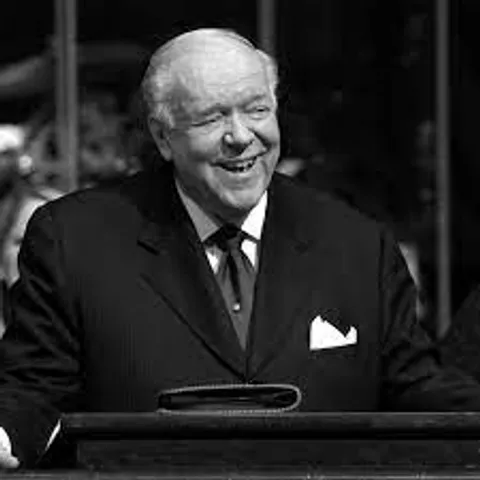 Rev. Kenneth Erwin Hagin was born on Aug. 20, 1917, in McKinney, Texas. Rev. Hagin was sickly as a child, suffering from a deformed heart and an incurable blood disease. He was not expected to live and became bedfast at age 15. In April 1933 during a dramatic conversion experience, he reported dying three times in 10 minutes, each time seeing the horrors of hell and then returning to life.
In August 1934, Rev. Hagin was miraculously healed, raised off a deathbed by the power of God and the revelation of faith in God’s Word. Jesus appeared to Rev. Hagin eight times over the next several years in visions that changed the course of his ministry. In 1967, he began a regular radio broadcast that continues today as Rhema for Today.
In 1968 Rev. Hagin published the first issues of The Word of Faith. That magazine, now produced nine times a year, has a circulation of over 200,000. The publishing outreach he founded, Faith Library Publications, has circulated worldwide more than 75 million copies of books by Rev. Hagin, Kenneth W. Hagin, Lynette Hagin, Craig W. Hagin, and several other authors. Faith Library Publications also has produced millions of audio and video teachings.
Other outreaches of Kenneth Hagin Ministries include Rhema Praise, a weekly television broadcast hosted by Revs. Kenneth and Lynette Hagin; Rhema Correspondence Bible School; Rhema Alumni Association; Rhema Ministerial Association International; the Rhema Prayer and Healing Center; and the Rhema prison ministry.
In 1974 Rev. Hagin founded what is now Rhema Bible Training College. The school has campuses all over the world and continues to expand.
Until shortly before his death, Rev. Hagin continued to travel and teach throughout the United States and into Canada conducting All Faiths’ Crusades and other special meetings.
Known as the “father of the modern faith movement,” Rev. Hagin was a dynamic preacher, teacher, and prophet. His teachings and books are filled with vivid stories that show God’s power and truth working in his life and the lives of others. He will be remembered not only as a great minister but as a great family man—for his family was his heart. He was there at every milestone ready to talk, to answer, to pray. He was a man whose belly laugh filled the room at the sight of one of his grandchildren or great-grandchildren.
Rev. Kenneth Erwin Hagin was born on Aug. 20, 1917, in McKinney, Texas. Rev. Hagin was sickly as a child, suffering from a deformed heart and an incurable blood disease. He was not expected to live and became bedfast at age 15. In April 1933 during a dramatic conversion experience, he reported dying three times in 10 minutes, each time seeing the horrors of hell and then returning to life.
In August 1934, Rev. Hagin was miraculously healed, raised off a deathbed by the power of God and the revelation of faith in God’s Word. Jesus appeared to Rev. Hagin eight times over the next several years in visions that changed the course of his ministry. In 1967, he began a regular radio broadcast that continues today as Rhema for Today.
In 1968 Rev. Hagin published the first issues of The Word of Faith. That magazine, now produced nine times a year, has a circulation of over 200,000. The publishing outreach he founded, Faith Library Publications, has circulated worldwide more than 75 million copies of books by Rev. Hagin, Kenneth W. Hagin, Lynette Hagin, Craig W. Hagin, and several other authors. Faith Library Publications also has produced millions of audio and video teachings.
Other outreaches of Kenneth Hagin Ministries include Rhema Praise, a weekly television broadcast hosted by Revs. Kenneth and Lynette Hagin; Rhema Correspondence Bible School; Rhema Alumni Association; Rhema Ministerial Association International; the Rhema Prayer and Healing Center; and the Rhema prison ministry.
In 1974 Rev. Hagin founded what is now Rhema Bible Training College. The school has campuses all over the world and continues to expand.
Until shortly before his death, Rev. Hagin continued to travel and teach throughout the United States and into Canada conducting All Faiths’ Crusades and other special meetings.
Known as the “father of the modern faith movement,” Rev. Hagin was a dynamic preacher, teacher, and prophet. His teachings and books are filled with vivid stories that show God’s power and truth working in his life and the lives of others. He will be remembered not only as a great minister but as a great family man—for his family was his heart. He was there at every milestone ready to talk, to answer, to pray. He was a man whose belly laugh filled the room at the sight of one of his grandchildren or great-grandchildren.
What Is Life’s Ultimate Good
Dear Dan, I agree; any view that has God as the foundation of morality — like the Christian view I described in my last letter — will have further, serious issues to address. In fact, your two objections get at the most central ones. Let me respond to both. What Makes God’s Laws Good? Your first objection has a great pedigree and can be traced all the way back to Plato. Namely, what makes God’s moral laws — his moral values — good? Does he like these laws because they are good? Or are they good because he likes them? Either way seems to spell trouble for Christianity. Take the first option. Are God’s laws good because they meet some separate standard of good, one “outside” of God? If so, God has to defer to — is beholden to — some higher authority. And that’s impossible, according to Christianity. But the alternative seems just as bad. If God’s laws are good because he likes them, it makes morality seem arbitrary, dependent merely on his personal tastes or whims. After all, what if he had preferred things like murder, rape, and torture? Would these therefore be good? Do we really want to define “good” as “what God likes,” similar to the way “coolness” is just whatever the cool kids like? Wouldn’t this rob statements like “God is good” of all significance, reducing them to saying merely that “God is the way he is”? Again, neither choice looks very promising. So, which horn of the dilemma should the Christian choose? Goodness Is Godness I think the second option is the right one: God’s laws are good because he likes them. That is, anything that God likes or values is good by definition. Goodness just is Godness. So then, is the phrase “God is good” nothing but an empty tautology, saying no more than “God is God”? “Anything that God likes or values is good by definition. Goodness just is Godness.” Well, no. In this specific context, where we’re defining “good,” “God is good” tells us something informative — namely, that God’s values are what make things morally good. But in most other contexts, when we say, “God is good” we can generally take for granted which properties or characteristics go on the “good” list. In these ordinary cases, “God is good” expresses something different — for example, “Here’s what God is like: he hates lying, murder, stealing — things we all agree are bad.” But then, if goodness is defined as whatever God likes, doesn’t my view mean that murder and rape would have been good if God had liked them? In a sense, perhaps; at least their advocacy would have been included in his moral laws. But remember that we’re currently defining “good,” and I think some of the rhetorical force of the wouldn’t-rape-therefore-be-good objection comes from ignoring this context. After all, it seems that regardless of what we say ultimately “makes” something good, if that “good-maker” were different, good would be different. And in any case, the traditional Christian view of God holds that he couldn’t have liked these things, that it’s logically impossible for God to be different than he is, just as a square couldn’t fail to have four equal sides. It turns out, therefore, that things aren’t as nearly as bad as the objection initially implied. Why Follow God’s Moral Law? Then there’s your second objection: why should we follow God’s laws? Is it because, if we don’t, he’ll submit us to everlasting punishment? Should we follow God’s laws simply to avoid pain? Does it turn out, after all, that morality is merely a matter of might makes right? Well, I think Christians should acknowledge that avoiding pain and suffering is a good reason to follow God’s moral laws. Moreover, I concede that this would be a genuine problem — if this were the only reason for obeying God. And as I said, even this reason isn’t without its virtues. After all, if we think of God as a parent — which the Bible encourages us to do — it’s a perfectly good reason, morally as well as rationally. As children we often obeyed our parents, in part, to avoid discipline. In fact, this was the reason for discipline in the first place — to help motivate us to obey. But of course, our obedience wasn’t merely motivated by a fear of discipline. We also obeyed our parents because we loved and trusted them. We knew that their requirements were an integral part of their deep love and affection for us, that they gave us these rules to benefit us. Their laws were evidence of our parents’ love. This interweaving of love and law, this close relation between our love for our parents, their love for us, and their moral values (that is, their moral loves) usually resulted in us adopting their morals; their values naturally became our values. We liked these values. And it didn’t stop with moral values; we sometimes adopted our parents’ values about sports teams, movies, and music — again, sometimes simply because we loved them. So, according to my view, we ought to follow God’s laws because, ultimately, we want to — and the main reason we want to is that we love him. In this way, morality is ultimately personal and grounded in what we love. Meaning of Life The personal aspect of value isn’t limited to moral value; it’s a component of all value, including life’s ultimate value. What we might call life’s ultimate meaning or purpose is perhaps the most important topic of all. So, what is our ultimate value, meaning, purpose, or goal in life? Well, suppose you’re right that there’s no God. The meaning of life, then, would be like all value in a godless cosmos: subjective and relative. And because each person has his own values, there would be as many meanings of life as there are persons. In such a world, there would be no objective meaning that life has. But according to Christianity, humans have been made for something, for a purpose. Moreover, this purpose does not depend on us, and so, in this sense, it’s objective, human-independent. And because we were designed for a specific purpose, humans will only truly flourish and thrive by fulfilling this purpose. Fulfilling God’s purpose for us is life’s ultimate meaning. That doesn’t mean that, in a world without God, humans could not find some measure of meaning or value in things like family, work, art, gardening, or whatever. But unless these individual goods are put into the context of the much larger, overall purpose, they will never be as meaningful (to us) as they could be. Only by fulfilling this ultimate purpose is our meaning of life maximized. What Are Humans For? What is this larger context or purpose? What were we made for? We find a hint by noticing that, for many of us, relationships and community are what we most value, where we find our greatest fulfillment. We flourish best in community with people we love. And this fact is entirely in line with the Christian view that our ultimate purpose is to know and love the ultimate Person, God himself. Christianity is of one voice on this. As one famous confession says, our ultimate purpose “is to glorify God and enjoy him forever.” Indeed, God is a loving relationship, as odd as that sounds. The mysterious doctrine of the Trinity says that the Godhead is an intimate community of three (divine) persons. That’s what he is. (This is one reason why monistic religions can’t truly make sense of the view that God is love: Who was God loving before he created persons other than himself? Such a being couldn’t essentially be love; at best, he would need creatures in order to love.) “Our ultimate purpose is to know and love the ultimate Person, God himself.” Notice that the centrality of relationships is also evident when Jesus sums up all of God’s laws in just two: love God and love your neighbor. The moral law — and, not coincidentally, life’s ultimate meaning — is about relationships, both human and divine. God, then, created humans for his own purpose. Our purpose — the meaning of life — is also importantly objective, just as morality is: it is human-independent. Yet it’s obvious that we can and do reject God’s purpose for us. In fact, the gospel message — and the entire Bible — is predicated on such rejection. But God has given us another chance to truly flourish, to find ultimate meaning through the life, death, and resurrection of Jesus Christ. He has made this possible at an immense cost to himself. Dan, I get why you would reject Christianity, viewing it as you do from the outside. I hope you’ll continue to consider all this and at least begin to sense that genuine atheism might be a lot different from your current “kinder, gentler” version. I also hope that in the process you’ll reconsider Christianity’s claims — in particular, Jesus’s offering of himself and the relationship you were made for. Article by Mitch Stokes

