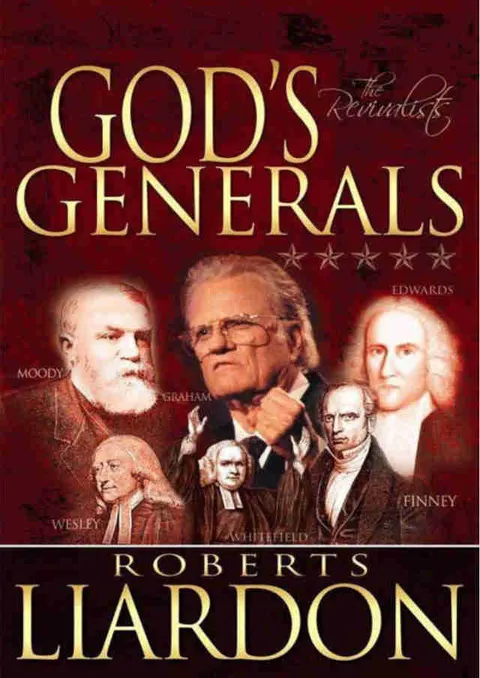

God's Generals: The Revivalists Order Printed Copy
- Author: Roberts Liardon
- Size: 1.59MB | 427 pages
- |
Others like god's generals: the revivalists Features >>
-160.webp)
God's Generals (Aimee Semple Mcpherson)
God's Generals: William Branham

God’s Generals: John Alexander Dowie
God's Generals: Why They Succeeded And Why Some Failed
God's Generals - The Martyrs
-160.webp)
God's Generals (Maria Woodworth)
God's Generals: The Roaring Reformers
-160.webp)
God's Generals (Smith Wigglesworth)
God's Generals: Jack Coe
God's Generals: Evan Roberts
About the Book
"God's Generals: The Revivalists" by Roberts Liardon is a historical account of the lives and ministries of some of the most influential Christian revivalists throughout history. The book highlights the incredible faith, dedication, and impact of individuals such as John Wesley, Charles Finney, Maria Woodworth-Etter, and others who played key roles in sparking spiritual revivals around the world. Through their stories, readers can gain inspiration and insight into how these leaders overcame challenges and obstacles to bring about transformative change in their communities.
David Livingstone
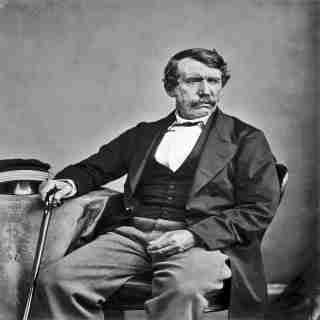 "[I am] serving Christ when shooting a buffalo for my men or taking an observation, [even if some] will consider it not sufficiently or even at all missionary."
With four theatrical words, "Dr. Livingstone, I presume?"—words journalist Henry Morton Stanley rehearsed in advance—David Livingstone became immortal. Stanley stayed with Livingstone for five months and then went off to England to write his bestseller, How I Found Livingstone. Livingstone, in the meantime, got lost again—in a swamp literally up to his neck. Within a year and a half, he died in a mud hut, kneeling beside his cot in prayer.
Berlin Congress spurs African independent churches
The whole civilized world wept. They gave him a 21-gun salute and a hero's funeral among the saints in Westminster Abbey. "Brought by faithful hands over land and sea," his tombstone reads, "David Livingstone: missionary, traveler, philanthropist. For 30 years his life was spent in an unwearied effort to evangelize the native races, to explore the undiscovered secrets, and to abolish the slave trade." He was Mother Teresa, Neil Armstrong, and Abraham Lincoln rolled into one.
Highway man
At age 25, after a childhood spent working 14 hours a day in a cotton mill, followed by learning in class and on his own, Livingstone was captivated by an appeal for medical missionaries to China. As he trained, however, the door to China was slammed shut by the Opium War. Within six months, he met Robert Moffat, a veteran missionary of southern Africa, who enchanted him with tales of his remote station, glowing in the morning sun with "the smoke of a thousand villages where no missionary had been before."
For ten years, Livingstone tried to be a conventional missionary in southern Africa. He opened a string of stations in "the regions beyond," where he settled down to station life, teaching school and superintending the garden. After four years of bachelor life, he married his "boss's" daughter, Mary Moffat.
From the beginning, Livingstone showed signs of restlessness. After his only convert decided to return to polygamy, Livingstone felt more called than ever to explore. During his first term in South Africa, Livingstone made some of the most prodigious—and most dangerous—explorations of the nineteenth century. His object was to open a "Missionary Road"—"God's Highway," he also called it—1,500 miles north into the interior to bring "Christianity and civilization" to unreached peoples.
Explorer for Christ
On these early journeys, Livingstone's interpersonal quirks were already apparent. He had the singular inability to get along with other Westerners. He fought with missionaries, fellow explorers, assistants, and (later) his brother Charles. He held grudges for years. He had the temperament of a book-reading loner, emotionally inarticulate except when he exploded with Scottish rage. He held little patience for the attitudes of missionaries with "miserably contracted minds" who had absorbed "the colonial mentality" regarding the natives. When Livingstone spoke out against racial intolerance, white Afrikaners tried to drive him out, burning his station and stealing his animals.
He also had problems with the London Missionary Society, who felt that his explorations were distracting him from his missionary work. Throughout his life, however, Livingstone always thought of himself as primarily a missionary, "not a dumpy sort of person with a Bible under his arms, [but someone] serving Christ when shooting a buffalo for my men or taking an observation, [even if some] will consider it not sufficiently or even at all missionary."
Though alienated from the whites, the natives loved his common touch, his rough paternalism, and his curiosity. They also thought he might protect them or supply them with guns. More than most Europeans, Livingstone talked to them with respect, Scottish laird to African chief. Some explorers took as many as 150 porters when they traveled; Livingstone traveled with 30 or fewer.
On an epic, three-year trip from the Atlantic Ocean to the Indian Ocean (reputedly the first by a European) Livingstone was introduced to the 1,700-mile-long Zambezi. The river was also home to Victoria Falls, Livingstone's most awe-inspiring discovery. The scene was "so lovely," he later wrote, that it "must have been gazed upon by angels in their flight."
Despite its beauty, the Zambezi was a river of human misery. It linked the Portuguese colonies of Angola and Mozambique, the main suppliers of slaves for Brazil, who in turn sold to Cuba and the United States. Though Livingstone was partially driven by a desire to create a British colony, his primary ambition was to expose the slave trade and cut it off at the source. The strongest weapon in this task, he believed, was Christian commercial civilization. He hoped to replace the "inefficient" slave economy with a capitalist economy: buying and selling goods instead of people.
The ill-fated Zambezi expedition
After a brief heroic return to England, Livingstone returned to Africa, this time to navigate 1,000 miles up the Zambezi in a brass-and-mahogany steamboat to establish a mission near Victoria Falls. The boat was state-of-the-art technology but proved too frail for the expedition. It leaked horribly after repeatedly running aground on sandbars.
Livingstone pushed his men beyond human endurance. When they reached a 30-foot waterfall, he waved his hand, as if to wish it away, and said, "That's not supposed to be there." His wife, who had just given birth to her sixth child, died in 1862 beside the river, only one of several lives claimed on the voyage. Two years later, the British government, which had no interest in "forcing steamers up cataracts," recalled Livingstone and his mission party.
A year later, he was on his way back to Africa again, this time leading an expedition sponsored by the Royal Geographical Society and wealthy friends. "I would not consent to go simply as a geographer," he emphasized, but as biographer Tim Jeal wrote, "It would be hard to judge whether the search for the Nile's source or his desire to expose the slave trade was his dominant motive." The source of the Nile was the great geographical puzzle of the day. But more important to Livingstone was the possibility of proving that the Bible was true by tracing the African roots of Judaism and Christianity.
For two years he simply disappeared, without a letter or scrap of information. He reported later that he had been so ill he could not even lift a pen, but he was able to read the Bible straight through four times. Livingstone's disappearance fascinated the public as much as Amelia Earhart's a few generations later.
When American journalist Henry Stanley found Livingstone, the news exploded in England and America. Papers carried special editions devoted to the famous meeting. In August 1872, in precarious health, Livingstone shook Stanley's hand and set out on his final journey.
When Livingstone had arrived in Africa in 1841, it was as exotic as outer space, called the "Dark Continent" and the "White Man's Graveyard." although the Portuguese, Dutch, and English were pushing into the interior, African maps had blank unexplored areas—no roads, no countries, no landmarks. Livingstone helped redraw the maps, exploring what are now a dozen countries, including South Africa, Rwanda, Angola, and the Republic of the Congo (formerly Zaire). And he made the West aware of the continuing evil of African slavery, which led to its being eventually outlawed.
"[I am] serving Christ when shooting a buffalo for my men or taking an observation, [even if some] will consider it not sufficiently or even at all missionary."
With four theatrical words, "Dr. Livingstone, I presume?"—words journalist Henry Morton Stanley rehearsed in advance—David Livingstone became immortal. Stanley stayed with Livingstone for five months and then went off to England to write his bestseller, How I Found Livingstone. Livingstone, in the meantime, got lost again—in a swamp literally up to his neck. Within a year and a half, he died in a mud hut, kneeling beside his cot in prayer.
Berlin Congress spurs African independent churches
The whole civilized world wept. They gave him a 21-gun salute and a hero's funeral among the saints in Westminster Abbey. "Brought by faithful hands over land and sea," his tombstone reads, "David Livingstone: missionary, traveler, philanthropist. For 30 years his life was spent in an unwearied effort to evangelize the native races, to explore the undiscovered secrets, and to abolish the slave trade." He was Mother Teresa, Neil Armstrong, and Abraham Lincoln rolled into one.
Highway man
At age 25, after a childhood spent working 14 hours a day in a cotton mill, followed by learning in class and on his own, Livingstone was captivated by an appeal for medical missionaries to China. As he trained, however, the door to China was slammed shut by the Opium War. Within six months, he met Robert Moffat, a veteran missionary of southern Africa, who enchanted him with tales of his remote station, glowing in the morning sun with "the smoke of a thousand villages where no missionary had been before."
For ten years, Livingstone tried to be a conventional missionary in southern Africa. He opened a string of stations in "the regions beyond," where he settled down to station life, teaching school and superintending the garden. After four years of bachelor life, he married his "boss's" daughter, Mary Moffat.
From the beginning, Livingstone showed signs of restlessness. After his only convert decided to return to polygamy, Livingstone felt more called than ever to explore. During his first term in South Africa, Livingstone made some of the most prodigious—and most dangerous—explorations of the nineteenth century. His object was to open a "Missionary Road"—"God's Highway," he also called it—1,500 miles north into the interior to bring "Christianity and civilization" to unreached peoples.
Explorer for Christ
On these early journeys, Livingstone's interpersonal quirks were already apparent. He had the singular inability to get along with other Westerners. He fought with missionaries, fellow explorers, assistants, and (later) his brother Charles. He held grudges for years. He had the temperament of a book-reading loner, emotionally inarticulate except when he exploded with Scottish rage. He held little patience for the attitudes of missionaries with "miserably contracted minds" who had absorbed "the colonial mentality" regarding the natives. When Livingstone spoke out against racial intolerance, white Afrikaners tried to drive him out, burning his station and stealing his animals.
He also had problems with the London Missionary Society, who felt that his explorations were distracting him from his missionary work. Throughout his life, however, Livingstone always thought of himself as primarily a missionary, "not a dumpy sort of person with a Bible under his arms, [but someone] serving Christ when shooting a buffalo for my men or taking an observation, [even if some] will consider it not sufficiently or even at all missionary."
Though alienated from the whites, the natives loved his common touch, his rough paternalism, and his curiosity. They also thought he might protect them or supply them with guns. More than most Europeans, Livingstone talked to them with respect, Scottish laird to African chief. Some explorers took as many as 150 porters when they traveled; Livingstone traveled with 30 or fewer.
On an epic, three-year trip from the Atlantic Ocean to the Indian Ocean (reputedly the first by a European) Livingstone was introduced to the 1,700-mile-long Zambezi. The river was also home to Victoria Falls, Livingstone's most awe-inspiring discovery. The scene was "so lovely," he later wrote, that it "must have been gazed upon by angels in their flight."
Despite its beauty, the Zambezi was a river of human misery. It linked the Portuguese colonies of Angola and Mozambique, the main suppliers of slaves for Brazil, who in turn sold to Cuba and the United States. Though Livingstone was partially driven by a desire to create a British colony, his primary ambition was to expose the slave trade and cut it off at the source. The strongest weapon in this task, he believed, was Christian commercial civilization. He hoped to replace the "inefficient" slave economy with a capitalist economy: buying and selling goods instead of people.
The ill-fated Zambezi expedition
After a brief heroic return to England, Livingstone returned to Africa, this time to navigate 1,000 miles up the Zambezi in a brass-and-mahogany steamboat to establish a mission near Victoria Falls. The boat was state-of-the-art technology but proved too frail for the expedition. It leaked horribly after repeatedly running aground on sandbars.
Livingstone pushed his men beyond human endurance. When they reached a 30-foot waterfall, he waved his hand, as if to wish it away, and said, "That's not supposed to be there." His wife, who had just given birth to her sixth child, died in 1862 beside the river, only one of several lives claimed on the voyage. Two years later, the British government, which had no interest in "forcing steamers up cataracts," recalled Livingstone and his mission party.
A year later, he was on his way back to Africa again, this time leading an expedition sponsored by the Royal Geographical Society and wealthy friends. "I would not consent to go simply as a geographer," he emphasized, but as biographer Tim Jeal wrote, "It would be hard to judge whether the search for the Nile's source or his desire to expose the slave trade was his dominant motive." The source of the Nile was the great geographical puzzle of the day. But more important to Livingstone was the possibility of proving that the Bible was true by tracing the African roots of Judaism and Christianity.
For two years he simply disappeared, without a letter or scrap of information. He reported later that he had been so ill he could not even lift a pen, but he was able to read the Bible straight through four times. Livingstone's disappearance fascinated the public as much as Amelia Earhart's a few generations later.
When American journalist Henry Stanley found Livingstone, the news exploded in England and America. Papers carried special editions devoted to the famous meeting. In August 1872, in precarious health, Livingstone shook Stanley's hand and set out on his final journey.
When Livingstone had arrived in Africa in 1841, it was as exotic as outer space, called the "Dark Continent" and the "White Man's Graveyard." although the Portuguese, Dutch, and English were pushing into the interior, African maps had blank unexplored areas—no roads, no countries, no landmarks. Livingstone helped redraw the maps, exploring what are now a dozen countries, including South Africa, Rwanda, Angola, and the Republic of the Congo (formerly Zaire). And he made the West aware of the continuing evil of African slavery, which led to its being eventually outlawed.
to men who want to marry - how to prepare to lead well
A few months into our marriage, it dawned on me: I was unprepared, as though I had studied for the wrong exam. Before our wedding, I had thought daily devotions, church and small group, and premarital counseling would sufficiently prepare me to be a godly husband. They did not. After a short season of bliss, we began to struggle and argue. So much, in fact, that our counselor literally sat between us and warned us we were in danger of fulfilling Galatians 5:15: “If you bite and devour one another, watch out that you are not consumed by one another.” My lack of preparation showed up in other ways too. I didn’t understand how to lead my wife spiritually, bring up hard conversations, or help us reconcile after an argument. My status as a seminary student and pastoral intern added layers of shame. Worst of all, I had no idea how to make our marriage better. I now know that we were not alone in our experience. My wife and I have walked with many Christian women who are deeply frustrated by the relative lack of marriage-ready Christian men, as well as with many Christian men who either don’t know they need to prepare or have no idea how. If I could go back and give my younger, not-yet-married self some advice, I’d tell him men need a good plan as they prepare for marriage. More specifically, I’d tell him to pursue God above all else and work on growing as a leader, provider, and protector. Pursue God Above All Else Preparing well for marriage begins with regular encounters with God — seeing him in Scripture for who he is in all his glory, greatness, and grace. No matter how many times we’ve read through the Bible, we need to be continually captivated by God again and again. “Great is the Lord, and greatly to be praised, and his greatness is unsearchable” (Psalm 145:3). Similarly, the apostle Paul urges us to follow his example and “count everything as loss because of the surpassing worth of knowing Christ Jesus my Lord” (Philippians 3:8). “Preparing well for marriage begins with regular encounters with God.” As C.S. Lewis famously phrased it, God invites us to “come further up and further in.” An ever-expanding view of God is worth more than a million tips and hacks for marriage. Most of us, however, have had the experience of reading our Bibles and feeling cold and unmoved. Therefore, we meditate on the Bible, slowing down to think about and pray over what we read. When we do, God often brings a new sweetness to our souls. As Psalm 1:2 says, “His delight is in the law of the Lord, and on his law he meditates day and night.” In our distracted age, meditation will be a battle. But we can strive to read our Bibles during our best discretionary time, the time when we are most rested and unhurried. For many of us, this will be first thing in the morning. Before you begin reading, ask God to make something glorious stand out to you. “Open my eyes, that I may behold wondrous things out of your law” (Psalm 119:18). When he answers that prayer, slow down and feast. Lead, Provide, and Protect Preparing well for marriage begins with pursuing God, but it certainly doesn’t end there. Pursuing God provides the strength and fuel men need to keep growing into God’s calling as leaders, providers, and protectors. “Pursuing God provides the strength and fuel men need to keep growing into God’s calling.” God clearly calls men, not just husbands, to these kinds of responsibilities in Scripture. While marriage radically narrows and heightens the responsibilities of leading, providing, and protecting, it does not create them. Before Eve’s creation or the fall, God established Adam as a leader by creating him first, as a provider by commanding him to “work and keep” the garden (Genesis 2:15), and as a protector by commanding him to avoid the tree of the knowledge of good and evil (Genesis 2:17). Every man can practice and grow into these callings now, even before he gets married. In particular, the church is an especially good place for a young man to cultivate the kind of responsibility and initiative that will be required of him in marriage. So what are ways for single men to learn to lead, provide, and protect within the church? 1. Grow As a Leader As a husband, a man will be tasked with sacrificially leading his wife (Ephesians 5:22). God will call him to become the kind of Christlike leader a godly woman can follow wholeheartedly, even as the church follows Christ. Paul says, “The husband is the head of the wife even as Christ is the head of the church, his body, and is himself its Savior” (Ephesians 5:23). Practically, men can grow into this kind of sacrificial leadership by cultivating humble initiative. As both Lion and Lamb (Revelation 5:5–6), Jesus embodies both strength and humility. While Christian men are being renewed, we are still drawn toward arrogant initiative (like Joab in 2 Samuel 3:26–27) or selfish passivity (like Adam in Genesis 3:6). With the help of others, we can see our own particular tendencies, repent, and seek grace to grow in concrete ways. For instance, a man characterized by pride might invite trusted friends to plainly point out selfishness they observe. A man who leans toward selfish passivity might take the initiative to greet people sitting alone at church, rather than merely moving toward those he already knows. 2. Grow As a Provider As a husband, a man will be called to another form of leadership: primary provision for his family. Paul makes this plain in Ephesians 5:28–29: “In the same way husbands should love their wives as their own bodies. He who loves his wife loves himself. For no one ever hated his own flesh, but nourishes and cherishes it, just as Christ does the church.” Just as a man provides for his own needs, God calls him to provide for his wife. This does not mean the husband will be the home’s only breadwinner, or even that he will necessarily earn more than his wife. It simply means he will take ultimate responsibility to ensure his family’s physical and spiritual needs are met. Unmarried men can begin applying this by working hard for the right reasons (Proverbs 14:23; Colossians 3:23–24). Are we essentially working to fund hobbies, experiences, and vacations? Or, believing God has called us to meaningful work, are we actively, tangibly using it to love him and others? 3. Grow As a Protector In marriage, God calls men to accept danger, as necessary, to protect their wives, a third critical dimension of a husband’s calling. Jesus set the ultimate example for men by giving up his life on the cross for his bride’s sanctification (Ephesians 5:25), thereby protecting us from God’s eternal judgment (John 3:36). This does not mean men are fearless or more courageous than their wives. Instead, it involves a willingness, like Jesus in Gethsemane (Luke 22:40), to protect others even if we’re afraid ourselves. Christian men will not need to search very far for opportunities to practice protection. We are surrounded by injustice and people at risk. It’s easy — like the Levite and priest in the Parable of the Good Samaritan (Luke 10:25–37) — to look the other way, but godly men learn to step in. One man I know, for example, keeps granola bars in his car for homeless people, and looks for opportunities to serve and engage them. You might also take the risk to speak up on behalf of others who are being slandered or treated unfairly because of their Christian beliefs. More than that, however, godly men understand protecting others from an eternity without Christ is the greatest service they can render. Such spiritual protection requires a deep belief in God ourselves, and a willingness to accept resistance when we speak the truth in love — as, for example, when we gently warn non-Christian friends of their spiritual danger (1 Peter 3:15) or confront other Christians about their sin (Matthew 18:15–17). Find a Husband to Follow While seeking God first and leaning into his callings for us as men is critical, it’s immensely helpful to find a godly married man to disciple you (1 Corinthians 11:1; 2 Timothy 2:2). Proactively find someone you admire who’s willing to be transparent, and ask to spend time with him and his family. Ask him what he’s learned from the successes and failures in his marriage, and consider how you might incorporate those lessons even now. As men, all of us are called to run hard after Christ (Philippians 3:8–12), regardless of whether we marry one day. But as we pursue Christ and grow as leaders, providers, and protectors, we will be more prepared to date — and ultimately, marry — a godly woman, if God wills.