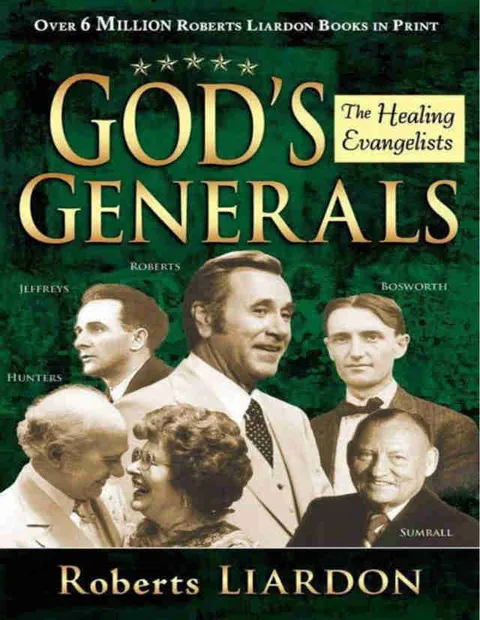

Others like god's generals: evan roberts Features >>
-160.webp)
God's Generals (Smith Wigglesworth)

God's Generals: The Roaring Reformers
-160.webp)
God's Generals (Maria Woodworth)

God's Generals: The Martyrs
God's Generals: The Revivalists
-160.webp)
God's Generals (Aimee Semple Mcpherson)
God's Generals - The Revivalists
-160.webp)
God's Generals (Charles F. Parham)
God's Generals: The Missionaries
-160.webp)
God's Generals (Evan Roberts)
About the Book
"God's Generals: Evan Roberts" by Roberts Liardon is a biography of Welsh revivalist Evan Roberts, who played a key role in the 1904-1905 Welsh Revival. The book explores Roberts' life, ministry, and impact on the Christian faith, highlighting his passion for prayer and revival. Through engaging storytelling and historical insights, Liardon provides a captivating account of Roberts' spiritual journey and his enduring legacy as a powerful instrument of God.
Henry Alline
 Henry Alline’s early years
He was born and received his early education in Newport, Rhode Island and his family moved to Nova Scotia in 1760, when he was 12 years old. When he was nine he began to read theological works and became somewhat mystical, but after years of soul-searching and spiritual conflict he was powerfully converted in 1775, simultaneously receiving a call to the ministry.
Alone and desperate he prayed until…’redeeming love broke into my soul… with such power that my whole soul seemed to be melted down with love…and my will turned of choice after the infinite God. A year later he began to preach.
His preaching career
His preaching career lasted until his death eight years later. He was an itinerant preacher in Nova Scotia and Prince Edward Island in an ever-widening circuit, beginning what became known as the ‘New Light’ movement and which is still the greatest revival that Canada has ever seen. He preached the new birth powerfully and effectively and his admirers compared him to George Whitefield and John the Baptist.
Considered an emotional and dangerous fanatic by some and a ‘ravager of congregations,’ the Congregationalists withdrew his right to preach in their churches, so he spoke in barns, houses and the open air. In all he began eight ‘New Light’ Congregational churches based on his non-Arminian but anti-Calvinist views of free-will and predestination, and his strong rejection of outward religious form.
Ironically, despite his indifference regarding baptism, his major 19th century influence was amongst the Baptists of eastern Canada, many of whom were his converts.
Despite possibly unorthodox views and methods, his ministry was without doubt that of an extraordinary revivalist.
Alline’s sermon style was always simple and extemporary, using a few simple, understandable points to help the unchurched to grasp the simple truths of the gospel. As with other itinerant revivalists, his objective was to lead the hearers to a point of decision – to accept or reject Christ as Saviour and Lord, which opened the door to the “new birth.”
Doubtless, his sermons were repeated over time, but he was never in one place long enough for his listeners to notice.
Alline also employed the ministry of prayer and of singing, writing many hymns which were helpful in communicating the gospel. A collection was gathered after his death and was reprinted at least four times in the United States, and several were included in the standard hymnals of the 19th century.
Henry Alline’s early years
He was born and received his early education in Newport, Rhode Island and his family moved to Nova Scotia in 1760, when he was 12 years old. When he was nine he began to read theological works and became somewhat mystical, but after years of soul-searching and spiritual conflict he was powerfully converted in 1775, simultaneously receiving a call to the ministry.
Alone and desperate he prayed until…’redeeming love broke into my soul… with such power that my whole soul seemed to be melted down with love…and my will turned of choice after the infinite God. A year later he began to preach.
His preaching career
His preaching career lasted until his death eight years later. He was an itinerant preacher in Nova Scotia and Prince Edward Island in an ever-widening circuit, beginning what became known as the ‘New Light’ movement and which is still the greatest revival that Canada has ever seen. He preached the new birth powerfully and effectively and his admirers compared him to George Whitefield and John the Baptist.
Considered an emotional and dangerous fanatic by some and a ‘ravager of congregations,’ the Congregationalists withdrew his right to preach in their churches, so he spoke in barns, houses and the open air. In all he began eight ‘New Light’ Congregational churches based on his non-Arminian but anti-Calvinist views of free-will and predestination, and his strong rejection of outward religious form.
Ironically, despite his indifference regarding baptism, his major 19th century influence was amongst the Baptists of eastern Canada, many of whom were his converts.
Despite possibly unorthodox views and methods, his ministry was without doubt that of an extraordinary revivalist.
Alline’s sermon style was always simple and extemporary, using a few simple, understandable points to help the unchurched to grasp the simple truths of the gospel. As with other itinerant revivalists, his objective was to lead the hearers to a point of decision – to accept or reject Christ as Saviour and Lord, which opened the door to the “new birth.”
Doubtless, his sermons were repeated over time, but he was never in one place long enough for his listeners to notice.
Alline also employed the ministry of prayer and of singing, writing many hymns which were helpful in communicating the gospel. A collection was gathered after his death and was reprinted at least four times in the United States, and several were included in the standard hymnals of the 19th century.
you can’t fake what you love
The soul is measured by its flights, Some low and others high, The heart is known by its delights, And pleasures never lie. I was 25 years old when John Piper’s book The Pleasures of God was first released in 1991. My wife and I had been attending Bethlehem Baptist for two years and had read John’s book Desiring God , which unpacked what he called Christian Hedonism. His fresh emphasis on the truth that God is most glorified in us when we are most satisfied in him was working its way into our spiritual bones. But as I read the introduction to The Pleasures of God , the one-sentence poem above crystalized the truth of Christian Hedonism for me, opening my mind to the role delight plays in the Christian life. One Sentence Begets Another John wrote that life-changing sentence as a kind of exposition of another life-changing sentence he had read four years earlier. In fact, the whole sermon series that birthed the book was born of his meditation on that sentence written in the seventeenth century by a young Professor of Divinity in Scotland named Henry Scougal. Scougal had actually penned the sentence in a personal letter of spiritual counsel to a friend, but it was so profound that others copied and passed it around. Eventually Scougal gave permission for it to be published in 1677 as The Life of God in the Soul of Man . A year later, Scougal died of tuberculosis before he had reached his twenty-eighth birthday. John Piper describes what gripped him so powerfully: One sentence riveted my attention. It took hold of my thought life in early 1987 and became the center of my meditation for about three months. What Scougal said in this sentence was the key that opened for me the treasure house of the pleasures of God. He said, “ The worth and excellency of a soul is to be measured by the object of its love .” (18) John realized that this statement is as true of God as it was of man. The worth and excellency of God’s soul is measured by the object of its love. This object must, then, be God himself, since nothing of greater value exists than God. John previously devoted a whole chapter in Desiring God to God’s happiness in himself — the God-centeredness of God. Scougal’s sentence, however, opened glorious new dimensions of this truth for John as he contemplated how the excellency of God’s soul is measured. And John’s sentence opened glorious new dimensions for me as I began to contemplate that a heart, whether human or divine, is known by its delights. Pleasures Never Lie It was the last line of John’s poem that hit me hardest: The heart is known by its delights, And pleasures never lie. Pleasures never lie. This phrase cut through a lot of my confusion and self-deceit to the very heart of the matter: what really matters to my heart. “Our lips can lie about what we love, but our pleasures never lie.” “Pleasures never lie” doesn’t mean things we find pleasurable are never deceitful. We all know, from personal experience as well as the testimony of Scripture, that many worldly pleasures lie to us (Hebrews 11:25). Rather, it means that pleasure is the whistle-blower of the heart. Pleasure is our heart’s way of telling us what we treasure (Matthew 6:21). When we take pleasure in something evil, we don’t have a pleasure problem ; we have a treasure problem . Our heart’s pleasure gauge is working just like it’s supposed to. What’s wrong is what our heart loves. Our lips can lie about what we love, but our pleasures never lie . And we can’t keep our pleasure-giving treasures hidden, whether good or evil, at least not for long. What we truly love always ends up working its way out of the unseen heart into the plain view of what we say and don’t say, and what we do and don’t do. My heart, like God’s heart, is known by its delights. I found this wonderfully clarifying. It resonated deeply; all my experience bore out its truth. And I saw it woven throughout the Bible. The more I contemplated it, however, the more devastating this truth became. Devastated by Delight It’s devastating because if the worth and excellency of my soul is measured by the heights of its flights of delights in God, I find myself “naked and exposed” before God, without embellishment or disguise (Hebrews 4:13). No professed theology, however robust and historically orthodox, no amount of giftedness I possess, no “reputation of being alive” (Revelation 3:1) can compensate if I have a deficit of delight in God. And to make sure I understand what is and isn’t allowed on the affectional scale, John says, You don’t judge the glory of a soul by what it wills to do with lukewarm interest, or with mere teeth-gritting determination. To know a soul’s proportions you need to know its passions. The true dimensions of a soul are seen in its delights. Not what we dutifully will but what we passionately want reveals our excellence or evil. (18) As I place my passions on God’s soul-scale, my deficits become clear. I’m a mixed bag when it comes to my passion for God. I can savor God like Psalm 63 and yet still sin against him like Psalm 51. I have treasured God like Psalm 73:25–26, and questioned him like Psalm 73:2–3. Sometimes I sweetly sing Psalm 23:1–3, and sometimes I bitterly cry Psalm 10:1. At times I keenly feel the wretchedness of Romans 7:24, and at times the wonder of Romans 8:1. I have known the light of Psalm 119:105 and the darkness of Psalm 88:1–3. I’ve known the fervency of Romans 12:11 and the lukewarmness of Revelation 3:15. Many times I need Jesus’s exhortation in Matthew 26:41. “We must know our spiritual poverty before we will earnestly seek true spiritual wealth.” It is devastating to stand before God with only what we passionately want revealing the state of our hearts, measuring the worth of our souls. But it is a merciful devastation we desperately need. For we must know our spiritual poverty before we will earnestly seek true spiritual wealth. We must see our miserable idolatries before we will repent and forsake them. We must feel our spiritual deadness before we will cry out, “Will you not revive us again, that your people may rejoice in you?” (Psalm 85:6) That’s all true. However, the longer I contemplated John’s sentence over time, the more I realized the devastating exposure of my spiritual poverty is meant to be a door into an eternal world of delight-filled love. Pleasures Forevermore I made this discovery in the story of the rich young man (Mark 10:17–22). When Jesus helped this man see his heart’s true passions (when he exposed his spiritual poverty), the exposure wasn’t Jesus’s primary purpose. Jesus wanted the man to have “treasure in heaven,” to give this man eternal joy (Mark 10:21). And Jesus knew the man would never joyfully sell everything he had to obtain the treasure that is God unless he saw God as his supreme treasure (Matthew 13:44). So he tried to show him by calling the man to the devastating door of exposure and knocking on it. And he grieved when the man wouldn’t open it, because the door led to a far greater treasure than the one he would leave behind. God created pleasure because he is a happy God and wants his joy to be in us and our joy to be full (John 15:11). When he designed pleasure as the measure of our treasure, his ultimate purpose was that we would experience maximal joy in the Treasure. And that the Treasure would receive maximal glory from the joy we experience in him. It is a marvelous, merciful, absolutely genius design: God is most glorified in us when we are most satisfied in him . If God has to expose our poverty to pursue our eternal joy, he will. But what he really wants for us is to experience “fullness of joy” in his presence and “pleasures forevermore” at his right hand (Psalm 16:11). And so it is a great mercy, even if at times devastating, that our pleasures never lie.